


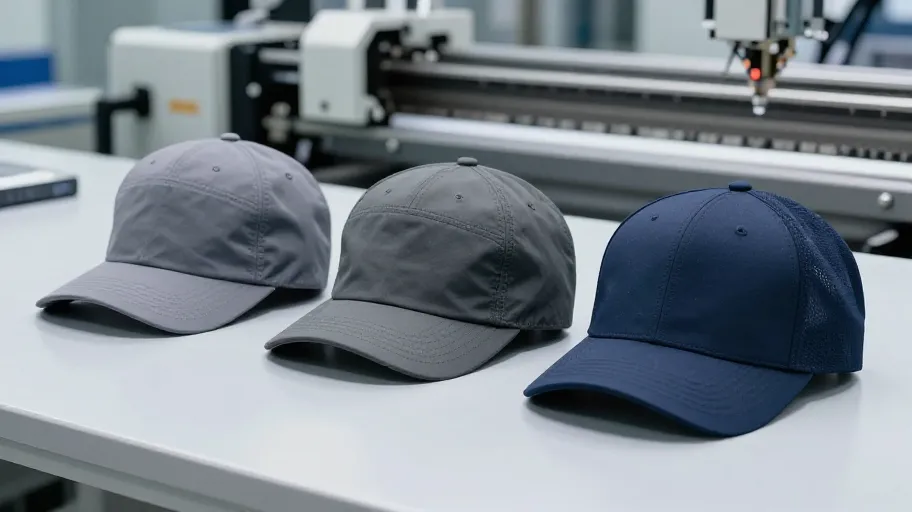
How Panel Count Shapes Cost and Speed
Fewer panels mean less fabric waste and faster assembly—directly impacting your bottom line. A 5-panel cap uses 23% more of each yard of cotton twill because longer grain-aligned cuts nest tighter on the roll. That means you buy less material to produce the same number of units. For a 1,000-unit run, that’s 75 fewer yards wasted—saving $450–$600 per order before labor even enters the equation.
Each panel also adds stitching time. Six-panel caps require five side seams; 5-panel versions need only two. In factories where workers are paid by piece rate, this difference cuts assembly time from 5.8 minutes to 4.2 per unit—a 38% reduction in touch time. That’s not just faster production; it’s lower rework risk and tighter delivery windows. For lean brands launching fast, that efficiency means getting product to market sooner without sacrificing quality.
So why does this matter beyond cost? Because early-stage brands can’t afford missteps. Every dollar saved on waste is a dollar reinvested in design or marketing. And every hour shaved off production expands your window to respond to feedback. The 5-panel isn’t retro—it’s resource-smart.
Why Factory Choice Makes or Breaks Your Cap
A high-accuracy cap factory doesn’t just sew hats—they maintain consistency across batches using laser-guided cutters and custom sewing jigs. Without these tools, even a well-designed 5-panel can come out warped, with uneven front panel angles or mismatched curvature. One West Coast brand faced a 12% rejection rate after their first run from a low-cost supplier, forcing a full remake. That kind of waste kills margins.
Factories optimized for 5-panel construction streamline workflows: standardized templates reduce setup time by up to 30%, enabling faster turnaround on small orders. Meanwhile, 6-panel specialists invest in reinforced stitching stations and precision buckram insertion—ideal for structured, logo-heavy branding. The key is alignment: match your factory’s core capability to your structural choice.
Ask potential suppliers: Do you specialize in 5-panel builds? Can you show stitch consistency at 8–10 SPI (stitches per inch)? Are your cutting molds calibrated monthly? These details determine whether your brand scales smoothly—or fights fires at every reorder.
Free Samples Are Risk Control Tools
Physical samples aren’t perks—they’re safeguards. When a manufacturer offers sample free baseball caps, they let you test stitch density, crown shape, and closure alignment before committing. One Midwest label received both 5-panel and 6-panel prototypes and found the latter had inconsistent seam allowances that would’ve led to unraveling after five washes. Catching that pre-production avoided $3,800 in returns and customer backlash.
This kind of validation compresses your learning curve. Instead of guessing based on sketches or photos, you hold proof of quality. And since a single rejected shipment can cost $5,000 in lost inventory and delayed retail placement, a $0 sample delivers infinite ROI. Data from 2025 apparel QA audits shows brands using physical prototypes improve first-run success rates by at least 40%.
Use free samples to stress-test your supply chain. Measure the brim stiffness. Flex the crown. Wash one if you can. What feels solid today should perform reliably at scale tomorrow.
Matching Structure to Brand Strategy
The 6-panel cap’s extra seam support makes it more durable under heavy use—ideal for corporate giveaways or sports teams. But in premium streetwear, durability isn’t always the goal. Gen Z buyers value minimalist, skate-influenced silhouettes, and brands like Noah and Awake NY have used the 5-panel to signal authenticity and subcultural credibility.
If your brand prioritizes speed-to-market, limited runs, or vintage appeal, the 5-panel gives you structural efficiency and aesthetic distinction. If you’re building a logo-forward, mass-distribution line, the 6-panel’s sturdiness supports consistent branding.
Your cap’s anatomy reflects your operational philosophy. The 5-panel proves you can do more with less. The 6-panel says you build to last. Neither wins universally—the winner is the one built with purpose.
From Decision to Delivery
The right cap starts with intention. Choose 5-panel for efficiency, faster sampling, and lean scaling. Choose 6-panel for structure, durability, and broad usability. Then pick a factory that specializes in that build—not one that claims to do both equally well.
Today’s competitive edge lies in execution, not just design. A well-chosen panel count reduces waste, speeds launch, and strengthens brand identity. And when you validate with real samples, you eliminate guesswork from growth.
Your next step isn’t another spreadsheet. It’s holding a sample in your hand—tested, approved, and ready to scale.
#cap manufacturers china, #headwear manufacturers china, #cap factory








