

Sourcing men sustainable custom caps successfully comes down to three things: a written specification that defines what "sustainable" means for your order, a sample evaluation that tests material and construction against that spec, and a documented sign-off that both parties reference during production. This guide gives you the SPEC–SAMPLE–SIGN-OFF framework, a comparison table, and the approval questions that protect your order.
What "sustainable" must mean in your spec sheet
The word sustainable is doing a lot of unpaid work in most sourcing enquiries. Without a defined spec, two suppliers quoting "sustainable caps" may be describing entirely different products — one using certified fibre content, another using a recycled label on a conventional construction.
Before you request quotations, decide what evidence you will accept. That decision belongs in your spec sheet, not in a later negotiation. Consider defining:
- Fibre content and origin. Which recycled or organic inputs do you require, and in which components — shell, sweatband, lining, thread, visor board?
- Documentation. Which certificates, transaction certificates or material declarations will you require, and will you accept supplier-issued declarations or require third-party documentation? Ask each supplier to state which current credentials they hold and can evidence for your specific material choice.
- Trims and closures. Closures, eyelets, buttons and embroidery thread are frequent blind spots. Specify whether these must also meet your sustainability criteria.
- Dyeing and finishing. Ask what information the supplier can provide about dye and finishing processes for your chosen fabric, and what documentation supports it.
None of these points can be assumed. Ask each supplier to confirm in writing what they can currently evidence for your exact material and trim selection, and treat unverifiable claims as a comparison data point, not a disqualifier — but never as a spec.
The SPEC–SAMPLE–SIGN-OFF ladder
A useful way to structure the whole process is the SPEC–SAMPLE–SIGN-OFF ladder:
- SPEC. Write the specification before contacting suppliers: materials, construction, sizes, decoration method, packaging and sustainability documentation requirements. Every supplier receives the same document so quotes are comparable.
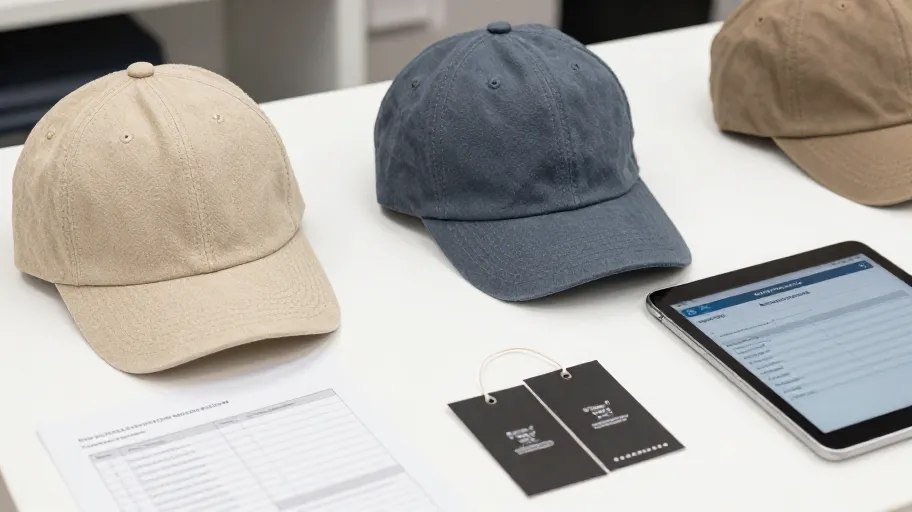
- SAMPLE. Evaluate physical samples against that written spec, not against a photo or a verbal description. Record what you measure, photograph everything and file deviations.
- SIGN-OFF. Approve a golden sample in writing, reference it in the purchase order, and agree how any deviation from it will be handled — as questions to confirm with the supplier, not assumptions.
The ladder works because each stage creates evidence the next stage depends on. A sign-off without a written spec is an approval of nothing in particular.
Specification decision table for supplier comparison
Use a table like this to force like-for-like comparison. The "confirm with supplier" column keeps unknowns visible instead of buried.
| Spec element | What to define | Questions to confirm with the supplier |
|---|---|---|
| Shell fabric | Fibre type, recycled/organic content, weight | Which sustainability documentation can you provide for this exact fabric? |
| Construction | Panel count, seam type, visor structure | Can construction be prototyped in the sample before production? |
| Closure | Type and material of closure | Does the closure meet the same material criteria as the shell? |
| Decoration | Embroidery, printing or patch method | Which thread, ink or patch materials are used, and what documentation exists? |
| Sizing and fit | Size range and adjustment approach | What measurement references will you supply with the sample? |
| Packaging | Packaging materials and labelling | Can packaging align with the sustainability positioning of the product? |
| Documentation | Certificates and declarations required | Which current credentials can you evidence for this order's materials? |
| Order terms | MOQ, pricing, lead time, sample policy | What are your current terms for this specific project? |
Sample evaluation: what to check and document
When samples arrive, evaluate them the way a QC inspector would — against the written spec, with records.
- Verify fibre content claims against the documentation provided, and ask for clarification where paperwork and sample labels disagree.
- Inspect construction under consistent lighting: seams, panel alignment, visor attachment, closure function.
- Test the decoration as it will be used: wash or handle the sample if your end use demands it, and document the result.
- Photograph the sample next to your spec sheet and any measuring references.
- Compile deviations into a written revision request rather than a loose email thread.
Approval questions to put in writing
Before sign-off, send these questions and require written answers that become part of your order file:
- Does this sample conform to the specification dated [X], and if not, which deviations are documented?
- Which sustainability documentation applies to this exact sample, and will the same documentation cover bulk production?
- What is your process if bulk production deviates from the approved golden sample?
- What are your current terms for this project — MOQ, pricing, lead time, and sample policy — confirmed in writing?
- Who is the named contact responsible for approvals and revisions?
FAQ
What should I ask for first when sourcing men sustainable custom caps? A written specification covering materials, trims, decoration and required documentation — sent identically to every supplier you are comparing. Quotes and samples mean little without it.
How do I verify sustainability claims from a Chinese OEM/ODM supplier? Ask which credentials they currently hold for your specific material choice, request the supporting documents, and check whether those documents cover the finished product or only the fibre. Where evidence is thin, decide whether the claim belongs in your marketing at all.
How many sample rounds should I plan for? This depends on how completely your initial spec is written and how complex the decoration is. Treat revision count as a question to discuss with the supplier rather than a fixed assumption, and build approval checkpoints into each round.
What is a golden sample and why does it matter? It is the physical sample you approve in writing and reference in your purchase order. It becomes the shared reference for quality judgements during production, replacing opinions with evidence.
Should I compare multiple suppliers for sustainable headwear? Yes — comparison is the only way to see who documents claims, who answers precisely, and whose samples match their spec. Those behaviours predict the production relationship better than a quotation does.
Download the sourcing brief
If you are comparing suppliers for men sustainable custom caps, 获取采购 Brief — the structured brief that turns your enquiry into a comparable, document-backed specification.
Before you contact any supplier, run through this checklist:
- Written spec sent to every supplier, identical wording
- Sustainability documentation requirements stated
- Sample policy questions asked in writing
- Sample evaluated against spec, deviations documented
- Golden sample approved in writing and referenced in the PO
#cap manufacturers china, #headwear manufacturers china, #cap factory