

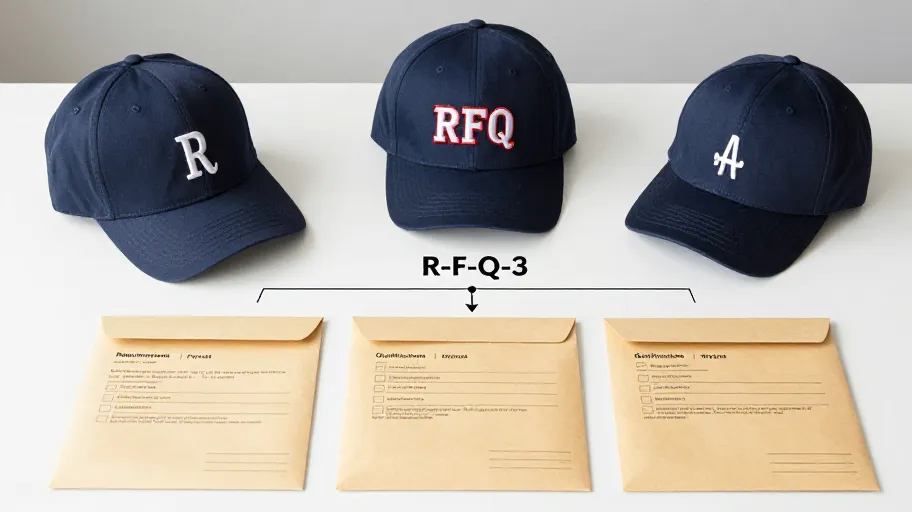
A clear RFQ turns scattered buyer requirements into one comparable document every baseball cap manufacturer can answer the same way. Use the R-F-Q-3 framework: define Requirements precisely, fix the quote Format, request Qualifications evidence, and collect at least 3 responses. This article shows you how to build that document, score replies, and approve a supplier with documented confidence.
Why vague RFQs cost you comparison power
When an RFQ says "5-panel cap, embroidered logo, good quality," each baseball cap manufacturer fills the gaps differently. One quotes a heavy brushed cotton; another a lightweight poly blend. One includes embroidery setup in the unit price; another lists it separately. The quotes are not lying — they are answering different questions.
The fix is not to ask more suppliers. It is to ask better-structured questions so that every answer lands in the same shape, and you can compare like with like.
The R-F-Q-3 framework, step by step
R — Requirements. Before writing to any manufacturer, document every specification you already know and flag every open decision. Include:
- Cap construction (5-panel, 6-panel, structured, unstructured — confirm terminology with the supplier).
- Panel, visor and closure type, plus sweatband material.
- Decoration method and logo placement (embroidery stitch count, print method, woven label, heat transfer).
- Target retail market and any labeling, packaging or hangtag requirements you must verify against destination-market rules.
- Colour references (e.g., a named colour system code) rather than descriptive words.
F — Format. Instruct every manufacturer to quote in an identical line-item structure: blank cap cost, decoration cost, setup/tooling (if any, stated as a separate line), packaging options, and whatever the supplier's current policy is on samples and shipping — which you must confirm directly, as this article does not assert any policy.
Q — Qualifications. Ask for verifiable evidence, not adjectives: business licence, manufacturing scope, quality-control process description, and any certifications the supplier claims to hold — then verify validity with the issuing body. Do not accept claimed credentials at face value; document them.
3 — Three quotes minimum. Three structured responses let you see whether a single quote is an outlier on any line item, and give you a factual basis for follow-up questions.
Decision table: scoring manufacturer responses
| Evaluation dimension | What a strong response looks like | How to verify | Red flag |
|---|---|---|---|
| Specification accuracy | Restates your spec and flags feasibility issues per item | Compare line by line against your RFQ | Silent substitutions of materials or methods |
| Quote format compliance | Follows your line-item template exactly | Side-by-side comparison | Merged, all-in figures with no breakdown |
| Qualification evidence | Documents provided, with scopes and validity dates | Check with issuing bodies | Verbal claims, "certificates available on order" |
| Open-question transparency | States which requirements need engineering review and why | Log answers in your RFQ file | "Everything is fine" with no questions asked |
| Communication quality | Technical answers that address your actual spec | Review the reply thread | Sales boilerplate ignoring listed requirements |
| Policy clarity | Sample, tooling, and revision policies stated in writing | Confirm current policy directly with the supplier | Refusal to put policies in writing |
Score each dimension in your Supplier Scorecard before moving any manufacturer to the approval stage.
Approval questions for your shortlisted manufacturer
Before signing off, get written answers to these project-specific questions:
- Which items in our specification require engineering review, and what alternatives do you propose?
- What is your current sample policy — cost, timing and shipping arrangement? (Confirm directly; do not rely on assumptions.)
- How do you document colour matching against our reference code, and what approval step gates bulk production?
- What is your in-line and final quality-control process, and what inspection documentation accompanies each shipment?
- Which certifications do you currently hold that are relevant to our destination market, and can we verify them with the issuer?
- What is your current production lead time for this exact specification, and what factors could change it?
- How do you handle and document revisions, defects and rework claims after delivery?
None of these has a universal answer. Every one depends on the supplier's current capability and policy — which is exactly why they belong in writing before approval.
FAQ
Should I send the same RFQ to every baseball cap manufacturer? Yes — identical wording and identical line-item format. Variation in your RFQ creates variation in quotes, which destroys comparability. Keep a master copy and log each supplier's version of events against it.
How detailed does a first RFQ need to be? Detailed enough that no supplier has to guess a material, decoration method or packaging format. Where you genuinely haven't decided, mark the item "open — please propose options with pricing impact" so the ambiguity is visible rather than hidden.
What evidence should I request before approving a supplier? Business licence, manufacturing scope, QC process description, and copies of any certifications claimed — each verified with the issuing organisation. Claims without documents should carry no weight in your scorecard.
How many manufacturers should I quote? At least three. Fewer than three gives you no way to spot an outlier line item; far more than three spreads your evaluation time thin. Three well-scored responses beat ten unstructured ones.
Who should sign off the RFQ internally? The person accountable for landed cost and quality — in most private-label teams, the procurement lead with brand-side sign-off on artwork and packaging. Confirm your own approval chain before the RFQ leaves your desk.
Next step: score your suppliers on one page
Download the Supplier Scorecard and rate every baseball cap manufacturer against the same dimensions — specification accuracy, quote transparency, verifiable qualifications, policy clarity and communication quality. Three quotes, one page, one defensible decision.
Prefer to start smaller? Run the approval-question checklist above against your current top supplier and file the written answers. Either way, you leave this article with a documented basis for comparison.
#cap manufacturers china, #headwear manufacturers china, #cap factory