


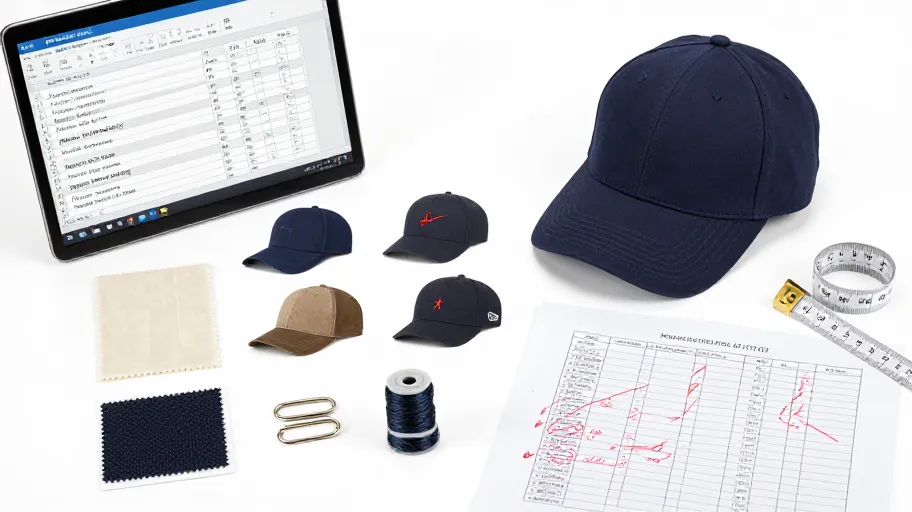
A baseball cap tech pack causes rework when it leaves construction, materials, pattern, branding and approval criteria open to interpretation. Use the CAP-SPEC framework — Construction, Apparel materials, Pattern & size, Surface & branding, Evaluation & approval, Conditions of trade — to audit your document, close every gap in writing, and get each closed item confirmed by your manufacturer before sampling begins.
Rework is a specification problem before it is a supplier problem
When a pre-production sample comes back wrong, the first question worth asking is not "what went wrong at the factory" but "what did my document allow to be interpreted two ways." In custom headwear, almost every disputed detail — brim curvature, crown panel seam placement, sweatband attachment, embroidery density — can be read differently by two professional teams unless the tech pack states it explicitly.
That is the point of this article. It is not a pitch for one factory or one process. It is a gap review you can run on your own baseball cap tech pack before you send it to any manufacturer in Shenzhen or elsewhere. The goal: fewer sample rounds, fewer surprise change requests, and a written trail you can approve against.
The CAP-SPEC framework: six gates to review before you send anything
Review your tech pack against these six gates. Each gate is a place where a missing line item becomes a rework loop.
C — Construction. Panel count and panel shape, brim type and curvature, closure type, eyelet style and placement, seam types and top button construction. If a drawing exists, confirm the drawing matches the written spec.
A — Apparel materials and trims. Fabric by name and specification, lining or none, sweatband material, thread, closure hardware, care label and brand label. "Cotton twill" is not a material spec; the document should reference the exact fabric designation you agreed with the supplier — and you should confirm in writing which designation the supplier will use.
P — Pattern and size. Size chart, measurement points with a diagram, and the fit reference. State where each measurement is taken. Avoid embedding any fixed tolerance in the doc without agreeing it with your supplier — the tolerance itself is a negotiation point to confirm in writing.
S — Surface and branding. Logo files with format and colour references, placement coordinates, embroidery or printing method, stitch type, backing, and thread colour codes. Include a strike-off or logo sample requirement.
E — Evaluation and approval. What counts as approved: which sample round, who signs, what the acceptance criteria are, and how changes are logged after sign-off. This is the gate buyers skip most — and the one that protects them most.
C — Conditions of trade. Every commercial term that lives outside the drawing: sample policy, fees, shipping responsibility, lead times, MOQ, tooling for custom trims, IP ownership of your designs. None of these can be assumed. Confirm each one directly with the supplier in writing before production is committed.
Specification gap decision table
Use this table to triage each open item in your document:
| Gap in the tech pack | Risk if left open | Close it by | Approval question to put in writing |
|---|---|---|---|
| Brim curvature and construction unstated | Sample brim doesn't match the intended silhouette | Reference drawing plus written brim spec | "Please confirm the brim construction and curvature match the attached reference, and flag any constraint." |
| Fabric identified by generic name only | Substituted or mismatched material | Exact fabric designation agreed with supplier | "Please confirm in writing the exact fabric specification you will use." |
| Measurement points undefined | Two teams measure differently; disputes at inspection | Measurement diagram tied to the size chart | "Please confirm each measurement point on the diagram is how your QC team measures." |
| Tolerances not discussed | Acceptance arguments after inspection | Negotiate and document tolerances per measurement | "Please propose the tolerances you can commit to per measurement, for our written approval." |
| Logo placement given as "front centre" | Position drifts between samples | Coordinates from a defined reference point | "Please confirm the placement coordinates and provide a strike-off for approval." |
| Approval process undefined | Changes after sign-off with no record | Named approver, sign-off gate, change log | "Please confirm you will not proceed past each gate without our written approval." |
| Commercial terms outside the doc | Cost and timeline surprises mid-project | Written confirmation of sample, fee, shipping, MOQ and lead-time policy | "Please confirm your current sample policy, fees, shipping responsibility, MOQ and lead times for this project." |
Gap-review checklist: run this before you send the tech pack
- Every construction element (panels, brim, closure, eyelets, seams, button) is specified in words and drawings
- Fabric, lining, sweatband, thread and hardware are named by exact designation, confirmed in writing
- Size chart includes a measurement diagram and stated fit reference
- Tolerances have been proposed, discussed and documented with the supplier — not assumed
- Logo files are final, with format, colour codes, method, placement coordinates and strike-off requirement
- Labels, tags and packaging are specified or explicitly excluded
- Acceptance criteria and the named approver are written into the document
- A change log exists for anything agreed after sign-off
- Sample policy, fees, shipping responsibility, MOQ, lead times and IP terms are confirmed directly with the supplier in writing
- Every open question from the decision table has a written answer, not a verbal one
Turn questions into gates
A strong baseball cap tech pack does more than describe the product — it structures the conversation. Every approval question above should appear inside the document, with a place for the supplier's written confirmation. When both sides sign the same answers, sampling becomes a sequence of gates rather than a loop of corrections. If a supplier resists confirming something in writing, that itself is decision-relevant information: document it, weigh it, and compare it across the suppliers you are evaluating.
FAQ
1. How detailed does a baseball cap tech pack need to be? Detailed enough that two factories working independently from the same document would ask you the same questions — and ideally, ask none. Anything you would explain verbally during a call belongs in the file.
2. What is the most valuable part of the tech pack for avoiding rework? The evaluation and approval gate. Construction and material specs reduce errors; a written approval process with a named approver and change log prevents the ambiguity that turns small errors into repeated rounds.
3. Should commercial terms like sample fees and MOQ go inside the tech pack? They belong in the project file the tech pack lives in. We cannot state any supplier's sample policy, fee treatment, shipping responsibility, MOQ or lead time — confirm each one directly with every supplier you evaluate and record the answer alongside the specification.
4. How do I compare suppliers fairly using the tech pack? Send the same document to each and compare the quality of their written responses. Which supplier answered every approval question precisely, flagged constraints honestly, and proposed measurable tolerances? That comparison is more decision-relevant than any sales conversation.
5. What if my brand is new and the tech pack is incomplete? That is workable — send what you have and ask each supplier to respond with a written list of open items. Their questions reveal how they think, and the gap review above tells you which answers you need before sampling starts.
Close every gap before the first sample
Run the CAP-SPEC review, fill every row of the decision table, and get each confirmation in writing. Then — and only then — start sampling.
[下载 Tech Pack Checklist] — get the complete gap-review checklist and send your next tech pack with every gate closed.
Prefer to start smaller? Grab the one-page gap-review checklist and audit your current tech pack in ten minutes.
#cap manufacturers china, #headwear manufacturers china, #cap factory








