

A comprehensive beanie tech pack is the single most effective tool to bridge the gap between a design concept and manufacturing reality. By precisely defining yarn weights, dimensions, and decoration methods before sampling begins, buyers can significantly reduce quotation errors and minimize the number of prototyping iterations required.
For private label buyers and importers, the sourcing process often stalls not due to price, but due to miscommunication. A visual reference or a simple "make it like this photo" is rarely sufficient for OEM/ODM manufacturers to achieve bulk consistency. To streamline the procurement workflow, buyers should adopt the Specification-to-Sample Alignment Protocol. This framework treats the tech pack not as a drawing, but as a legal and technical document that defines the acceptance criteria for the finished goods.
The 5-Point Specification Matrix
When preparing your beanie tech pack, divide your specifications into five distinct categories. This ensures that every critical aspect of production is addressed.
1. Material & Yarn Construction
The "hand feel" and thermal properties of a beanie are determined by the raw materials. Generic terms like "soft wool" or "acrylic" are open to interpretation. You must specify:
- Fiber Composition: Define the ratio (e.g., 100% acrylic, 80% wool/20% nylon, or recycled blends). Confirm with your supplier if specific blend ratios impact minimum order quantities.
- Yarn Weight: This is often measured in gauge or grams per square meter (GSM). A lighter 7G knit offers breathability, while a heavier 3G or 5G knit provides structure and warmth.
- Texture: Specify if the finish is standard, fuzzy (brushed), or marled (heathered effect).
2. Dimensions & Tolerances
Beanies are stretchable, making sizing difficult without defined parameters. A beanie tech pack must move beyond "One Size Fits Most" (OSFM) and define:
- Flat Lay Measurements: Provide the width and height of the beanie when laid flat and unstretched.
- Stretched Measurements: Define the maximum circumference the hat should stretch to without deforming.
- Cuff Height: Specify the exact height of the folded cuff (e.g., 7.5cm folded, 15cm total fabric).
3. Shape & Silhouette
The visual impact of the headwear relies on its construction. Your tech pack should detail:
- Profile: Is the crown standard, slouchy (excess length), or fitted (beanie with a visor)?
- Crown Construction: Specify if it is a cuffed beanie (folded brim) or a beanie with a sewn hem.
- Pom-Pom: If applicable, detail the material (faux fur, yarn, leather) and attachment method (removable or fixed). Note that pom-pom styles often affect packing dimensions.
4. Branding & Decoration
This is the most critical area for brand equity. Because beanies are curved and elastic, artwork behaves differently than on a flat t-shirt.
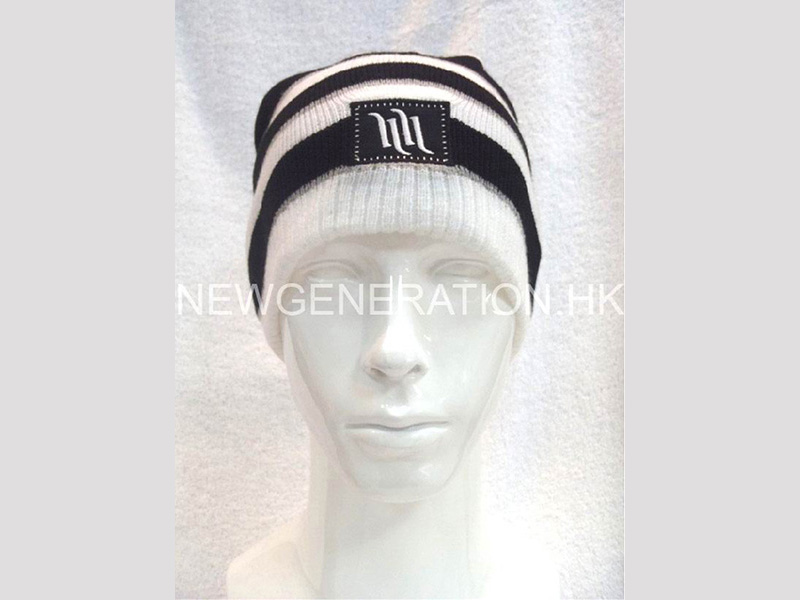
- Logo Type: Is the design woven directly into the beanie (jacquard), embroidered, or a patch?
- Placement: Provide measurements from the bottom of the cuff or the center seam to the logo.
- Sizing: Decoration size must be proportional to the stretch of the fabric. An overly dense embroidery patch on a lightweight beanie can cause the fabric to pucker.
5. Labelling & Packaging
Compliance and retail readiness are often overlooked in initial briefs.
- Labels: Specify the content of the main label, wash care instructions, and origin. Determine if these are woven or heat-transfer.
- Packaging: Define if individual polybagging is required and what barcode standards are necessary for your distribution network.
Decision Table: Sizing Strategy
When defining your specs, you must decide between a universal fit and graded sizing. This decision impacts inventory complexity and production setup.
| Feature | OSFM (One Size Fits Most) | Sized Run (S/M/L) |
|---|---|---|
| Inventory Risk | Lower SKU count, easier warehousing. | Higher SKU count, higher carrying cost. |
| Target Audience | General retail, streetwear, promotional giveaways. | Performance apparel, premium retail, specific fit requirements. |
| Production Complexity | Requires testing a wider stretch tolerance range. | Requires separate patterns or graded knitting programs for each size. |
| Spec Requirement | Must define a broad stretch range (e.g., 54cm–60cm). | Must define specific flat lay measurements for each tier (S, M, L). |
Concrete Approval Questions
Before submitting your beanie tech pack to a manufacturer, verify the following to avoid delays:
- Have you provided Pantone (PMS) color codes for both the yarn and the branding threads?
- Have you confirmed if the chosen yarn composition is compatible with the requested decoration method (e.g., heat transfer on high-heat sensitive synthetics)?
- Is the logo file provided in a vector format (AI or PDF) to allow the factory to convert it for knitting or digitizing?
- Have you defined the acceptable tolerance for color variation between dye lots?
- Do you require a pre-production sample (PPS) for bulk approval, or will a digital photo mock-up suffice for the initial order?
FAQ
What is the difference between a jacquard beanie and an embroidered beanie? A jacquard beanie features the logo or pattern knitted directly into the fabric during the manufacturing process using different colored yarns. This creates a premium, durable finish that lies flat. An embroidered beanie involves stitching a design onto a completed knit panel, which adds texture and weight but may cause pucker if the backing is not stabilized correctly.
Can I provide a physical sample instead of a digital tech pack? While a physical sample is excellent for referencing "hand feel" and general shape, it is insufficient on its own. Manufacturers need a digital tech pack to deconstruct the measurements, yarn types, and artwork placement. A physical sample should complement the tech pack, not replace it, to ensure the factory can replicate the product consistently.
How do I specify the fit if I don't have technical measurements? If you lack technical data, the best approach is to provide a "fit sample" of a beanie whose size and shape you already like. Ask the manufacturer to perform a "measurement audit" on that sample and translate those findings into the spec sheet for your new design.
Does the tech pack need to include packaging specifications? Yes, particularly if you are importing. Packaging affects the volume of your shipment (dimensional weight) and compliance with destination country regulations (e.g., suffocation warnings on polybags). Specifying packaging early prevents surprise costs during logistics planning.
How does yarn gauge affect the cost and lead time? Generally, finer gauges (higher numbers, like 12G or 13G) require more knitting time per unit and finer yarns, which can increase production costs. Coarser gauges (lower numbers, like 3G or 5G) knit faster and use more yarn per stitch but offer a chunkier aesthetic. Always discuss gauge options with your supplier to balance the aesthetic goal with project budget.
Ready to streamline your sourcing process?
[Get Beanie Brief] Submit your detailed requirements for a preliminary technical review.
Need a structured format to fill out?
[Download the Beanie Tech Pack Checklist] Ensure you have all necessary data points before you engage.