


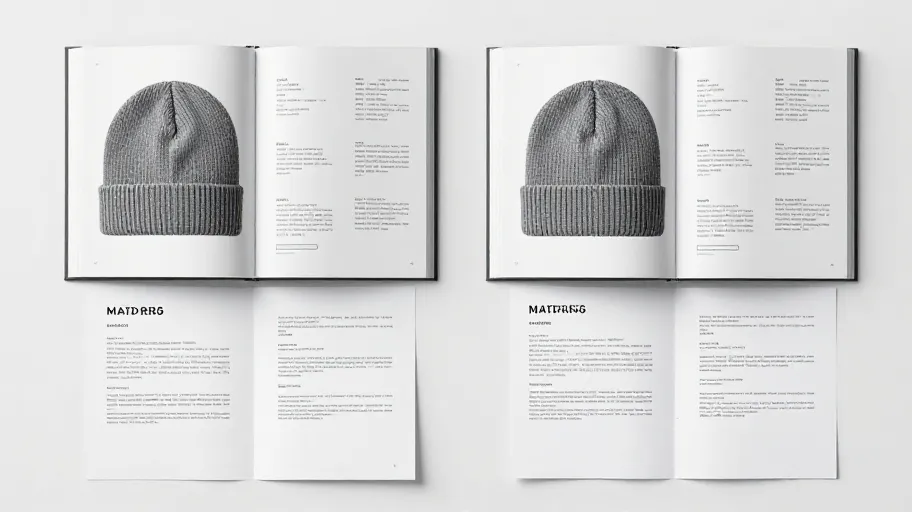
Comparing two beanie quotes is only meaningful when both suppliers quote against the same beanie tech pack. A tech pack fixes the specification — knit construction, yarn, weight, dimensions, finish, labelling, packaging — so every price line answers the same question. Without that baseline, a lower quote may reflect a different product, not a better deal. This article walks through a line-by-line comparison method you can apply to any two quotes.
Why two quotes that look similar can be completely different products
A beanie quote is not a price. It is a bundle of silent assumptions. Supplier A may have quoted a single-layer knit with a folded cuff; Supplier B may have assumed a double-layer body. One may have included woven labels and polybagging; the other may have priced the beanie alone and left labelling as an "extra" line you did not notice. One may have quoted against your tech pack; the other may have quoted against their own standard construction and not told you.
The buyer's job before comparing is therefore not analysis. It is alignment. Both quotes must answer to the same document, and every place a supplier deviated from that document must be surfaced as a written line, not a verbal note.
The QUOTE-Lens framework
Use nine lenses to examine each quote. Each lens maps a quote line back to a field in your beanie tech pack:
- Q — Quantity terms. What quantity is the price based on, and how does the price ladder change with quantity? Confirm the quoted quantity matches what you intend to order.
- H — Hidden assumptions. Where the quote does not specify a construction detail, the supplier has assumed something. Ask what was assumed for cuff style, fold, lining, seams and closure.
- O — Origin of materials. Which yarn composition, yarn source and dyeing route were priced? A quote that says "acrylic beanie" has not told you enough to compare.
- T — Technique and finish. Knit gauge, structure (flat knit, rib, cable), embroidery or patch attachment method, washing and finishing steps. Each affects cost and hand feel.
- E — Engineering details. Dimensional targets, stretch behaviour, seam construction, cuff attachment. Ask each supplier how they will hold these and how you will verify them.
- L — Labelling, extras and packaging. Labels, hangtags, polybags, cartons, printing. Confirm what is inside the quoted price and what appears as a separate line.
- N — Non-price terms. Payment terms, tooling or setup charges, sample charges, revision charges, shipment split options. Confirm the current policy for each directly — do not assume any charge is included or excluded.
- S — Service gates. Sample approval, pre-production confirmation, inspection arrangements, and what happens if the delivered goods do not match the approved sample. These are questions to confirm in writing, not assumptions to make.
- E — Evidence. For every claim a supplier makes in the quote, ask what document supports it — a spec sheet, a counter-sample reference, a written confirmation.
Line-by-line comparison decision table
Place both quotes in this table. Every cell where the two suppliers differ becomes either a clarification question or a documented decision.
| Tech pack field | Quote line to examine | What to record | Decision rule |
|---|---|---|---|
| Knit construction | Body and cuff structure as priced | Exact construction words used by each supplier | If wording differs from your tech pack, request a re-quote or written confirmation |
| Yarn composition | Fibre content and yarn type | Composition, and whether dyeing route is stated | Unstated composition = clarification required before comparison |
| Weight and gauge | Grammage and knit density per unit | The number each supplier priced | Compare only after both state the same basis |
| Dimensions | Size targets and tolerance approach | How each supplier describes holding size | Ask how you will verify; document the answer |
| Decoration | Embroidery, patch, print, woven label | Stitch count, patch material, attachment method | Method differences change cost and durability — isolate them as separate lines |
| Labelling | Internal labels, care labels, hangtags | Included vs. quoted as extra | Move every "extra" into the comparison table explicitly |
| Packaging | Individual polybag, carton, marking | Included vs. separate line, carton quantity | Confirm current packaging policy with each supplier |
| Tooling and setup | Setup, digitising, mould charges | Whether charged, at what stage, under what conditions | Confirm charge and approval basis directly |
| Sample terms | Sample charge and approval route | The stated current policy from each supplier | Do not infer policy — request it in writing |
| Payment and delivery terms | Payment milestones, shipping arrangement, Incoterms | Stated terms only | Terms differ between suppliers even at similar unit prices |
| Quality gates | Inspection and claim route | What each supplier commits to in writing | Verbal commitments do not count |
Approval questions to put in writing
Send the same list to both suppliers and require written answers:
- Which construction, yarn and gauge exactly did you price, and can you confirm it matches our beanie tech pack field by field?
- Where our tech pack is silent, what did you assume, and what would that assumption change in the price?
- What setup or tooling charges apply, and what triggers them?
- How will we confirm size and decoration before production, and what document records that confirmation?
- If delivered goods differ from the approved sample, what is your committed route to resolve it?
- Which items in our packaging and labelling section are inside your quoted price, and which are separate lines?
The supplier's willingness to answer precisely, in writing, is itself comparison data. A supplier who resists documenting their own quote has told you something no price line shows.
Closing the decision
Once both quotes sit in the table and every difference is either clarified or documented as a conscious trade-off, the comparison becomes simple arithmetic plus risk judgement. Do not let a single headline number decide. A quote is only as good as the specification it is anchored to and the confirmations behind it. Keep the completed table, the written answers and the approved sample references together as your approval record for the order.
FAQ
Can I compare quotes if I don't have a full beanie tech pack yet? You can, but the comparison will be weak. Even a one-page spec — construction, composition, size target, decoration, labelling, packaging — gives both suppliers the same baseline. Without it, each quote reflects the supplier's assumptions rather than your requirements.
What is the most overlooked line in a beanie quote? Labelling and packaging inclusions. Quotes can differ on whether labels, hangtags, polybags and carton marking are inside the price. Confirm the current inclusion policy from each supplier in writing.
Should I ask both suppliers the same questions? Yes, word for word. Identical questions produce comparable answers, and differences in how suppliers respond — precise, vague, evasive — are decision information.
What if one supplier will not confirm details in writing? Treat that as a finding, not a footnote. A comparison requires documented commitments. A quote that cannot be documented cannot be reliably compared, whatever the price.
How many quotes should I compare? Two well-aligned quotes are more useful than five misaligned ones. Quality of alignment to your beanie tech pack matters more than quantity of quotes.
Get the comparison baseline first
Before you send another RFQ, make sure your specification is complete enough to hold both suppliers to the same product. 获取 Beanie Brief and use it to standardise what every supplier must quote against — so your next comparison is a real comparison.
Low-friction option: Start with the line-by-line checklist below and run it against the two quotes you already have. Any row you cannot fill is your next question to the supplier.
Quote comparison checklist
- Both suppliers quoted against the same beanie tech pack
- Construction, yarn and gauge confirmed in writing by both
- All assumptions surfaced and documented
- Labelling and packaging inclusions stated line by line
- Sample policy confirmed in writing from each supplier
- Setup and tooling charges identified and approval basis agreed
- Size and decoration confirmation route defined
- Non-price terms (payment, shipping, inspection) recorded
- Claim route if goods differ from approved sample committed in writing
- Completed table and answers archived as the approval record
#cap manufacturers china, #headwear manufacturers china, #cap factory








