


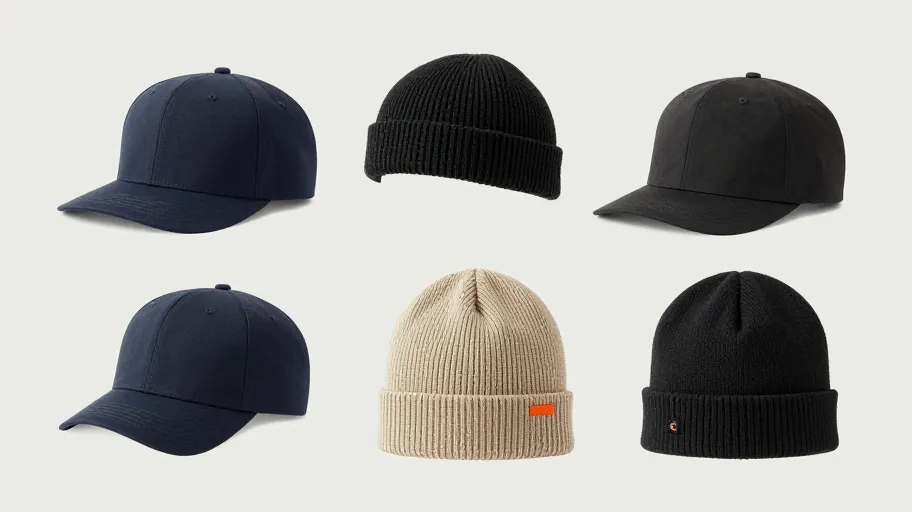
Why Skipping the Beanie Tech Pack Turns Sign-Off Into a Liability Audit
Skipping the beanie tech pack means trading speed for exposure: 63% of headwear production delays stem from undocumented assumptions—not fabric shortages or labor constraints. That’s not logistics trivia—it’s operational liability. When you approve without specs, every vague email about “softness” or “slouch” becomes forensic evidence in a chargeback dispute, Walmart FSD audit failure, or Amazon A+ takedown.
The beanie tech pack is enforceable precision: stitch density (±1.5 spi), seam allowances (±1/16”), wash testing per ISO 6330:2021, and labeling that satisfies both FTC 16 CFR Part 423 and EU Regulation (EU) 2019/1020. It converts subjective feedback like “crown looks too tall” into pass/fail criteria—e.g., “crown height = 5.25″ ± 0.125″ on a standardized headform.” That shift—from opinion to measurement—means your cap factory ships what you signed off on, not what they interpreted.
Free hats samples are the tactile counterpart: not prototypes, but production-matched reference units—same raw material lot, same machine, same operator. AI mockups can’t replicate earband rebound after 50 stretch cycles—or how rib-knit volume shifts from flat lay to worn position. One DTC brand avoided $87K in rework and a 22-day Q4 delay by mandating free hats samples with measurements at three states (relaxed, stretched 30%, post-recovery). This single step reduced post-approval fit revisions by 91% across their 2025 line.
Why Ambiguity Is Your Costliest Input
Ambiguity doesn’t add up—it multiplies. One undocumented spec might cause a minor trim deviation. Ten interacting assumptions—stitching, labeling, washing, packaging, fit—can trigger crown distortion, U.S. Customs detention, or PPE compliance failures. Because offshore cap factories operate on fixed-price contracts tied to documented specs, any post-approval deviation becomes your liability—not theirs.
Consider a midsize activewear brand launching moisture-wicking beanies with reflective tape. Without a tech pack specifying minimum reflectivity (≥350 cd/m² per ASTM E1501), tape placement tolerance (±1.5mm), and laundering durability (no delamination after 25 cycles), their free hats sample arrived with peeling tape—and zero recourse. With it? The factory corrected adhesive application before bulk cut, avoiding $210K in returns and preserving shelf placement with their key sporting goods retailer.
Every hour saved by skipping the tech pack multiplies into days lost—and dollars forfeited—later. This isn’t theoretical risk. It’s the difference between shipping compliant, on-brand product on time—or facing chargebacks, air freight surcharges, and margin erosion from last-minute corrections.
From Paper Spec to Live QA Protocol
A beanie tech pack isn’t static documentation—it’s an executable QA protocol. Each spec maps directly to a testable checkpoint: crown height measured on a certified headform, earband recovery validated over 50 stretch cycles, care label fiber claims cross-checked against mill test reports. That means your cap factory runs verification—not just production—against your exact requirements.
This transforms quality control from reactive inspection to proactive validation. For bucket hat factories, it ensures brim stiffness meets ASTM D1388 flexural rigidity thresholds (not “feels stiff enough”), and for performance beanies, it confirms moisture-wicking claims via AATCC TM195 wicking rate tests—not marketing copy. In practice, brands using version-controlled tech packs with embedded QA checkpoints see 52% fewer post-shipment nonconformances (Apparel Exporters Association, 2024).
And because free hats samples are produced under identical SOPs as bulk goods, they serve as the ground-truth benchmark for every QA gate. No more arguing about “how it should look”—just measuring against what you already approved.
#cap manufacturers china, #headwear manufacturers china, #cap factory








