


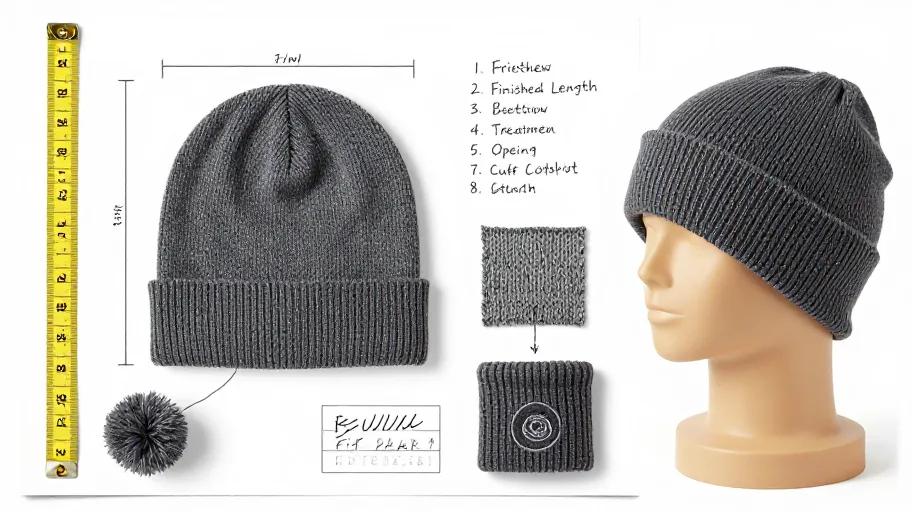
A beanie tech pack's fit and compatibility section should record six things: target head circumference and intended stretch range, finished length and cuff treatment, opening dimensions before and after wear simulation, knit gauge and yarn behaviour, the interaction between the body and every attached component, and a dated, signed approval of the fit sample against each of those numbers. Written properly, this section is what allows a manufacturer to reproduce your fit without guessing — and what protects you when the production sample doesn't match the approved one.
Why fit is the hardest section to write for knit headwear
Woven caps hold their shape. Knit beanies don't. A beanie's "size" is a moving target: it depends on yarn, gauge, rib structure, finishing and even how the sample was stored before you measured it. That is precisely why a beanie tech pack needs more disciplined fit documentation than a structured-cap spec — and why buyers who skip this section end up arguing about intent instead of comparing against numbers.
Two beanies can measure identically flat and wear completely differently. The flat measurement tells you almost nothing without the accompanying fit notes: how much negative ease the design assumes, where the slouch sits, and how the cuff behaves after stretching. Your job during a fit check is to convert subjective feel into a record a factory can act on.
The FIT-LOG framework
Use the FIT-LOG framework to structure your notes: Fabric behaviour, Interactions between components, Tolerances you will accept — recorded across Length, Opening and Gauge.
- F — Fabric behaviour. Document how the knit responds: recovery after stretching, whether the rib snaps back or relaxes, and how the surface reads under your brand's lighting. Record yarn composition as specified, not as assumed.
- I — Interactions. Every attached element changes fit and drape: woven labels, leather patches, embroidery backings, print, swing tags. Each pairing needs its own check.
- T — Tolerances. Decide, with your supplier, what deviation from the approved measurement is acceptable to you on each critical dimension. Do not accept a verbal "close enough" — write the range into the tech pack as a project-specific agreed figure.
- LOG — Length, Opening, Gauge. These are the three dimensions where misunderstanding is most expensive: finished length, head-opening behaviour, and knit gauge. Each gets its own line in the measurement log.
What to record during fit checks
| Record | What to note | Why it matters to the factory |
|---|---|---|
| Target head circumference | The wearer range you are designing for | Anchors all ease calculations |
| Finished length (flat) | Crown-to-hem, cuff folded and unfolded | Determines slouch and styling |
| Opening behaviour | Width relaxed vs stretched to target, plus recovery after a set rest period | Defines negative ease and comfort |
| Cuff treatment | Single, double, fold depth, seam position | Affects both length and opening readings |
| Crown construction | Shaping method, seam or link location, seam feel on the head | Comfort and visual signature |
| Weight/feel notes | Hand-feel, drape, warmth perception as subjective notes clearly labelled | Context for yarn and gauge choices |
| Gauge and structure | As confirmed in the sample, not as drawn | Knit density drives stretch and recovery |
| Sample condition | Date measured, storage and handling before measuring | Prevents false rejections of good samples |
Label every subjective note as subjective. The factory needs your feel, but it must be able to distinguish observation from instruction.
Compatibility checks: body, trims, branding, packaging
Compatibility failures are quieter than fit failures but just as costly. Check each pairing:
Body vs label or patch. Does the backing of an embroidered or stitched patch stiffen the knit and create a visible pull? Does a woven label sit flat against a ribbed structure, or does the rib distort around it?
Body vs embroidery or print. Where does the design sit when the beanie is worn versus laid flat? Stretch distorts graphics; the artwork placement must be approved on the worn sample, not the flat one.
Body vs packaging. How does the beanie look when it comes out of the polybag or box? Does folding create creases that a retail buyer will see on the shelf? How does a swing tag attach without snagging the knit?
Body vs care expectations. Whatever care claim appears on your label must be one your supplier has confirmed is achievable for the specified yarn and construction. Ask, document the answer, and align the label wording to it.
Decision table: what to do with the fit sample
| Finding | Evidence | Decision | Record action |
|---|---|---|---|
| All critical dimensions match, feel matches intent | Complete measurement log | Approve | Sign, date, photograph sample, archive with tech pack |
| One dimension off, within agreed tolerance | Measurement log vs agreed range | Approve with note | Log the deviation; confirm in writing it is accepted |
| Dimension off beyond agreed range | Measurement log | Revise | Specify the correction and which measurement governs |
| Dimensions correct, feel wrong | Worn-sample notes | Re-spec | Likely a gauge, yarn or finishing question — discuss with supplier before revising the pattern |
| Compatibility failure (patch pull, label distortion) | Component-pairing check | Revise component | Redocument the pairing, not just the body |
Approval questions to send your supplier
Before you sign off on fit and compatibility, put these in writing and get written answers:
- What tolerance range does your team hold on finished length and opening for this construction — and can we agree it into the tech pack?
- Which of our specified measurements are the critical ones in your production setup, and where do you see risk in hitting them?
- How do you measure recovery, and can we align your method with ours so we're comparing the same thing?
- What are the current sample, cost, shipping and revision policies — including who pays what and under which conditions — for this project?
- For the patch/label/embroidery pairings we've approved, what checks do you run in production to keep them consistent with the approved sample?
- What do you need from us — beyond this tech pack — to quote and schedule accurately?
These questions don't commit you to anything. They convert unknowns into documented answers, which is the entire point of a beanie tech pack.
FAQ
How detailed does the fit section of a beanie tech pack need to be? Detailed enough that someone who has never seen the worn sample could reproduce the fit from the page: target circumference, intended ease, finished lengths, cuff treatment, gauge, and your agreed tolerances, plus dated photos of the approved sample on a head form or model.
Can I use flat measurements alone for a knit beanie? You can record them, but don't rely on them alone. Flat measurements without opening behaviour and recovery notes describe the beanie at rest, not on the wearer. Pair every flat number with a worn-state observation.
Who owns the tolerance decision — buyer or factory? You own the acceptance decision; the factory owns telling you what it can hold. Agree the range together, write it into the tech pack, and treat the agreed figure as the contract reference for later samples.
When should compatibility checks happen — at fit sample or pre-production? Start them at fit sample so problems surface before tooling or trim production, then re-verify at the pre-production sample with the actual production trims, labels and packaging in place.
What if my supplier and I measured differently and both feel right? That's a method mismatch, not a quality dispute. Compare how each of you measured, align on one method, and record that method in the tech pack so every future comparison is like-for-like.
Get the Beanie Brief — request our beanie project brief template and bring a structured, factory-ready fit and compatibility file to your next supplier conversation. Confirm current sample, pricing, MOQ and lead-time policies directly with our team, as they are project-specific.
Low-friction option: Download the fit-check checklist below and run it against your next sample — no conversation required until you're ready.
- Target head circumference recorded
- Finished length, cuff folded and unfolded, logged
- Opening: relaxed, stretched, recovery noted
- Gauge confirmed on the actual sample
- Every trim/branding pairing checked on the worn sample
- Tolerances agreed in writing with supplier
- Deviations logged and dispositioned
- Approved sample photographed, dated and archived
#cap manufacturers china, #headwear manufacturers china, #cap factory








