
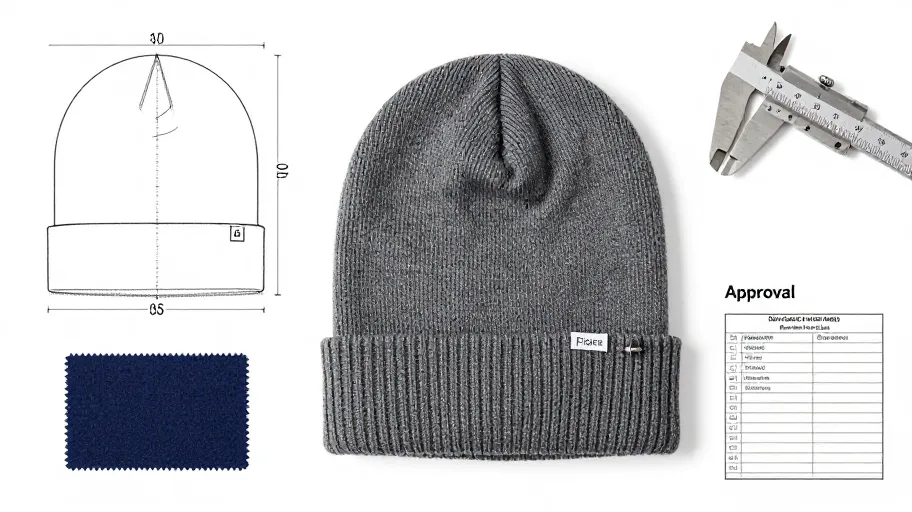
A complete beanie tech pack separates visual intent, physical composition, and quality directives into three distinct documents: the technical drawing, the bill of materials (BOM), and approval notes. By isolating design geometry, material composition, and inspection criteria, overseas buyers reduce quoting errors and align supplier expectations before physical sampling begins.
The DBA Framework: Structuring Your Documentation
When sourcing custom headwear, submitting a cohesive set of documents is vital. The Drawing-BOM-Approval (DBA) Framework helps procurement teams organize technical data systematically. This prevents ambiguity and ensures the manufacturer has the exact parameters needed to evaluate production feasibility and provide an accurate quotation.
1. The Drawing
The drawing communicates the visual geometry of the beanie. It must convey shape, structural elements, and proportions. A drawing lacking precise callouts forces the manufacturer to make assumptions, which alters the final product.
Include the following elements in the drawing:
- Silhouette and Profile: Provide flat front, side, and top views. Document whether the crown is rounded, squared, or features a specific fold.
- Structural Callouts: Identify the cuff style (rolled, double-fold, or none) and indicate the presence of a pom-pom, visor, or patches.
- Knit Direction and Pattern: Specify the intended knit structure (jersey, cable, ribbed) and the direction of the knit.
- Seam Placement: Document the location of joining seams, particularly for multi-panel designs.
- Proportional Ratios: Instead of relying solely on absolute dimensions, use ratios (e.g., cuff height to total height) to maintain shape across different sizes.
2. The Bill of Materials (BOM)
The BOM defines the physical composition of the beanie. It tells the manufacturer exactly what inputs are required. A detailed BOM allows the supplier to source raw materials accurately and assess availability.
Your BOM must document:
- Yarn Composition: State the exact fiber blend (e.g., acrylic, wool, cotton, recycled polyester). Note the requested yarn weight or thickness.
- Color Standards: Do not rely on screen colors. Provide a physical color swatch or a recognized color system reference number. Clarify whether the color applies to the shell, cuff, or threads.
- Knit Gauge: Specify the desired stitch density, which dictates the stretch and thickness of the headwear.
- Accessories and Hardware: List all additional components, including woven labels, hangtags, leather patches, buttons, or drawstrings. Detail the material and attachment method for each.
- Lining Material: If the beanie features a lining, document the fabric type (e.g., fleece, jersey) and its attachment method to the outer shell.
3. Approval Notes
Approval notes dictate how the visual and material elements combine into a finished, salable product. These notes function as the quality and compliance directive for the pre-production sample.
Essential approval notes include:
- Label Placement: Document the exact stitch location for care labels, brand labels, and size tags. Indicate whether labels are sewn flat, die-cut, or folded.
- Embroidery and Print Specifications: Provide digital files for logos. Specify the stitch type, thread colors, and density for embroidery. For prints, document the ink type, curing method, and exact placement coordinates.
- Packing Instructions: Detail folding methods, polybag requirements, inner carton quantities, and master carton labeling. Specify humidity control or desiccant needs if necessary.
- Compliance Requirements: List any required physical testing, chemical restrictions, or certification requirements the finished headwear must meet.
Routing Details: A Decision Table
Use the following decision table to determine where specific details belong within your documentation. This routing ensures no parameter is overlooked.
| Sourcing Detail | Document Location | Rationale |
|---|---|---|
| Pom-pom attachment coordinates | Drawing | Visual geometry defines exact placement on the crown. |
| Yarn fiber percentage | BOM | Material composition defines the physical raw input. |
| Care label stitch type | Approval Notes | Construction quality dictates how the label is attached. |
| Stitch density (gauge) | BOM | Manufacturing parameter dictates the physical machine setup. |
| Logo size relative to cuff | Drawing | Proportional ratios define the visual layout. |
| Master carton dimensions | Approval Notes | Packing and logistics instructions dictate final dispatch. |
| Thread color match | BOM | Physical input definition requires a color standard. |
Concrete Approval Questions for Your Supplier
After submitting your beanie tech pack, verify the supplier's understanding by asking targeted questions. You must confirm all production policies and capabilities directly.
- "Based on the provided BOM, can you confirm the current availability of the specified yarn composition and color standards?"
- "Does the drawing provide enough proportional detail for your team to create a prototype without assuming the cuff-to-crown ratio?"
- "What is your current policy regarding sample fees and shipping costs for the initial prototype?"
- "Can your production facility accommodate the specific knit gauge and stitch density outlined in the BOM?"
- "How do you document and communicate label placement revisions during the approval phase?"
Frequently Asked Questions
What happens if I submit a drawing without a complete BOM? The manufacturer must guess the physical composition. Without a documented yarn composition or knit gauge, the supplier cannot provide a reliable quotation, and the resulting prototype will rely on assumptions rather than your specifications.
Can I use digital color codes instead of physical swatches in the BOM? Digital codes are helpful for reference, but screen monitors vary. To ensure accurate color matching, document a recognized color system reference and request a physical yarn swatch for approval before production begins.
Where do I document sizing instructions? Sizing instructions belong in the drawing as proportional ratios, combined with a target stretch parameter in the BOM. This combination ensures the manufacturer understands both the visual shape and the physical stretch required to fit the target dimensions.
How do I handle compliance documentation? List all testing, certification, and chemical restriction requirements in the approval notes. You must confirm directly with the supplier which testing laboratories they use and verify their current compliance capabilities.
Next Steps
Before you begin sourcing custom caps and headwear, ensure your documentation is complete. Download our structured brief to organize your Drawing, BOM, and Approval Notes.
获取 Beanie Brief
Alternatively, start with our pre-sourcing verification list:
- Define proportional ratios in the drawing.
- Document exact yarn composition in the BOM.
- Attach physical color standards to the BOM.
- Specify label placement in the approval notes.
- Confirm all sample and production policies directly with the supplier.
#cap manufacturers china, #headwear manufacturers china, #cap factory