


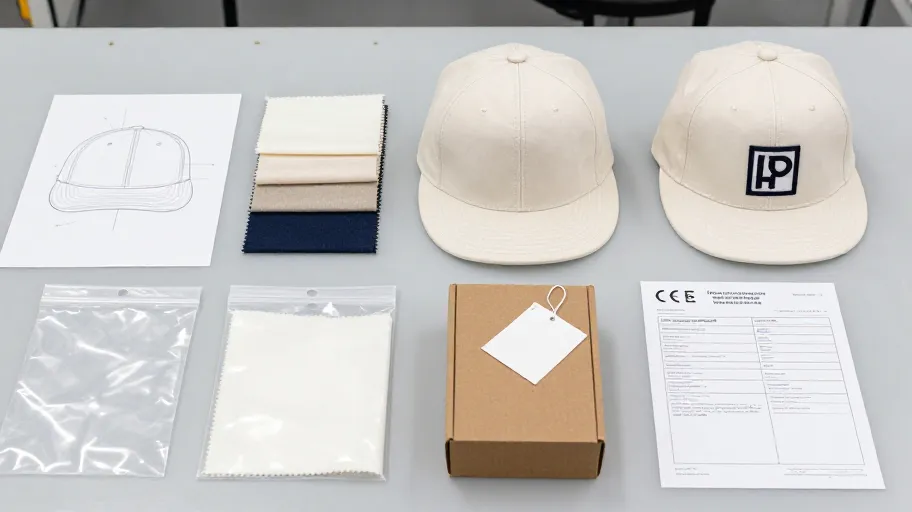
The best hat manufacturers in China can only quote accurately when you send a complete, comparable enquiry: locked design, defined construction, target quantity ranges, decoration method, packaging, destination and compliance needs. Vague requests force suppliers to guess, so quotes arrive non-comparable. Define inputs first, then compare manufacturers on documentation quality.
Why the buyer controls quote accuracy
When procurement teams search for the best hat manufacturers in China, the instinct is to request quotes from several factories and compare numbers. The problem is that the numbers are only as good as the inputs. If one supplier receives a photo, another receives a sketch, and a third receives a full tech pack, the three quotes describe three different products. Comparing them is meaningless — and any shortlist built on them will need to be rebuilt.
Accuracy in quoting is a shared responsibility. A manufacturer in Shenzhen producing custom caps under OEM and ODM arrangements can price precisely once it knows what it is pricing. The work before the RFQ is therefore the buyer's highest-leverage activity in the entire sourcing cycle.
This article sets out a practical framework for that stage.
The RFQ-Ready Framework
The RFQ-Ready Framework asks five questions about your own enquiry before any supplier receives it:
- Design lock. Is the style finalised — crown construction, panels, closure type, visor shape, materials, and colours specified against a reference such as a Pantone number?
- Decoration definition. Is the branding method fixed (embroidery, printing, woven label, patch, or a combination), with artwork in a usable format and placement defined?
- Quantity and cadence. Do you know your target quantity range and whether this is a one-off or repeat programme? Quantity changes how any manufacturer plans production, so quote requests should state the range you are actually considering.
- Destination and compliance. Which markets will the caps enter, and what labelling, safety or material documentation do those markets expect from you as the importer? Put these in the RFQ so the supplier can respond to them, not discover them later.
- Commercial terms. Packaging expectations, delivery terms, inspection arrangements and who handles freight. For every policy question — samples, fees, shipping of samples, payment terms — confirm the current policy directly with each supplier and record the answer in writing.
If you can answer all five, your enquiry is RFQ-ready. If you cannot, the gap is where quote distortion enters.
Decision table: comparing quoted hat manufacturers
Once RFQ-ready enquiries go out, compare responses on evidence quality rather than only on the headline number:
| Evaluation dimension | What to look for in the response | How to score it |
|---|---|---|
| Spec comprehension | Supplier restates your spec and asks targeted clarification questions | High / Medium / Low |
| Options offered | Construction or material alternatives with trade-offs explained, not just one number | High / Medium / Low |
| Documentation | Structured quote with itemised components, artwork handling and packaging | High / Medium / Low / Not provided |
| Policy transparency | Sample, fee, payment and revision terms stated in writing | Confirmed / Partial / Not confirmed |
| Compliance responsiveness | Direct answers on requested documentation for your destination markets | Confirmed / Partial / Not confirmed |
| Communication quality | Single point of contact, consistent terminology, reasonable turnaround on questions | High / Medium / Low |
Score each supplier on the same rows so the comparison stays honest. The goal is not to find a supplier who says yes to everything; it is to find one whose answers are specific and documented.
Concrete approval questions to send each supplier
Before approving any manufacturer for sampling, send these questions and require written answers:
- Please confirm your understanding of the attached spec in your own words, including construction, materials and decoration method.
- What clarifications do you need before you can hold your quote steady if artwork or colours are adjusted?
- What artwork formats and colour references do you work from for this decoration method?
- What does your sampling process involve step by step, and at what points do I approve before production? Confirm the current policy directly.
- How do you handle revision requests on a sample, and how are revisions documented? Confirm the current policy directly.
- What documentation can you provide for the destination markets stated in the RFQ?
- Who is my single point of contact, and what is the escalation path if a question stalls?
- What information do you need from me at each gate so that the project does not pause?
A supplier's answers to questions 4 and 5 tell you more about how the project will run than any sales material. Suppliers who document their process are easier to work with when something needs adjusting — and in custom headwear, something needs adjusting.
Verify, don't assume
A few neutral rules keep the evaluation honest:
- Do not treat any stated capability, capacity figure or credential as verified until the supplier provides current evidence you can check.
- Ask which claims are backed by documents and which are verbal, and note the difference in your scorecard.
- Where a claim matters commercially — compliance, capacity, materials — ask for the evidence in writing as part of the approval file.
- Confirm the current policy directly for anything involving samples, fees or terms; record answers verbatim.
This approach protects both sides. Good manufacturers prefer buyers who specify clearly, because it lets them quote with confidence.
FAQ
How many hat manufacturers in China should I send an RFQ to? Enough to compare meaningfully — a short shortlist of suppliers who have each received the identical RFQ-ready package. Three to five comparable responses beat twenty vague ones, because every response answers the same specification.
Should I send the same tech pack to every supplier? Yes. Identical inputs are the only way to make quotes comparable. If you tailor the request per supplier, you lose the ability to compare, and the exercise collapses back into guesswork.
What if a supplier quotes without asking any questions? Treat it as a signal to probe. An accurate quote for custom headwear depends on details the supplier cannot infer. Ask them to restate the spec and list their assumptions in writing; the quality of that answer is itself evaluation data.
Do I need to have my final quantities before requesting quotes? You need a real target range, stated in the RFQ. Exact figures can move, but a quote built on an undefined quantity is a quote built on an assumption. Share the range you are genuinely planning for.
How do I evaluate an ODM proposal for a custom cap style? Ask the supplier to separate what is their existing construction from what is developed for you, who owns the developed design, and how revisions to a developed style are handled. Document the answers before approving the ODM direction.
Download the Supplier Scorecard
Turn this framework into a repeatable gate for your team. Download the Supplier Scorecard and score every quoted manufacturer on the same dimensions — spec comprehension, documentation, policy transparency and compliance responsiveness — so your shortlist decision is documented, comparable and defensible internally.
Before you send anything: the pre-RFQ checklist
Not ready to download yet? Run this quick checklist first:
- Design locked: construction, materials, colours referenced
- Decoration method and artwork format defined
- Target quantity range stated
- Destination markets and required documentation listed
- Packaging and delivery terms drafted
- Policy questions prepared, to confirm the current policy directly
- Approval questions from this article copied into the enquiry
Complete this, and your enquiry is ready for the best hat manufacturers in China to quote accurately.
#cap manufacturers china, #headwear manufacturers china, #cap factory








