


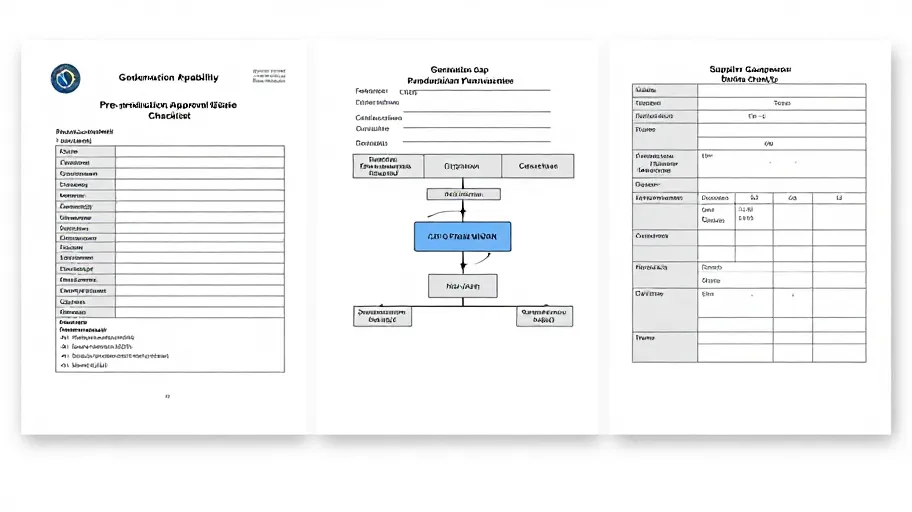
Before you shortlist anyone to produce your generation cap, compare four things side by side: verified production capability, written commercial terms, documentary proof of quality systems, and a pre-production approval gate you control. Ask every candidate the same question set, in writing, and score the answers. Do not proceed to sampling until a supplier has documented answers on record. This article gives you the framework, the decision table and the questions to send today.
The CAP-Q Framework: four lenses for shortlisting a cap supplier
When buyers source custom headwear from China, the expensive mistakes happen before the first sample is cut — at the shortlisting stage, when vague answers are accepted because they sound reassuring. The CAP-Q Framework forces every candidate through the same four lenses:
- C — Capability. Can the supplier document the construction methods, materials and decoration techniques your generation cap design requires?
- A — Agreement. Are commercial terms, IP handling and specification ownership written down before any commitment?
- P — Proof. What verifiable evidence — certifications, inspection records, audit reports — can the supplier share, and can you validate it independently?
- Q — Quality gate. Does the process include a pre-production sample approval step that you sign off on, with defined acceptance criteria for your specific project?
Each lens produces written answers. Suppliers who cannot or will not answer in writing reveal something important before you spend money on sampling.
Capability: audit the machine, not the brochure
A supplier's catalogue tells you what they want to sell. A capability audit tells you what they can build. Send every candidate the same capability questions:
- Which cap constructions can you produce in-house, and which do you outsource? Ask them to state this in writing.
- Which decoration methods do you offer for this generation cap design — embroidery, printing, weaving, appliqué, laser, heat transfer — and which would you recommend for my artwork, and why?
- Can you match a specified pantone colour, fabric composition and closure type? How will you document the match?
- What material options can you present for this design, and can you supply material swatches for approval before production?
- Who owns the tooling, embroidery files or screens created for my order?
The last question matters more than buyers expect. If digitised artwork or tooling is not addressed in writing, you may pay for setup work you cannot take elsewhere. Ask for the answer in your agreement, not in a chat message.
Agreement: get the commercial skeleton in writing
Every commercial term you care about is project-specific, so treat it as a question, not an assumption. Confirm the current policy directly with each supplier on:
- Minimum order quantity for this specific design and decoration combination.
- Unit pricing structure across quantity tiers, and what drives price changes.
- Sampling arrangements and costs.
- Production scheduling and how the supplier handles schedule changes.
- Payment terms and deposit structure.
- Shipping terms (Incoterms), and who arranges customs documentation.
- Intellectual property protection for your artwork and brand assets.
- Rework, rejection and dispute-resolution procedures.
None of these can be assumed from a website or a sales conversation. A supplier's willingness to put each answer in writing is itself a comparison signal: it tells you how the relationship will run after the first order.
Proof: evaluate evidence without assuming norms
Do not accept capability claims at face value; ask for documents you can verify. A robust proof request includes:
- Quality-management documentation, and whether it has been audited by a third party.
- Product-safety or compliance documentation relevant to your destination market — ask which regulations the supplier can support for your product and market, and confirm current evidence.
- Recent inspection reports for comparable headwear projects, with client details redacted if confidentiality applies.
- References or verifiable project history for work similar to your generation cap design.
When a supplier shares a certificate, check its scope, validity period and issuing body. A document that does not cover your product category or destination market is not proof for your project. If a claim cannot be evidenced, treat it as unverified and note it in your comparison table.
Quality gate: control the approval step
The single most valuable protection in custom headwear sourcing is a pre-production sample that you approve in writing before bulk production starts. Build the gate into your process:
- Submit a complete tech pack: artwork files, colour references, material specifications, construction details, sizing and closure type.
- Inspect against written acceptance criteria you define for this project — colour match, stitch density, seam finishing, sizing consistency, closure function.
- Approve, request revision, or reject — in writing. Only approved samples authorize production.
Define what happens when a bulk order does not match the approved sample: the correction procedure, cost responsibility and re-inspection rights. Put it in the agreement before production begins.
Decision table: score your shortlist
| Comparison criterion | What to request | Evidence to demand | Red flag |
|---|---|---|---|
| Construction capability | Written list of in-house vs outsourced processes | Process documentation | Vague or verbal-only answers |
| Decoration method fit | Recommendation for your artwork with rationale | Method samples or swatch set | No written recommendation |
| Colour and material matching | Swatches for approval before production | Physical swatch approval | Matching promised without documentation |
| Commercial terms | Full written quotation with MOQ, pricing tiers, payment terms | Signed or formal quotation | Terms introduced late or changed verbally |
| Compliance documentation | Certificates valid for your product and destination market | Issuing-body verification | Certificates out of scope or unverifiable |
| IP protection | Written IP and tooling-ownership clause | Draft agreement language | Refusal to address IP in writing |
| Pre-production approval | Sample approval gate with defined acceptance criteria | Signed sample approval record | Production starts without your written approval |
| Quality correction path | Rework, rejection and re-inspection procedure | Documented procedure | No defined correction process |
Score each supplier one to five per row. Suppliers that fail two or more rows on evidence — not on promises — should not advance to sampling.
Ten approval questions to send this week
- Please confirm in writing which processes for this generation cap design are performed in-house and which are outsourced.
- What is the minimum order quantity for this specific design, decoration method and material combination?
- Please provide a written quotation showing unit pricing across quantity tiers for this project.
- What are your sampling arrangements for this design? Confirm the current policy directly.
- Which compliance documentation can you provide that covers my product category and destination market?
- Who owns the embroidery files, tooling and screens created for my order, and where is this stated?
- Can you provide material swatches for approval before production begins?
- Will production begin only after my written approval of a pre-production sample?
- What is your documented procedure if bulk goods do not match the approved sample?
- What Incoterms and shipping arrangements can you support for my destination market? Confirm the current policy directly.
Send the identical set to every candidate. Identical questions make answers comparable, and comparable answers are what a shortlist is built on.
FAQ
What should I compare first when shortlisting a generation cap supplier? Start with capability: whether the supplier can document the construction, decoration and material matching your design requires. Everything else — pricing, scheduling, sampling — depends on capability being real.
How do I verify a supplier's quality claims? Request documentation covering your product category and destination market, verify the issuing body and validity, and ask for recent inspection records for comparable projects. Treat unevidenced claims as unverified in your comparison table.
Should I ask about IP protection before sampling? Yes. Ask who owns the artwork files, digitised embroidery files and tooling before any setup work begins, and require the answer in writing within your agreement.
What makes a pre-production sample approval meaningful? Written acceptance criteria you define for the project, an inspection against those criteria, and a documented approval that must precede bulk production. Without your written sign-off as a gate, the sample is advisory rather than controlling.
How many suppliers should I shortlist before requesting samples? Compare enough candidates with a fixed question set and decision table that the answers differentiate clearly. Advance to sampling only with suppliers whose evidence — not promises — scores consistently across your criteria.
Download the sourcing checklist
Run every candidate through the same audited process. 下载核对清单 to get the complete supplier-comparison checklist, including the ten approval questions, the decision table and the pre-production approval-gate prompts — ready to send to suppliers today.
Prefer to start smaller? Use the ten approval questions above as your first-pass filter, then download the full checklist when you are ready to compare shortlisted suppliers side by side.
#cap manufacturers china, #headwear manufacturers china, #cap factory








