


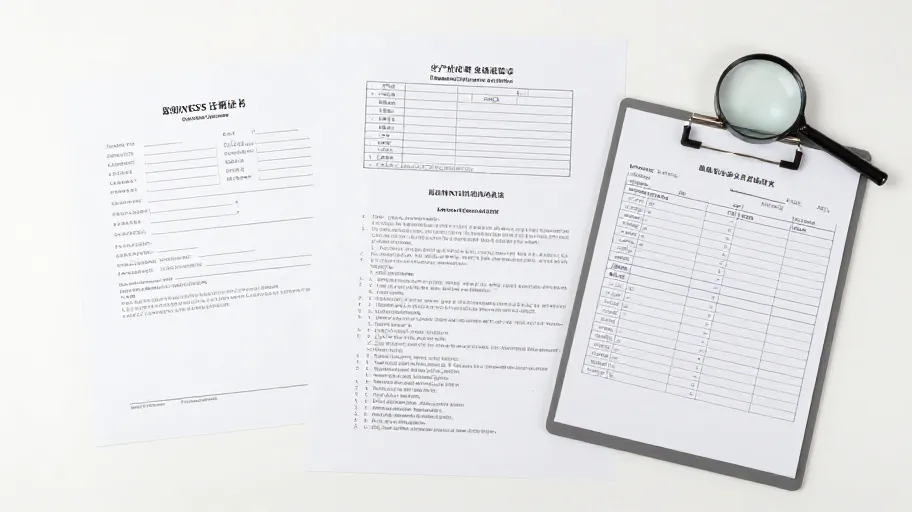
Comparing cap factories is safer when you compare documents rather than claims. A documentation-first approach asks each candidate factory for verifiable evidence — business registration, production scope, quality records and written policies — before you approve any order. The EVIDENCE framework below gives you a structured gate: no written confirmation, no commitment. This article shows you how to run it.
The EVIDENCE framework for comparing cap factories
The framework separates what a supplier says from what a supplier can show:
- E — Exposure. How does the factory present itself? Are company details, location and manufacturing scope stated openly?
- V — Verification. Can the business licence and manufacturing registration be verified through official channels or a third-party audit?
- I — Inputs. What materials, trims and components does the factory source, and can it document them?
- D — Documentation. Does the factory maintain written specs, tech packs, inspection records and revision control?
- E — Engineering. Can it handle construction details relevant to your headwear — panels, closures, sweatbands, embroidery or printing — and explain its processes?
- N — Negotiation. Are payment terms, tooling ownership and reorder conditions put in writing?
- C — Control. What inspection stages exist, and what happens when a defect is found? Ask; do not assume.
- E — Execution. How does the factory communicate during production, and what reporting do you receive?
Each letter translates into evidence you request. The absence of evidence is itself a data point for your comparison.
Decision table: comparing candidate cap factories
Score each factory against the same documentation requests. Keep the comparison neutral — you are scoring responsiveness and evidence, not promises.
| Criterion | What to request | Strong signal | Weak signal |
|---|---|---|---|
| Legal identity | Business licence and manufacturing scope | Documents provided promptly, scope matches caps/headwear | Vague scope, delays, or refusal |
| Production role | Confirmation of own factory vs trading company | Direct, transparent answer either way | Evasive or inconsistent answers |
| Quality system | Written QC process and inspection stages | Documented stages and reporting format offered | "Don't worry, we control quality" |
| Sample policy | Current sample terms and costs in writing | Clear written policy you can review | Verbal-only assurances; policy details deferred |
| Communication | Named contact and response protocol | Defined channels and escalation path | Anonymous or rotating contacts |
| IP and tooling | Written ownership terms for designs and moulds | Ownership addressed in draft agreement | Topic avoided |
| Reorder consistency | How specs are retained between orders | Revision-controlled tech packs referenced | No spec-retention answer |
| References | Verifiable buyer references or audit reports | Offered with contact or report scope | Promised but never delivered |
Add or remove rows to match your category, but keep every candidate scored on identical requests.
Concrete approval questions to send each cap factory
Send these before any deposit. Written answers become your evidence base.
Commercial and policy questions
- What are your current MOQ terms for this cap construction, in writing?
- What is your current sample policy — including cost, timing and whether fees are credited — as stated in your official policy?
- What are your current production lead times for this order profile, and what factors could change them?
- What are your payment terms, and under what conditions do they change?
- What does your current defect-resolution process look like, documented?
Capability and quality questions
- Which headwear constructions and decoration methods can you manufacture in-house, and which do you outsource?
- What inspection points exist in your process, and what documentation do I receive at each point?
- How do you record and retain specifications so a reorder matches the original order?
- What material documentation can you provide for the fabrics and trims in my specification?
- Which certifications or test reports relevant to my market can you provide for this product — current documents only?
Ownership and exit questions
- Who owns the design files, patterns, embroidery digitising and moulds I pay for?
- Under what conditions can I retrieve my tooling and files if we stop working together?
Treat "we'll confirm later" as an unfinished answer. Later is after your leverage disappears.
Red flags in documentation behaviour
Watch how factories respond to evidence requests, not just what they say:
- A factory that answers every question with enthusiasm but sends no documents
- Quotes that arrive without written terms attached
- Quality claims with no inspection framework behind them
- A refusal to state whether it is a factory or a trading company
- Ownership questions met with silence
None of these proves a bad supplier. Each one tells you the documentation-first gate has not been passed, and the risk is now yours to price in.
FAQ
Should I choose a cap factory or a trading company? Both can work; what matters is transparency. A trading company that openly states its role, documents its factory partnerships and accepts written accountability can be a valid route. A supplier that obscures its role removes your ability to verify anything. Ask directly and record the answer.
How do I verify a cap factory actually exists as a manufacturer? Request the business licence and manufacturing scope, verify them through official Chinese registries or an appointed third-party audit firm, and cross-check that the stated scope covers headwear. Confirm every step in writing rather than relying on directory listings.
What documents should I hold before approving an order? At minimum: verified company registration, a written quotation with terms, a signed tech pack or specification sheet, a documented sample approval, a written quality and inspection plan, and an agreement covering IP and tooling ownership. The checklist below covers the full set.
How can I judge quality without visiting the factory? Use staged evidence: a third-party audit, documented sample evaluation against an agreed spec, and pre-shipment inspection with photographic and written reporting. Each layer reduces dependence on trust alone.
How many cap factories should I compare? Enough to test the market — enough that you can see how different suppliers answer the same evidence requests side by side. The decision table above works best when every candidate receives the identical question set.
Your next step
下载供应商证据清单 — get the full supplier evidence checklist and run every candidate cap factory through the same documentation gate before you commit.
Prefer to start smaller? Use the ten approval questions above as a first-pass filter, and request written answers from each supplier this week.
#cap manufacturers china, #headwear manufacturers china, #cap factory








