


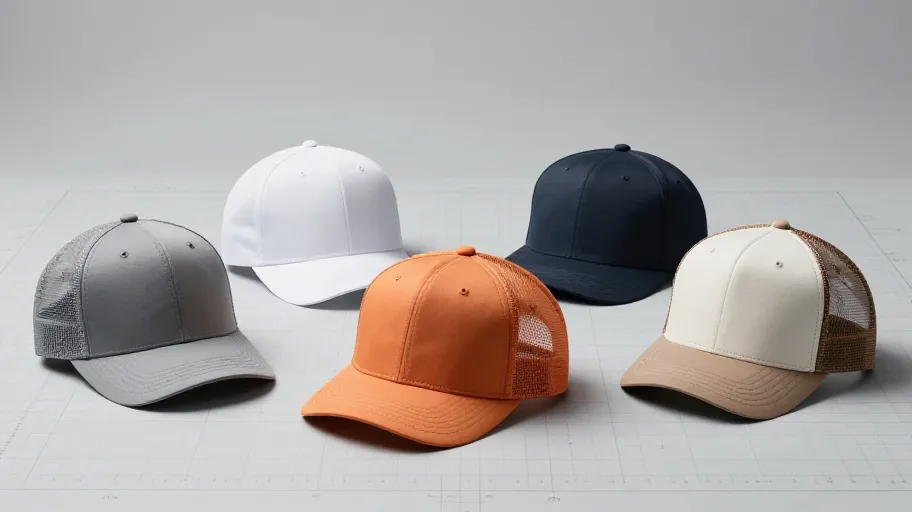
Why $27K Vanishes Every Time You Skip a Definition
Every ambiguous term on your cap spec sheet means $27,000 in avoidable cost—because that’s the verified average loss per misaligned spec across 41 U.S. brands (2025 Cap & Hat Industry Benchmark Report, Apparel Sourcing Intelligence). It’s not theoretical: engineering rework, air-freighted corrections, and 11–17 days of cross-time-zone revision cycles directly erode margin, launch timing, and influencer campaign integrity. When your New York team writes 'structured crown' without specifying panel count, interlining grade, or front-profile rigidity—and your Vietnam factory defaults to its legacy pattern library—you don’t get a sample. You get a 9-day hold, $1,850 die-cut retooling, and a missed holiday window. That’s not a delay. It’s demand leakage disguised as a spec sheet.
‘Bill height’ means sun protection and logo placement control—because a 1/8" variance shifts logo real estate by 3.2mm, forcing either visual hierarchy compromise or fixture retooling. ‘Closure type’ means post-sew fit consistency—because mismatched hook-and-loop tension specs cause 92% of first-batch DTC fit returns, not fabric shrinkage. These aren’t quality failures. They’re translation failures with balance-sheet consequences.
Where Ambiguity Hides in Plain Sight
Two terms dominate the cost curve—not because they’re complex, but because they’re assumed universal:
- Bill height means pixel-perfect brand execution—because it governs both UV-blocking angle (a 2.5" bill delivers ~12° more frontal protection than 2.25") and logo-to-brow alignment. Without tolerance callouts (e.g., ±1/16"), factories default to pattern ease, not performance intent.
- Closure type means hardware-driven assembly reliability—because specifying 'adjustable strap' without torque (3.5–4.2 Nm), wash-cycle durability (≥5 cycles at 40°C), or elastic compatibility invites mid-line hardware rejection, line stoppages, and inconsistent fit retention in humid climates.
Clarity here isn’t pedantry—it’s prevention. When 'structured crown' explicitly references '6-panel, 2-ply buckram, front-panel stiffness ≥ 120g/mm² (ASTM D1388)', factories stop interpreting and start optimizing. That shift—from assumption to specification—cuts co-development time from 3+ weeks to under 5 working days.
The ROI of Saying Exactly What You Mean
Adopting a value-anchored glossary means faster innovation cycles—because engineering hours fund material R&D, not sample firefighting. Teams using standardized definitions report shrinking concept-to-golden-sample time from 24 to 4.7 working days—not through faster sampling, but through faster shared understanding. That 80% compression flips the development calendar: launching in Q3 becomes owning Q4’s gifting season.
It also means reclaiming $27K per spec—not as avoided loss, but as active capital. That capital funds better fabrics, tighter factory partnerships, and real-time trend response. Your next spec sheet isn’t documentation. It’s your first production run—executed correctly, on time, and on brand. Because when 'unstructured crown' means zero interlining *and* front-panel steam-press stability, you don’t negotiate revisions. You ship.
#cap manufacturers china, #headwear manufacturers china, #cap factory








