


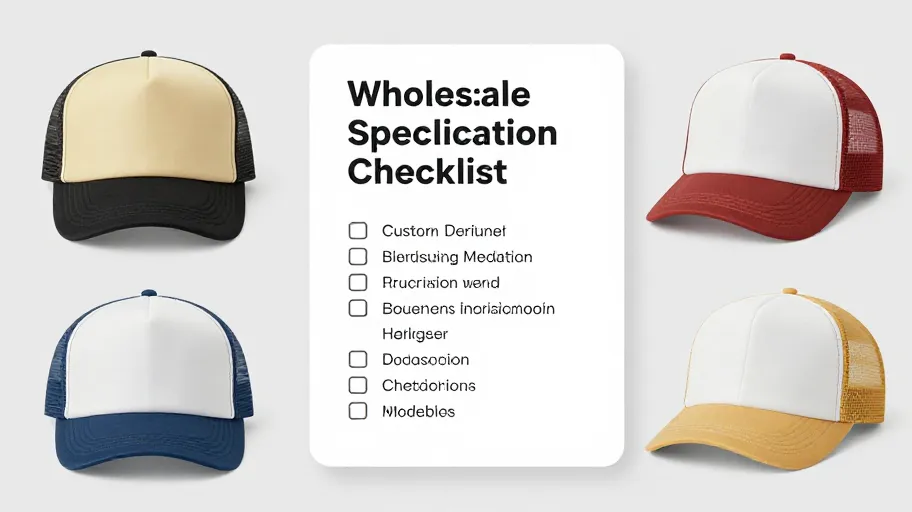
When sourcing custom embroidered trucker hats wholesale, the primary risk for overseas buyers lies in the ambiguity of construction details. A successful wholesale order relies on three distinct pillars: precise material specification, accurate structural definition, and verified decoration compatibility. Buyers must prioritize the "Material-Construct-Finish" (MCF) framework to ensure the final product aligns with brand expectations before mass production begins.
The Material-Construct-Finish (MCF) Framework
To avoid the common pitfalls of offshore sourcing—specifically the disconnect between design intent and factory output—procurement teams should utilize the MCF framework. This approach isolates the three variables that most frequently cause sample rejection.
- Material: Refers to the composition of the front panel and the mesh back.
- Construct: Encompasses the profile height, crown structure, and brim stiffness.
- Finish: Involves the closure type, stitching quality, and decoration application.
1. Material Selection: Front Panels and Mesh Backing
The defining characteristic of a trucker hat is the hybrid construction: a solid front and a ventilated back. When comparing products for wholesale, understanding the weight and composition of these two zones is critical.
The Front Panel Most wholesale trucker hats utilize a foam front to provide structure for embroidery. However, "foam" is not a monolith.
- Polyester Foam: Generally more durable and color-fast. It resists shrinking better than cotton blends and is easier to clean.
- Cotton/Twill Blends: Offer a premium, textured feel but are prone to fading and shrinkage if not pre-shrunk.
- Sourcing Tip: Ask the supplier for the "GSM" (grams per square meter) of the front fabric. A higher GSM usually indicates a sturdier base for heavy embroidery, preventing the "puckering" effect often seen with lighter fabrics.
The Mesh Backing The breathability of the hat depends on the mesh.
- Nylon Mesh: Known for extreme durability and a slightly glossy sheen. It is often more abrasive but resists tearing.
- Polyester Mesh: Softer to the touch and generally more cost-effective for large volume orders.
- Ventilation Patterns: Look at the "pore" density. Wider spacing offers better airflow but may reveal the hairline of the wearer more easily, which may not be suitable for all brand images.
2. Construct: Profile and Brim Geometry
This is the area where terminology often causes confusion. A "Standard" trucker hat for one factory might be a "High Profile" for another.
Crown Profile
- High Profile: Typically sits 3 to 4 inches high at the front. It offers a large, uninterrupted canvas for logos and creates a bold, retro aesthetic.
- Mid Profile: A lower slope that sits closer to the head. It is often preferred for corporate headwear as it is less ostentatious.
- Low Profile: Uncommon for traditional trucker styles but available for specific fashion-forward requests.
Brim Stiffness and Shape
- Flat Brim: Requires specific internal wiring (often plastic) to maintain shape. This is a popular choice for streetwear brands.
- Curved Brim: Usually pre-curved by the factory. The degree of the curve varies.
- Sourcing Question: "Does the brim contain a specific internal wire to maintain its shape, or does it rely solely on the stiffness of the board used?" This impacts washability and long-term shape retention.
3. Decoration Compatibility: Embroidery on Structured Hats
When purchasing custom embroidered trucker hats wholesale, the interaction between the needle and the foam front is a critical quality control point.
Stabilization and Backing Because the front panel is often foam-backed rather than pure fabric, it requires specific stabilization.
- Tear-away Backing: Used for lighter designs. It is removed after embroidery.
- Cut-away Backing: Used for dense logos to prevent the foam from bubbling or distorting during the stitching process. This remains permanently behind the design.
Digitization Density A logo designed for a cotton t-shirt will not translate perfectly to a foam trucker hat. The "underlay" (the stitches laid down before the top layer) must be adjusted to compress the foam rather than cut into it.
- Risk: If the density is too high, the needle will perforate the foam, causing "burnout" or holes in the design.
- Action: Request a "digitization proof" specifically for headwear, not just a general embroidery file.
Decision Table: Selecting the Right Trucker Specification
Use this table to align your brand requirements with the technical specs provided by your OEM/ODM partner.
| Feature Option | Best For | Key Consideration |
|---|---|---|
| Foam Front (Polyester) | Promotional events, Outdoor wear | Superior color retention; easier to maintain shape. |
| Foam Front (Twill) | Retail fashion, Premium branding | Higher perceived quality; requires careful washing instructions. |
| Plastic Snapback | Youth markets, Adjustable fit | Cost-effective; varying grades of plastic durability exist. |
| Velcro/Strapback | Vintage aesthetics, Adjustable fit | Can collect lint over time; offers a different tactile feel. |
| Flat Brim | Streetwear, Urban brands | Requires protective packaging to prevent bending during transit. |
| Pre-curved Brim | Corporate gifts, General use | Ready to wear immediately; less packaging bulk. |
Approval Protocol: Questions for Your Supplier
Before green-lighting the production run, verify the following with your manufacturing partner. Do not assume standard industry terms apply universally.
- Prototype Verification: "Can you provide a physical sample of the exact fabric weight and mesh color combination before bulk production begins?"
- Logo Testing: "Will you run a test stitch of our logo on the actual front panel material to check for foam burnout or puckering?"
- Color Consistency: "Do you use Lab Dip approvals for the plastic snaps, mesh, and thread to ensure they match our brand palette?"
- Packaging Standards: "How will the flat brims be protected during ocean freight to prevent deformation?"
Conclusion
Sourcing custom embroidered trucker hats wholesale requires moving beyond aesthetic preferences and into technical specification. By rigorously applying the Material-Construct-Finish framework, buyers can bridge the gap between concept and counter-sample. Focus your communication on fabric weights, profile definitions, and embroidery backing to ensure the final product meets your brand's standards.
Download the Specification Checklist Ensure your next batch meets quality standards. Use our comprehensive checklist to verify every detail with your supplier.
[Download the Specification Checklist]








