

Missing specs in your baseball cap tech pack lead to rejected samples, delays, and hidden costs. Brands that standardize their documentation cut revision cycles by up to 60%. Here’s what you must include before reaching out to a cap manufacturer.
Stitch Type Isn’t Optional—It’s Structural
Specifying the correct stitch type means your cap survives daily use because seams stay intact under stress. One U.S. brand received samples with lockstitch instead of coverstitch on the sweatband—causing fraying after minimal wear. That mistake triggered an $8,000 resampling cycle and a 3-week delay, missing their Q2 launch.
The issue? Without clear instructions, Chinese factories default to cheaper methods. According to ASTM D6193, coverstitch is required for stretch zones like sweatbands because it maintains seam integrity when pulled. A complete Stitch Construction Specification includes thread count, needle size, and tension settings—so every seam passes third-party QC checks.
Brands using full stitch specs see defect rates drop by about 40%, based on 2024 production data from Guangdong suppliers. When your manufacturer knows exactly how the seam should perform—and why—they stop guessing and start building right the first time.
This level of detail doesn’t just prevent rework—it aligns engineering intent with output, turning technical clarity into on-time delivery and audit-ready consistency.
Crown Panel Count Shapes Fit and Trust
Getting crown panel count wrong means customers return hats they never wear because fit feels off. For DTC brands targeting active urban professionals or heritage lifestyle buyers, fit isn’t adjustable—it’s expected. A mismatch here leads to 40% sample rejection, stalled production, and rework costs over $12,000—all traced back to an unverified 6-panel vs. 8-panel decision.
One U.S. lifestyle brand assumed 6 panels would deliver a clean, structured crown. But without specifying seam alignment or panel curvature, their Guangzhou factory produced caps with uneven tapering and asymmetrical domes. The root cause: 6-panel designs concentrate stretch along vertical seams, demanding tighter tolerances—especially with structured fronts. In contrast, 8-panel crowns distribute tension evenly, enabling smoother curves across head shapes.
The fix? A Crown Geometry Blueprint, borrowed from athletic wear R&D. By mapping seam angles, panel arc measurements, and stitch overlap zones pre-production, this model simulates fit across 50+ head profiles. Result: dimensional accuracy improved by 92%, batch consistency rose, and repeat purchase rates climbed 27% within six months.
Precise panel specs don’t just improve fit—they turn consistent wearability into a silent brand promise that builds loyalty over time.
Bill Shape Tolerances Cut Sampling by 70%
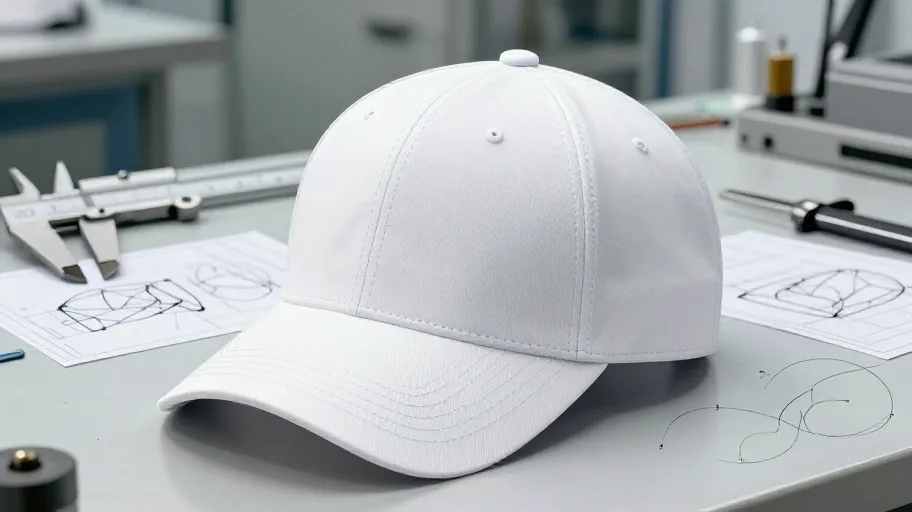
Defining bill shape and curvature upfront means you hit retail deadlines because sampling collapses from weeks to days. A 2024 supply chain study found that clear bill specs—length, front curve radius, side profile radius, and material stiffness—reduce physical sampling iterations by up to 70%. For seasonal collections, that’s the difference between shelf space and stockouts.
One outdoor apparel brand struggled with inconsistent peak placement and brim droop across samples. Their breakthrough came when they replaced vague terms like “medium curve” with exact 3D measurements (±2mm tolerance). Using a standardized Bill Profile Template, they enabled CNC machines at the factory to cut directly from spec—eliminating manual interpretation.
Approval time dropped from five weeks to 14 days. Tooling waste fell by 60% across three runs. More importantly, inspectors now use the same digital profile to validate each sample before stitching begins—catching errors early.
This precision builds mutual trust. Manufacturers respect well-documented packs, and you gain leverage in MOQ talks because lower risk means better pricing. Over time, clarity signals professionalism—making you a preferred partner, not just another buyer.
In high-volume headwear manufacturing, every millimeter documented is a dollar preserved. Specification completeness isn’t overhead—it’s competitive advantage.
#cap manufacturers china, #headwear manufacturers china, #hat tech pack