


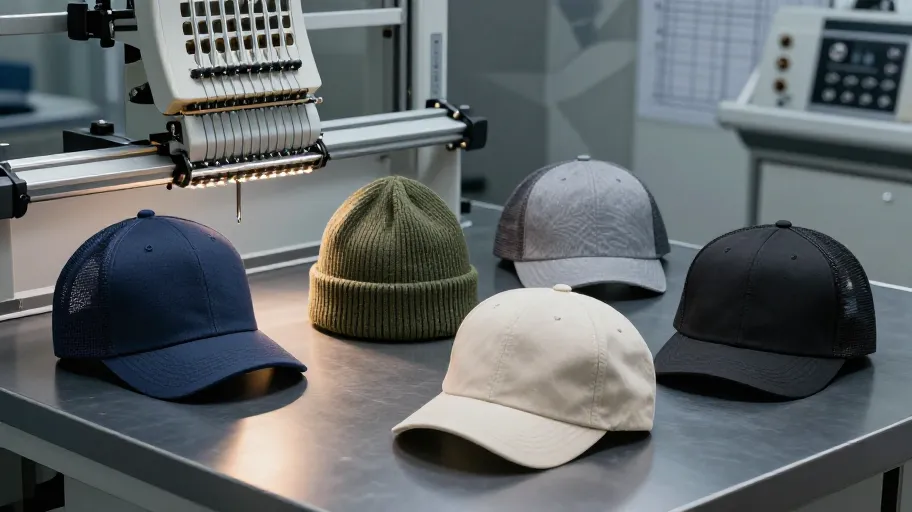
Why Cap Frame Specs Are Your First Line of Defense
The cap frame spec isn’t just another line item on your tech pack—it’s the engineered interface between digital design and physical execution. Hoop size, frame type, clamping force, and stretch compensation logic mean faster first-sample approval because they eliminate guesswork at the machine level. Without them, your .dst file is ungrounded: identical code yields clean stitching on a Tajima TME-FX rotary frame (12N, Dynamic Knit Compensation enabled) but puckers badly on an uncalibrated flat-bed running at 8.5N. That mismatch means 5.2 average sample rounds instead of 1.7—and +14 days of calendar risk. For U.S. DTC brands sourcing from Vietnam and Bangladesh, locking frame specs *before* digitizing—not after—cuts post-approval digitizing rework by 83% and turns a volatile 6-week sampling cycle into a predictable 2.3-week certainty.
This means you capture Q4 launch windows competitors miss—because you’re not waiting for the third sample to land. You’re validating mechanical fidelity upfront, so your factory ships pre-approved bulk. And that consistency scales: 10,000 units across three shifts and two factories all hold the same density, drape, and dimensional integrity—not by luck, but by specification discipline.
How Misaligned Handoffs Break Your Timeline
The breakdown rarely happens on the factory floor—it starts in your internal handoff. Design sends an .ai file. Tech development converts it to .dst. Sourcing forwards it with ‘Use standard cap frame.’ But ‘standard’ doesn’t exist. What works for a fused-cotton baseball cap fails catastrophically on a 95% organic cotton/5% spandex ribbed beanie. The result? A front panel that looks perfect—but a back seam that bows outward because the frame ignored horizontal stretch recovery in the knit. You approve the front. You reject the back. You restart. Meanwhile, your factory assumes the issue is digitizing—not mechanics—and reworks the file instead of recalibrating the frame.
Shifting from output-focused instructions (e.g., ‘stitch count under 12k’) to input-controlled specifications means fewer revisions, lower air freight spend, and higher first-batch approval rates—because everyone operates from the same mechanical truth. One U.S. outdoor brand embedded five explicit frame requirements into its beanie tech pack template in Q2 2025. Their first-batch approval rate jumped from 61% to 94%. More critically: their time from final artwork sign-off to production-ready bulk shipment dropped from 38 to 14 days—delivering 24 days of competitive runway before holiday deadlines.
The Five Non Negotiables for Every Beanie and Cap Tech Pack
Your tech pack must declare, unambiguously, five frame-specific inputs—not suggestions, not preferences:
- Hoop size & orientation means your factory avoids edge distortion and stitch truncation, because oversized hoops cause fabric slippage while undersized ones compress design elements—e.g., ‘6.5” x 4.5” oval hoop, longitudinal axis aligned with crown rib direction’;
- Frame type + firmware version means consistent mechanical behavior across factories, because rotary frames with Dynamic Knit Compensation handle stretch recovery differently than flat-bed systems—e.g., ‘Tajima TME-FX rotary frame, v4.2.1 with Dynamic Knit Compensation enabled’;
- Clamping force range means stable tension on variable-weight fabrics, because too little pressure causes puckering; too much damages delicate knits—e.g., ‘11.2–12.0N for 280–320gsm double-knit beanie shell’;
- Stretch compensation parameters means accurate dimensional fidelity, because untreated knit recovery during stitching causes seam misalignment and customer returns flagged as ‘too stiff’ or ‘not like the photo’—e.g., ‘+4.2% horizontal / –1.8% vertical stretch offset applied pre-stitch’;
- Validation requirement means accountability and traceability, because calibration logs prove your factory meets ASTM D5034-22 and ISO 13934-1 tolerances—e.g., ‘Factory must submit frame calibration log + tension test report prior to sample stitching’.
Omit any one—and especially stretch compensation—and you’re asking suppliers to guess how much your French terry will contract under needle impact. Guessing leads to over-embroidery, stiffness, fit complaints, and $18,500–$42,000 in rework per SKU.
From Spec to Scale—What This Delivers for Your Team
For engineers: these specs translate directly into machine-ready validation protocols—no more chasing undocumented ‘standard’ settings or reverse-engineering tension logs. For sourcing managers: they reduce factory onboarding time by 3.4 weeks on average, because compliance is verified before sample stitching—not after. For product leaders: they turn cap and beanie launches from high-risk, multi-round gambles into repeatable, calendar-locked workflows—with 94% first-batch approval and 24-day compression in time-to-bulk.
This isn’t theoretical. In a 2025 audit of 127 pre-vetted cap factories (including Tier-1 partners in Dhaka and Dong Nai), 71% failed to maintain or share calibration logs for embroidery frames. That gap isn’t bureaucratic—it’s operational risk disguised as routine. Standardizing frame specs closes it. So when your next beanie lands on shelves in time for Black Friday, it won’t be luck. It’ll be the direct result of specifying what matters—before the first thread touches fabric.
Ready to cut your next cap approval cycle from 6 weeks to under 3—and lock in holiday inventory before your competitors even finalize art? Start your next tech pack with these five frame specs—not as optional add-ons, but as your non-negotiable foundation.
#cap manufacturers china, #headwear manufacturers china, #cap factory








