
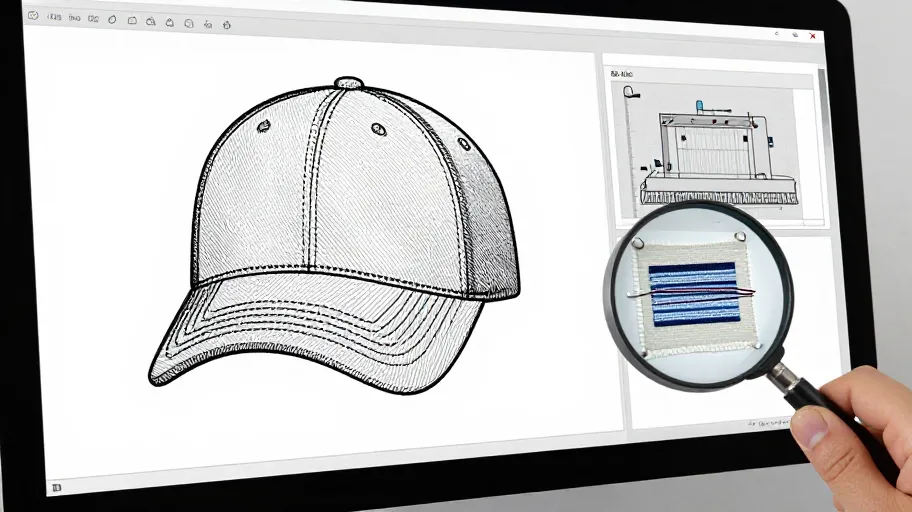
Embroidery digitising hats is the process of converting your logo file into a machine-readable stitch pattern, and on caps it deserves far more scrutiny than on flat garments because curved panels, seams and structured crowns change how every stitch behaves. This article walks you through a Four-Checkpoint Logo-to-Stitch Framework — File, Digitise, Sample, Approve — so you can compare suppliers on evidence rather than promises.
Why hats are harder to digitise than flat items
A flat embroidered patch or chest logo sits on stable, two-dimensional fabric. A cap does not. Your logo has to wrap around a curved front panel, sit close to a seam, or work within the limited height of a low-profile crown. Small text that reads cleanly on a T-shirt can blur into a solid mass on a six-panel cap. Letter spacing tightens as stitches follow the curve. Thin outlines can disappear entirely.
This is why experienced digitisers do not simply auto-convert artwork. They re-draw the design stitch by stitch, choosing stitch direction, density, underlay and pull compensation for that specific cap construction. When you compare suppliers of embroidery digitizing hats, the useful question is not "can you digitise?" — almost any workshop can run software. The useful question is "who reviews the design against the actual cap construction, and how do I verify the result before bulk?"
The Four-Checkpoint Logo-to-Stitch Framework
Use these four checkpoints to structure your conversations with any supplier you are comparing.
| Checkpoint | What happens | What you should verify | Red flags to watch for |
|---|---|---|---|
| 1. File | You supply artwork in a usable format | Vector or high-resolution files accepted; thread-colour reference discussed | Supplier accepts a screenshot and quotes immediately with no questions |
| 2. Digitise | Artwork is converted into a stitch file for the specific cap style | Design adapted for curved panels; text size, density and stitch direction discussed with you | One generic stitch file reused across cap styles with no adjustment |
| 3. Sample | The digitised design is stitched on an actual sample cap | You receive or review a physical or photo sample on the correct cap construction | Approval requested based on a flat fabric swatch alone |
| 4. Approve | You sign off before bulk production | Written confirmation of the approved design, placement, size and thread colours | Verbal approval or approval "carried over" from a previous order |
A supplier who works through all four checkpoints with documented sign-off gives you something a quote cannot: a repeatable record you can reference on reorder.
Preparing your logo files: a practical checklist
Before you submit artwork to any supplier, prepare the following:
- Vector source file where possible (such as AI, EPS or PDF). If you only have a bitmap, send the highest-resolution version you hold.
- Pantone or colour reference for each colour in the design, so thread matching is a discussion rather than a guess.
- Minimum text size noted. Flag the smallest text element in your design and ask the supplier to confirm it will remain legible as embroidery on your chosen cap.
- Placement and size guidance, ideally on a cap template or a photo of a similar cap marked up.
- Background context: cap style (structured/structured, six-panel, five-panel, bucket, beanie) and fabric, since the same design may need different treatment on different constructions.
- A flat, unmodified original, not a pre-distorted mockup, so the digitiser can work from clean geometry.
Then ask each supplier you are comparing the same question: How will you adapt this design for the specific cap style I am ordering, and will I see the result on a sample before bulk? Comparing answers to one identical question is far more revealing than comparing quotes.
What to evaluate on a stitch sample
A stitch sample is your single best piece of evidence — but only if you know what to look for. When your sample arrives, work through these checks:
- Letter legibility. Read the smallest text from arm's length. If you must guess at a letter, a buyer's customer will too.
- Edge integrity. Look at outlines and borders. Clean, even edges indicate good density and underlay decisions; ragged or wandering edges indicate a rushed digitise.
- Panel distortion. Check whether the design sits flat and centred on the curved panel or has shifted, wrinkled or pulled the fabric.
- Colour accuracy. Compare stitched thread colours against your Pantone references under daylight, not just under factory lighting.
- Seam interaction. If the design crosses or approaches a seam, check how the stitching behaves at that junction.
- Reverse side. Where you can inspect it, the back of the embroidery tells you about backing and density choices that affect durability and feel.
Concrete approval questions to ask before you sign off:
- Is this sample stitched on the exact cap construction and fabric of my bulk order?
- What is the approved design size and placement, and is it documented in writing?
- Which thread colours were used, and how are they recorded for repeat orders?
- If I request changes after seeing the sample, how is the revised design version-controlled?
- What happens at bulk if a production run deviates from my approved sample — and what is your current policy on this? (Ask the supplier to state their current policy; do not assume it.)
Note that last question carefully. Sample fees, shipping arrangements, revision charges and defect remedies vary by supplier and change over time. Do not treat any assumption about these as settled. Ask each supplier to state their current policy in writing and keep that document with your approved sample record.
Comparing suppliers on digitising quality
When you evaluate two or three suppliers side by side on embroidery digitizing hats, resist the temptation to rank them by price alone. Instead, run the same small test through each:
- Submit the identical logo file and cap brief to each supplier.
- Ask each the same five approval questions above.
- Request a stitch sample from each on the same cap specification.
- Compare the samples on the six evaluation points, and file your notes.
This costs you some time upfront but converts an abstract quality claim into a documented, side-by-side comparison you can defend internally — and it builds the sample record you will need for reorders regardless of which supplier you choose.
One further comparison point: responsiveness during digitising. A supplier who asks clarifying questions about text size and panel curvature before quoting is demonstrating the review step you need. A supplier who returns a quote with no questions has, in effect, told you their process — believe them.
FAQ
Q: What file format should I send for cap embroidery digitising? Vector formats such as AI, EPS or PDF are easiest to work from, but a high-resolution bitmap can sometimes be acceptable — confirm with your supplier before submitting. Always include colour references and a note on the smallest text in the design.
Q: Can any logo be embroidered on a cap? Most designs can be adapted, but not all designs work equally well. Very small text, fine gradients and highly detailed artwork may need simplification for stitched results on curved panels. Ask the supplier to flag any elements they recommend adjusting, and review the adaptation on a sample.
Q: Should I approve a flat swatch instead of a stitched sample cap? A flat swatch shows thread colours and basic stitch quality but not how the design sits on a curved panel, near seams or within crown height limits. For caps, a sample stitched on the actual cap construction gives you far more reliable evidence. Confirm with your supplier what form their sample takes.
Q: How do I make sure reorders match my approved sample? Ask for written documentation of the approved design file, placement, size and thread colours, and request that this record be referenced on each repeat order. Keep your own copy of the approved sample photos and the sign-off confirmation.
Q: Who pays for samples and revisions, and what if bulk does not match the sample? These policies differ between suppliers and can change, so do not rely on assumptions or second-hand advice. Ask each supplier you are considering to state their current policy in writing before you approve production.
Submit your logo for project-specific review
If you are sourcing custom caps from China and want a project-specific assessment of your artwork, send your cap brief, reference image or logo to New Generation. We will review the design against your chosen cap construction, flag any elements that need adaptation for embroidery, and walk you through the file, digitise, sample and approve checkpoints for your specific project. No two logos behave the same way on a curved panel — a review based on your actual artwork is the only honest answer.
Or start lighter: copy this quick self-check before you contact any supplier —
- Vector or highest-resolution logo file located
- Pantone or colour references listed
- Smallest text element identified and measured
- Cap style and fabric specified
- Placement marked on a template or reference photo
- Five approval questions ready to send to each supplier
#cap manufacturers china, #headwear manufacturers china, #cap factory