

Why Your Holiday Hats Arrive Late (And What’s Really to Blame)
A mid-sized headwear brand lost $1.2 million when its holiday collection landed three weeks late—not from cotton shortages, but from invisible delays across disconnected systems. This is typical: B2B hat manufacturing lead times average 8–14 weeks, with a 30% swing in delivery dates, per a 2024 McKinsey & Co. apparel benchmark.
The real culprit? Siloed planning. When ERP systems tracking factory output don’t talk to CRM platforms managing client promises, changes cascade into chaos. A last-minute fabric swap or dye delay becomes a missed milestone because teams work from stale spreadsheets, not live data.
Customs bottlenecks at LAX and JFK make it worse—not due to volume, but because paperwork lags between suppliers, freight forwarders, and compliance officers. The fix isn’t faster ships—it’s connected data. Leading cap manufacturers now run on unified digital backbones where ERP-CRM sync enables instant rescheduling when disruptions hit. One supplier cut lead time variability by 65% just by eliminating manual handoffs between sales and production.
This means brands can commit to retailers with confidence, because their timelines are predictable. That predictability turns shaky supply chains into reliable delivery windows—exactly what big-box retailers demand today.
On-Demand Machines That Build Caps Like Legos
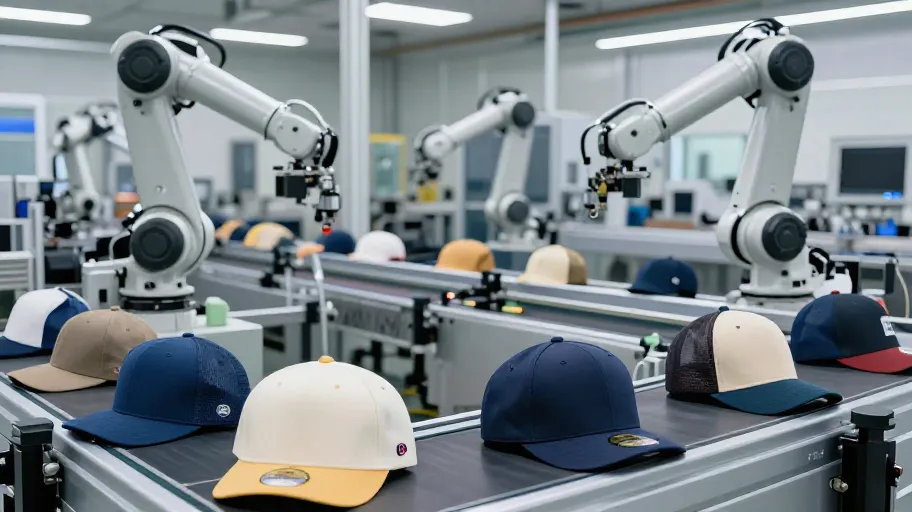
When a U.S. cap maker got a surprise order for 10,000 units with only three weeks to deliver, they didn’t panic. They fired up modular production cells—automated cut-and-sew lines that reconfigure fast—slashing setup time by 50% and delivering on schedule without overtime or air freight.
This agility comes from AI-driven forecasting and dynamic resource allocation. According to 2024 industrial automation surveys, 68% of top textile makers now use modular cells to switch between styles and volumes seamlessly. But the real win isn’t speed—it’s scaling without waste. On-demand systems now support hybrid models: bulk runs for forecasted demand, plus real-time spikes handled instantly.
Two technologies power this shift: just-in-time digital embroidery arrays and cloud-based order orchestration platforms. Programmable embroidery machines switch designs in seconds—no changeover downtime, zero minimums. Cloud platforms sync approvals, production status, and shipping across partners, creating one source of truth.
One retailer saw a 37% drop in fulfillment errors after adopting such a system. That means fewer returns, faster turnarounds, and stronger trust. For decision-makers, this translates to higher reorder rates. For executives, it’s a retention engine disguised as a production upgrade.
Why Dallas Just Became the New Port of Entry for Caps
A B2B hat supplier cut final-mile delivery from 7 days to just 2 by activating a micro-fulfillment node in Dallas-Fort Worth. That’s not just faster shipping—it triggered working capital gains, lower inventory costs, and better customer retention across their business.
Regional distribution math is powerful: every one-day reduction in transit improves forecast accuracy by up to 15%, per a 2024 McKinsey Supply Chain Practice analysis. Better forecasts mean less safety stock—cutting carrying costs by as much as 18% annually. But the bigger shift? Sustainability compliance.
Major retailers now score suppliers on Scope 3 emissions. Localized fulfillment cuts last-leg mileage by 60% on average, helping suppliers meet ESG targets without costly offsets. Nearshoring consolidation nodes—cross-dock facilities near I-35 and I-10—let suppliers scale coverage without long-term leases.
Pair these hubs with dynamic route optimization engines, which reroute shipments using live traffic and fuel prices, and you get SLA consistency even during holiday gridlock. One supplier achieved 98.6% on-time delivery in Q4 2025—without adding trucks.
Bottom line: regional fulfillment isn’t just about speed. It’s smarter, greener, and more agile. And as on-demand production takes hold, the final 500 miles will decide who wins in North American headwear.
What You Should Demand From Your Manufacturing Partner Now
The future of B2B hat manufacturing isn’t decided in factories abroad—it’s determined by how well digital production connects with intelligent North American logistics. Speed-to-shelf now depends on two things: real-time visibility across systems and proximity to market.
If your current partner can’t prove they’ve integrated ERP and CRM data to prevent scheduling gaps, you’re risking revenue. If they rely solely on ocean freight to West Coast ports, you’re adding weeks of uncertainty and carbon cost.
Ask them: Do you use modular production cells for rapid changeovers? Can you fulfill urgent orders without disrupting regular output? Are you partnered with regional fulfillment nodes east of the Rockies?
Because today’s competitive edge isn’t just cutting lead times by 40%. It’s turning unpredictable timelines into guaranteed delivery windows—so you can promise retailers what you’ll deliver, down to the week. Ready to stop guessing when your caps will land? Start measuring your partner’s digital and geographic readiness—now.
#cap manufacturers china, #headwear manufacturers china, #hat tech pack