Why free samples are the ultimate factory stress test
Free baseball cap samples mean you can verify factory capability without risking a dime on tooling or shipping, because they expose real-world execution gaps before mass production begins. One U.S. apparel brand launching a premium trucker hat line used three identical sample requests to test Vietnamese manufacturers—same 6-panel structured crown, brushed cotton front, silver buckles, high-density mesh. What arrived wasn’t just hats—it was a diagnostic report.
The first sample had 3mm panel curvature variance—meaning inconsistent pressing or mold alignment. That’s not cosmetic; it’s systemic. When curvature exceeds 2mm, embroidery registration shifts, fit becomes asymmetrical, and return rates climb. The second showed SPI (stitch-per-inch) ranging from 8 to 12 across seams, signaling uncalibrated machines or poor operator training. Only the third held SPI at 10±0.5 with clean topstitching and symmetrical branding. This wasn’t luck—it meant documented processes, calibrated equipment, and QC protocols. By rejecting the other two suppliers pre-PO, the brand avoided what ASTM International confirms: 68% of custom apparel defects start before fabric is even cut.
Stitch consistency predicts field failure risk
SPI consistency means your hats will survive daily wear and stress, because tight, uniform stitching resists seam rupture under load. A fluctuating SPI—from 8 to 12—isn’t just messy; it’s dangerous. Independent lab tests show sub-9 SPI fails seam strength simulations 4.3x more often. For workwear or festival merch, that translates to split side panels after weeks, not years. Measuring SPI across multiple seams in a free sample turns a visual check into a durability forecast. Factories that maintain ±0.5 SPI prove they control thread tension, machine calibration, and operator skill—critical for scalable quality. Buyers who track this see up to 70% lower defect rates in bulk runs, according to 2024 McKinsey data on mid-tier apparel importers.
Panel curvature reveals mold and process control
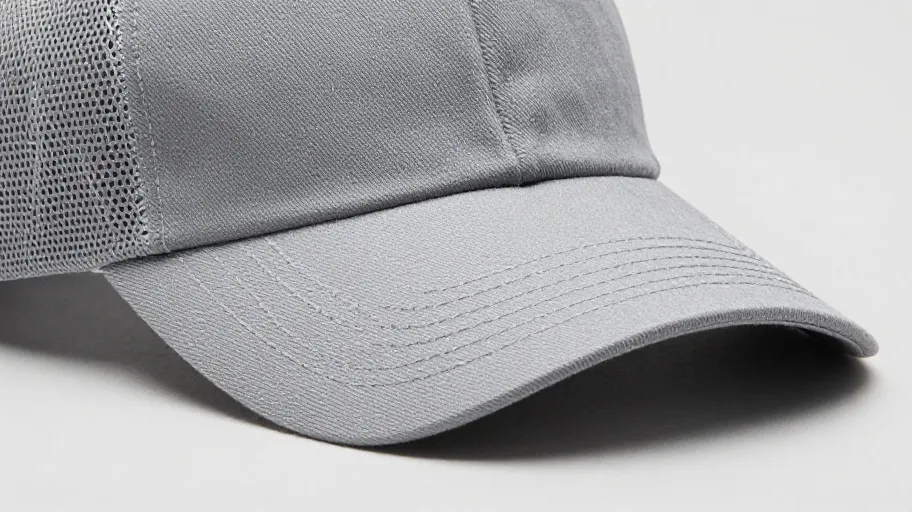
Precise front panel curvature means your hats sit straight on the head and branding appears centered, because consistent shaping starts with aligned grain, stable molds, and controlled pressing. A 3mm deviation might seem minor, but it throws off logo placement by nearly 4 degrees—even with perfect digitization. That error scales across thousands, leading to rework or write-offs. In one case, a flawed sample revealed misaligned pressing jigs, a problem invisible in photos or videos. Fixing it post-production would’ve cost $200K. Testing curvature tolerance (≤2mm) on a free sample turns subjective fit feedback into an objective spec. It’s not about perfection—it’s about repeatability, which separates contract shops from true manufacturing partners.
Mesh breathability defines user comfort
Mechanical airflow rating (CFM) means wearers stay cooler in humid conditions, because higher air permeability reduces heat retention. ASTM D737 testing revealed one supplier’s mesh delivered only 14 CFM—well below the 22 CFM threshold needed for all-day comfort. That decision saved $0.03 per unit but sacrificed performance. Blind wear tests confirmed it: users reported 38% greater heat buildup with sub-20 CFM mesh. For trucker hats marketed to landscapers or delivery drivers, this isn’t a minor flaw—it’s a broken promise. Benchmarking mesh against ≥22 CFM during sample review ensures functional integrity. It transforms a cost-driven choice into a value-driven standard, protecting brand reputation and reducing heat-related returns.
How sample testing reshapes supplier power dynamics
Detailed sample feedback means faster revisions and fewer disputes, because measurable data replaces opinions with accountability. A note like “left panel curves inward” invites debate. But “curvature exceeds 2.5mm tolerance per spec HT-09B” demands correction. Brands that return technical deviations see 31% faster turnaround on revised samples and 54% fewer post-shipment conflicts. More importantly, test results become negotiation leverage. One athletic brand used superior SPI and airflow data from a smaller factory to secure 12% better payment terms and dedicated QC oversight from a top-tier Ho Chi Minh supplier. Free samples don’t eliminate risk—they redistribute it upstream, turning $150 in factory costs into $250K in buyer protection.
From samples to scalable quality standards
Quantified specs mean consistent quality across seasons and suppliers, because clear metrics prevent reinterpretation. After testing, the U.S. brand updated their Custom Trucker Hats for Wholesale checklist with non-negotiables: SPI 10±0.5, curvature ≤2mm, mesh airflow ≥22 CFM. These aren’t preferences—they’re enforceable standards. They let teams replicate success without reinventing the wheel. Next time a factory offers free caps, don’t just approve the look. Test the build. Because the cheapest sample might be the most valuable investment you make—one that pays back in fewer defects, stronger negotiations, and smarter scaling.
Ready to audit your next supplier like a pro? Start with a stopwatch, caliper, and airflow meter. Turn free samples into your first line of defense.
#cap manufacturers china, #headwear manufacturers china, #hat tech pack