
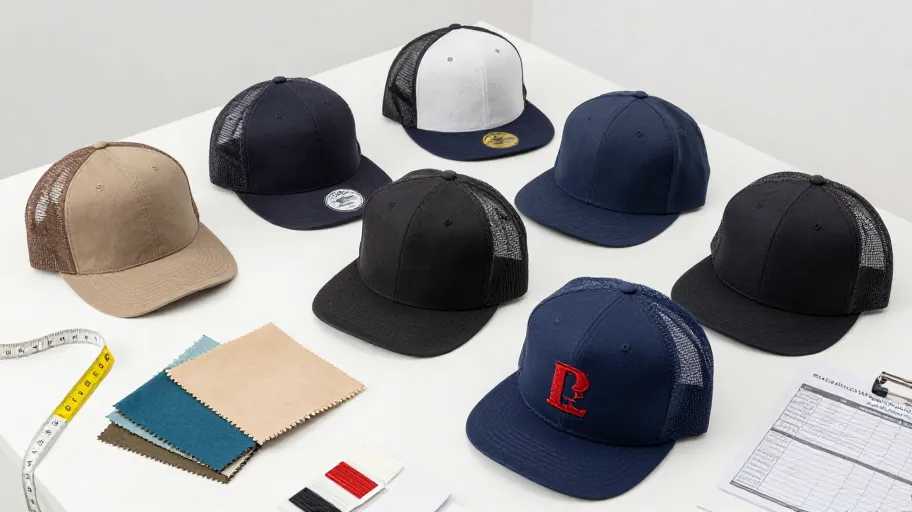
Evaluating baseball cap manufacturers in China for a wholesale private-label project means verifying three things before any deposit: capability (can they build your specific cap construction), accountability (who answers when something goes wrong), and process control (how quality is locked between sample approval and mass production). Compare at least three suppliers against identical written criteria, document every answer, and approve each stage — RFI, sampling, pre-production, and shipment — with evidence rather than promises.
This article gives you a working evaluation method, a comparison table you can copy, and the specific questions to ask at each gate. It deliberately does not assume any particular policy on minimums, pricing, sampling or lead times, because these vary by supplier and must be confirmed in writing for your project.
The CAP-Check framework
CAP-Check is a three-lens evaluation framework you can apply to every candidate manufacturer:
- C — Capability. Can this factory produce your specific product: your construction (structured/unstructured, closure type, panel count, stitching details), your materials, and your decoration methods (embroidery, printing, patches, laser)? Capability is project-specific. A factory that excels at simple promotional caps may not be the right partner for a fashion-grade private-label program — and the only way to know is to ask project-level questions and review evidence.
- A — Accountability. Who is contractually responsible for defects, delays and corrections? Is there a named English-speaking contact with decision authority? How are disputes documented and resolved? Accountability is about the paper trail, not the sales pitch.
- P — Process control. How does the supplier lock quality between the approved sample and bulk production? Ask about material inspection, in-line checks, and pre-shipment inspection rights. A supplier with a defined control process gives you something to hold them to; a supplier without one gives you only hope.
Decision table: comparing candidate manufacturers
Score each supplier 1–5 per row. Do not average — a low score on any single critical row should trigger follow-up questions, not cancellation justified by a high average.
| Evaluation criterion | What to request or ask | Supplier A | Supplier B | Supplier C |
|---|---|---|---|---|
| Construction capability for your spec | Written confirmation they can produce your exact construction and decoration method | |||
| Development support (OEM/ODM) | Samples, tech packs, pattern-making evidence for similar projects | |||
| Communication quality | Response clarity, single point of contact, decision authority | |||
| Quality control process | Documented inspection stages; right to third-party inspection | |||
| Compliance evidence | Current certificates/test reports applicable to your market — request and verify validity | |||
| Sample policy | Written confirmation of current sample terms, fees and timelines — confirm directly | |||
| Order terms | MOQ, pricing, tooling, payment and lead time for your project — confirm in writing | |||
| Traceability | Willingness to document materials, batches and corrections | |||
| References | Verifiable B2B references or audit reports they authorize you to check | |||
| Contract clarity | Defect responsibility, correction process, IP protection for your designs |
Approval questions by stage
RFI stage (before sampling):
- Can you confirm in writing that you can produce this exact construction, material and decoration method?
- What evidence — photos, prior project references with permission, audit reports — can you share?
- Which compliance documents applicable to my destination market can you provide, and are they current?
- What are your current sample terms, fees and timelines? (Confirm the policy directly; do not rely on assumptions.)
- Who is my point of contact, and can they make decisions on quality and scheduling?
Sampling stage:
- Can we approve a pre-production sample against a written tech pack with agreed construction points?
- If the bulk sample differs from the approved sample, what is the documented correction process?
- How are material specifications (fabric, sweatband, brim, closure) recorded so bulk matches the sample?
Pre-production stage:
- What inspection points exist before and during production, and can I appoint a third-party inspector?
- What is the agreed tolerance and correction route if an inspection finds deviations from the approved sample?
- Who holds responsibility for tooling (embroidery digitizing, molds, patterns), and who owns it after the order?
Pre-shipment stage:
- Can final inspection be completed and documented before balance payment and shipment?
- How are packing, labeling and hangtag requirements confirmed and checked?
- What is the agreed process for handling defects found at destination, and is it written into the contract?
Every one of these questions has a project-specific answer that only the supplier can confirm. Never accept a verbal answer for items that affect money, quality or legal exposure — request it in the quotation, proforma invoice or contract.
Red flags to document
- Refusal to put sample, MOQ, payment or correction terms in writing
- Vague answers on inspection rights or unwillingness to allow third-party inspection
- Compliance claims with no document, or documents that cannot be independently verified
- No named contact accountable for quality decisions
None of these automatically disqualifies a supplier, but each one shifts risk onto you. Document what was asked, what was answered, and what was evidenced — that record becomes your negotiating leverage and your protection.
FAQ
1. How many baseball cap manufacturers should I compare for a wholesale private-label project? Comparing at least three suppliers against identical written criteria gives you a defensible benchmark and negotiating context. More candidates increase evaluation cost; the right number depends on your order value and risk tolerance.
2. Should I choose an OEM or ODM manufacturer for private-label caps? OEM means you supply the design and the factory executes it; ODM means you adapt an existing factory design. OEM suits brands with distinct design requirements and tech packs; ODM can shorten development for simpler programs. Confirm which model each candidate actually supports for your specific product.
3. What documents should I verify before placing a deposit? At minimum: a written quotation covering your product spec, agreed sample approval, payment and delivery terms, correction/defect responsibility, IP protection for your designs, and any compliance documents applicable to your destination market. Verify validity directly with issuing bodies where possible.
4. Can I inspect the factory or appoint a third-party inspector? Ask directly. A supplier's willingness to allow on-site or third-party inspection at defined stages is one of the strongest accountability signals you can collect during evaluation. Confirm the timing, scope and cost responsibility of inspections in writing.
5. How do I protect my cap designs when sourcing from China? Use a written NNN agreement (non-disclosure, non-use, non-circumvention) reviewed by qualified counsel, register your IP in relevant jurisdictions, and document every design handover. Have legal counsel confirm the approach fits your situation — this article is sourcing guidance, not legal advice.
Evaluate every supplier with the same yardstick
The biggest evaluation mistake importers make is comparing suppliers on different criteria — one on price, one on samples, one on sales responsiveness. A private-label program lives or dies on consistency, so your evaluation process should be consistent too.
[下载 Supplier Scorecard] — download the Supplier Scorecard and score every candidate manufacturer against identical criteria, with evidence columns for what was requested, what was answered, and what was documented.
Prefer to start lighter? Use the 14 approval questions above as a first-pass checklist: send them to three candidates and compare the quality of their written responses before committing to sampling.
#cap manufacturers china, #headwear manufacturers china, #cap factory