


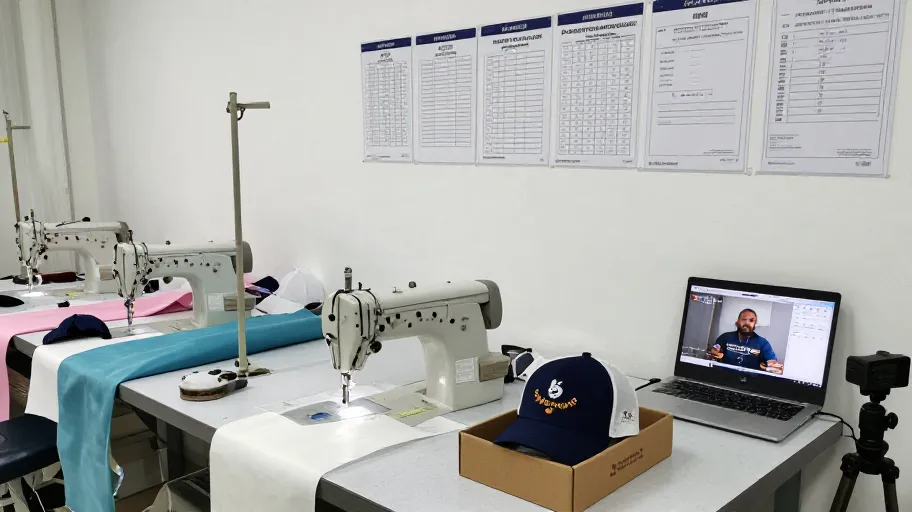
Evaluating a cap manufacturer in India for a private-label project means scoring each candidate against documented evidence rather than sales claims: verify production capability, examine physical samples, review compliance documentation, inspect processes through audits or video walkthroughs, test with a small pilot order, and contract every confirmed term in writing. Apply the same discipline to any supplier, in any country, before you commit budget.
Why buyers compare India and China for custom caps
If you are researching a cap manufacturer in India, you are doing what disciplined sourcing teams do: comparing options before committing. India has a substantial textile and apparel manufacturing base, and many overseas brands, importers and wholesalers evaluate Indian headwear producers alongside established OEM/ODM hubs in China, Bangladesh and Vietnam.
The mistake is comparing destinations on impressions. The productive comparison is supplier-by-supplier, evidence-by-evidence. A capable manufacturer in either country will answer detailed questions, provide documentation, and accept a structured approval process. A weak one, in either country, will deflect.
This article gives you a framework you can apply to any candidate — an Indian manufacturer you are screening, or a China-based OEM/ODM partner such as New Generation — so the comparison is documented and repeatable.
The VERIFIED framework for evaluating any cap manufacturer
V — Verify capability. Ask each manufacturer to describe the cap constructions they produce (structured, unstructured, five-panel, six-panel, trucker, snapback formats and so on) and the decoration methods they run in-house versus subcontracted. Ask which processes are on their own floor.
E — Examine samples. Request physical samples of work comparable to your programme before discussing bulk. Assess stitching consistency, crown shape, brim finish, closure function and embroidery or print registration with your own hands.
R — Review compliance documentation. Ask what certifications and test reports they currently hold, whether reports are current, and whether the testing laboratory is accredited. Do not accept "we can provide" — ask for the documents now.
I — Inspect processes. Visit in person, commission a third-party audit, or request a live video walkthrough of the cutting, embroidery, sewing, finishing and packing areas. Ask who performs in-line and final inspection, and against what written standard.
F — Ful a pilot order. Before a full private-label run, place a small production order at commercial terms. A pilot reveals how the manufacturer handles artwork files, colour matching, communication and correction cycles.
I — Insist on documentation. Confirm sample policy, pricing structure, minimum order quantity, lead time, payment terms, defect-resolution terms and IP protection in writing, per order, before any deposit.
E — Execute a contract. Convert confirmed terms into a signed agreement covering specifications, tolerances, packaging, labelling, shipping terms and remedies for non-conforming goods.
D — Document everything. Keep approved samples, counter-signed spec sheets, inspection reports and correspondence for every order. This is your reference for reorders and your evidence if a dispute arises.
Destination comparison: India vs. China as questions, not claims
Neither destination is universally better. Your programme decides. Use this decision table to structure your comparison — and remember, every cell should be answered by a specific supplier with documentation, not by general country impressions.
| Evaluation dimension | Questions to ask a cap manufacturer in India | Questions to ask a China-based OEM/ODM partner |
|---|---|---|
| Product fit | Which cap constructions and decoration methods do you run in-house? | Same question — plus which private-label services (design support, labeling, packaging) are offered directly |
| Consistency | How do you ensure bulk matches approved samples? Ask for the written procedure. | Same question — request the procedure and a recent inspection report structure |
| Compliance | Which current certifications and test reports can you share today? | Same question — verify currency and accreditation of the issuing body |
| Communication | Who is my named contact, in what time zone, responding within what window? | Same question — confirm language capability for spec documents |
| Logistics | What shipping terms and routing options do you support to my destination market? | Same question — compare transit routes and consolidation options for your market |
| Pilot flexibility | Will you accept a small first order at commercial terms? What is your minimum? | Same question — confirm the actual minimum and pilot terms directly |
| IP protection | How are my designs, tech packs and brand assets protected contractually? | Same question — confirm NDA terms and design-ownership language |
| Reorder reliability | How do you preserve spec continuity across repeat orders? | Same question — ask about retained approved samples and archived tech packs |
Score each answer. A supplier that cannot or will not answer with specifics, in either country, is telling you something.
Concrete approval questions to send before any deposit
- What is your minimum order quantity for this specific construction and decoration method?
- Please share the certifications and test reports you currently hold, with issue and expiry dates.
- Can you accept a live video walkthrough of the production floor at a scheduled time?
- What is your in-house quality inspection procedure, and against what written standard is final inspection performed?
- What are your payment terms for a first order, and what terms apply if goods fail final inspection?
- How is my artwork and brand IP protected during sampling and production?
- Who owns the approved samples and tech pack after production, and how are they stored for reorders?
A supplier that answers these questions in writing, promptly, is demonstrating how it will behave during production. One that answers vaguely is also demonstrating something.
Supplier evaluation checklist
Use this checklist for every candidate, in every country:
- Physical samples inspected against your spec sheet
- Cap construction and decoration methods confirmed as in-house or subcontracted
- Current certifications and test reports received and dated
- Audit, factory visit or live video walkthrough completed
- Sample policy confirmed in writing, including costs and shipping arrangements
- MOQ, pricing, payment terms and lead time quoted in writing for your programme
- Quality inspection procedure and written standard reviewed
- IP and confidentiality terms agreed in writing
- Pilot order placed and evaluated before bulk commitment
- Signed contract covering specifications, remedies and reorders
FAQ
Is a cap manufacturer in India a good option for private-label programmes? It depends on the individual supplier, not the country. Apply the VERIFIED framework: verify capability, examine samples, review compliance documentation, inspect processes, and run a documented pilot. Strong and weak manufacturers exist in every sourcing destination, and the disciplined evaluation process — not geography — determines your outcome.
How do I compare an Indian manufacturer with a China-based OEM/ODM supplier? Use the same question set and scorecard for both. Compare in-house capability, documented compliance, communication responsiveness, pilot-order terms, IP protection and reorder reliability. Score each answer with evidence attached so the comparison is repeatable and defensible internally.
What should I check before placing a first order with any cap manufacturer? Confirm the sample policy, MOQ, payment terms and quality inspection procedure in writing; verify current certifications; complete an audit or live walkthrough; and place a small pilot order before bulk. Never move from sample approval to bulk production without a signed specification.
How many samples should I approve before bulk production? Approve at least one pre-production sample that matches your final spec, decoration and packaging, and retain a counter-signed reference sample. Ask each supplier how the approved sample is used as the bulk-production standard and how deviations are handled.
Do I need to visit the factory in person? A visit is valuable but not the only route. A third-party audit or a scheduled live video walkthrough of cutting, decoration, sewing and packing areas can serve the same purpose when documented. What matters is that you inspect the actual processes, by some verified means, before committing.
Evaluate every supplier with the same scorecard
The buyers who succeed at private-label headwear sourcing are not the ones who pick the right country. They are the ones who document every claim, test every assumption and compare every supplier against the same criteria.
[下载 Supplier Scorecard] — get the reusable evaluation scorecard and run your India–China comparison on documented evidence, not impressions.
Prefer to start smaller? Reply with your cap construction and decoration requirements and we will send back a pre-sourcing checklist of the exact documents and answers to request from every manufacturer on your shortlist — India, China or anywhere else.
New Generation is a Shenzhen-based OEM/ODM manufacturer of custom caps and headwear, ready to answer every question in this article with documentation for your evaluation.
#cap manufacturers china, #headwear manufacturers china, #cap factory








