
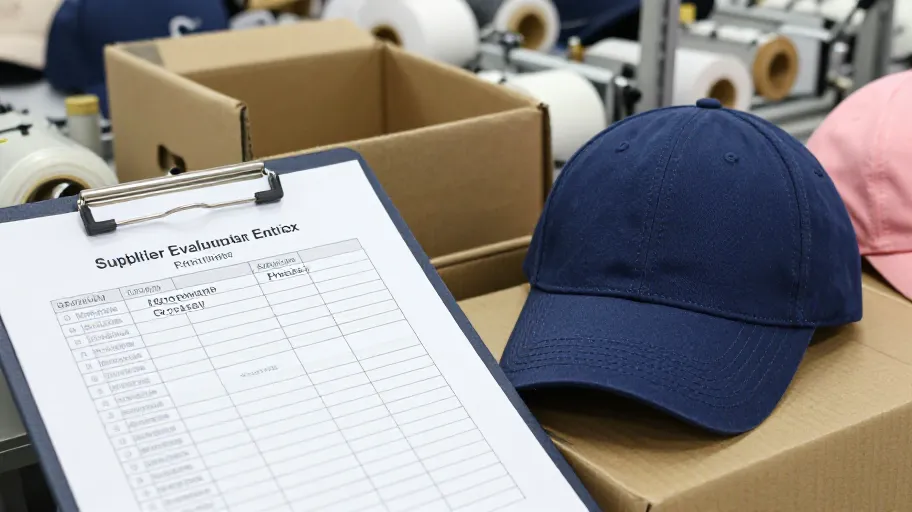
Evaluating cap manufacturers in China for a wholesale private-label project means verifying capability with evidence, documenting agreements in writing, and approving each production checkpoint yourself. Use a structured framework — Capability, Agreement, Process — to compare suppliers on facts you can confirm, not claims you must trust.
The CAP-Verify Framework
Remote sourcing fails when decisions rest on impressions. The CAP-Verify Framework gives you three lenses, each with questions the supplier must answer with documentation:
C — Capability. Can this manufacturer actually produce your product to your specification? Evidence includes machine lists, prior production of comparable constructions (e.g., structured six-panel, unstructured dad caps, five-panels, snapbacks, bucket hats), embroidery and printing capabilities, and a physical sample against your tech pack.
A — Agreement. Are the commercial and legal terms documented before any deposit? This covers MOQ, unit pricing by quantity tier, sample policy, payment structure, IP and design ownership, labeling and packaging requirements, and the remedy path if goods fail inspection.
P — Process. Who controls quality, and at which checkpoints? Confirm pre-production samples, inline inspection points, final random inspection, packaging and shipping documentation, and how the supplier handles defects discovered before or after shipment.
None of these can be assessed from a website. Every claim must be converted into a document, a sample, or a written answer.
Decision table: comparing supplier candidates
Score each candidate 1–5 per row. Weight rows according to your project's risk profile — an importer running a year-round program should weight agreement terms more heavily than a buyer testing one promotional run.
| Dimension | What to request | What counts as evidence | Red flag |
|---|---|---|---|
| Product capability | Samples of comparable constructions; tech-pack review response | Physical samples matching your spec sheet | Refusal to work from a tech pack; no samples of your construction type |
| Customization range | Embroidery, printing, patch, woven label, closure and fit options | Sample card or swatch book of decoration methods | Single decoration method presented as the only option without explanation |
| Sample policy | Current written policy on samples: availability, terms, costs, timing | A clear written statement you can reference later | Vague or shifting answers about sample terms |
| Commercial terms | MOQ, tiered pricing, payment structure, tooling/setup charges | Formal quotation valid for a stated period | Verbal pricing only; quotes that change without quantity logic |
| Quality control | Inspection stages, AQL preference, defect-remedy procedure | Written QC process; acceptance of third-party inspection | Resistance to third-party inspection |
| Communication | Named contact, response discipline, revision workflow | Response times and revision records during enquiry | Unnamed shared inbox with no accountable contact |
| IP and agreement | Design ownership, NDA willingness, brand-marking rules | Signed NDA and draft agreement before deposit | Hesitancy to put IP terms in writing |
| Logistics readiness | Incoterms offered, packaging specs, export documentation | Written answers specific to your destination market | Single shipping mode insisted on without rationale |
Approval questions by stage
Use these as gates. Do not move to the next stage until each gate is documented.
Enquiry stage
- What is your current MOQ for this construction, and how does pricing step with quantity?
- What is your current sample policy — availability, cost, and timing? Please send it in writing.
- Have you produced this construction and decoration combination before? May I see a sample?
- Who will be my named contact through the project?
Sampling stage
- Does this sample reflect production materials, or prototype-only substitutions? Which parts differ?
- What is the tolerance you will commit to in writing for panel alignment, stitching density, and closure fit?
- How many revision rounds does the sample phase include, and what triggers a new round?
Agreement stage
- Who owns the design, the pattern, and the digitized embroidery file once paid for?
- What remedy applies if final goods fail an agreed inspection standard — rework, replacement, or refund? How is it documented?
- Which certifications or compliance documents can you provide for my destination market, current and verifiable?
- What are the payment milestones, and what triggers each one?
Pre-production and pre-shipment
- May I approve a pre-production sample before bulk cutting?
- What inline inspection points do you run, and can a third party attend?
- What is the agreed final inspection standard and sampling level?
- How are goods packed, cartoned, and labeled for export to my market?
Pitfalls to document, not fear
- Unpriced changes. Every revision should have a documented cost and schedule consequence before approval.
- Undocumented sample terms. Whatever the current sample policy is — cost, inclusions, shipping responsibility, timelines — get it in writing rather than assuming anything; confirm the current policy directly each time.
- Ambiguous inspection standards. Agree the standard and sampling level before production starts, not when goods are finished.
- Unassigned IP. If design ownership isn't in the agreement, treat it as unresolved.
- Unweighted comparison. Two quotations that aren't structured on the same line items can't be compared honestly. Normalize them into the decision table first.
FAQ
How many cap manufacturers should I shortlist before deciding? Three to five is a workable range: enough to compare meaningfully, few enough to run each through sampling and documentation without stalling. Score all candidates on the same decision table so the comparison stays honest.
Should I visit the factory in China before ordering? A visit is valuable but not the only verification path. A third-party inspection, a video walkthrough scheduled live, and documented responses to the approval questions above can substitute at the evaluation stage — decide based on order value and your risk tolerance.
What should a tech pack for custom caps include? Construction type, materials and colors with references, decoration artwork and placement measurements, closure and sweatband spec, labeling placement, packaging method, and your inspection criteria. The richer the tech pack, the fewer assumptions the supplier has to make.
How do I handle branding and labeling for a private-label run? Specify every brand touchpoint in writing: woven labels, hangtags, interior taping, packaging, and carton marking. Confirm who sources the labels, who verifies placement, and how incorrect labeling is remedied — before bulk production begins.
Is a lower MOQ always better for a first order? Not necessarily. A lower MOQ can mean a higher unit cost, different decoration options, or a different production line. Compare candidates on total landed terms — pricing tiers, setup charges, inspection and shipping — not on MOQ alone, and confirm current terms directly with each supplier.
Score your candidates the same way every time
Comparing cap manufacturers for a China wholesale private-label project becomes manageable when every candidate is scored on identical, evidence-based criteria. A structured scorecard keeps your team aligned and makes the final decision defensible.
下载 Supplier Scorecard — get the evaluation template and run every supplier conversation through the CAP-Verify Framework.
Prefer to start smaller? Use the approval-questions checklist above as your next enquiry email — copy the questions, send them to your shortlist, and compare the written answers side by side. No download needed to begin.
#cap manufacturers china, #headwear manufacturers china, #cap factory