


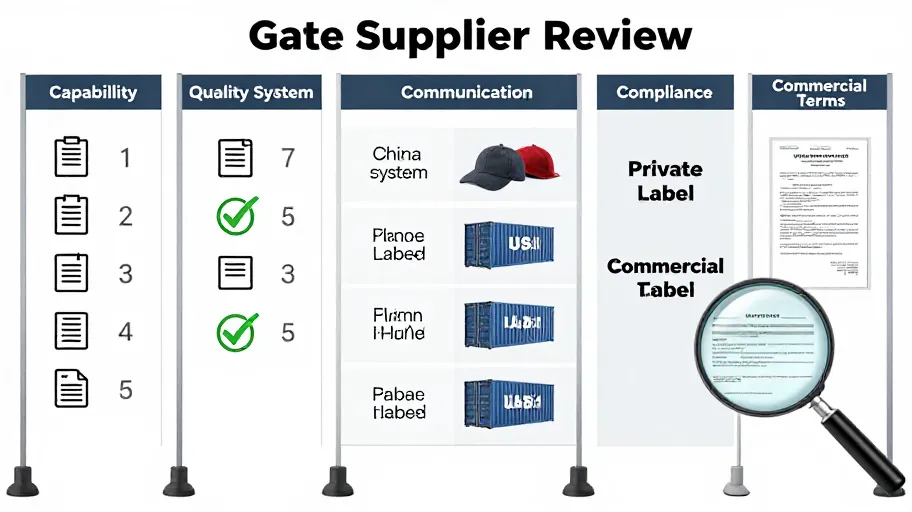
When overseas buyers search for China hat manufacturers for USA-bound private-label programs, the real job is not finding a factory — it is verifying one. Use the Five-Gate Supplier Review: Capability, Quality System, Communication, Compliance and Commercial Terms. Score each gate with documented evidence, compare shortlists side by side, and approve suppliers only after every gate clears. Confirm the current policy directly on any point a supplier cannot evidence in writing.
Why comparison needs a framework, not a feeling
Most sourcing teams evaluating Chinese headwear suppliers start with a long list from trade directories and end with a decision based on responsiveness and sample impressions. That approach collapses when volumes grow or specifications tighten. A private-label program involves construction methods, materials, labeling, packaging and repeat orders — each of which can drift if nothing was documented at selection time.
The alternative is a structured review. The Five-Gate Supplier Review forces every candidate through the same evidence-based questions, so a Shenzhen OEM/ODM specialist, a trading company and a multi-category factory can be compared on equal terms rather than on sales presentation quality.
The Five-Gate Supplier Review
Gate 1 — Capability. Does the manufacturer actually produce the categories you need — structured caps, unstructured caps, bucket hats, beanies, visors, performance headwear — with the decoration methods your brand requires, such as embroidery, patch application, printing or woven labels? Ask for category confirmation in writing and, where feasible, a live or video walkthrough of the relevant production area. Do not rely on catalog breadth: confirm which processes happen in-house and which are subcontracted, and how subcontracting is controlled.
Gate 2 — Quality System. Request the supplier's written inspection process: incoming material checks, in-process controls, and final inspection before shipment. Ask how defects are identified, recorded and corrected, and whether you can appoint a third-party inspector. Ask to see an example inspection report format — the format itself tells you whether quality is managed or improvised.
Gate 3 — Communication. Private-label programs fail on ambiguity. Evaluate whether the supplier can hold specifications steady in writing: tech packs, material codes, color standards, measurement points and labeling requirements. Note response quality, not just speed — a supplier who asks precise questions about your spec sheet is easier to work with than one who agrees instantly to everything.
Gate 4 — Compliance. For USA-bound goods, request the documentation relevant to your category and channel: labeling requirements, material declarations, and any testing or certification you intend to require. Do not assume any supplier holds a given credential; ask which documents they can provide now, which require your instruction, and which they cannot support. Record answers verbatim in your scorecard.
Gate 5 — Commercial Terms. Minimum order quantity, unit pricing, sampling, tooling, payment structure, lead time and logistics all sit here. These are project-specific and supplier-specific: state your program requirements, request written quotations against them, and confirm the current policy directly for sampling, payment and delivery terms before any commitment. Never accept verbal figures.
Decision table: scoring suppliers gate by gate
| Gate | Evidence to request | Pass signal | Fail signal | Your score (1–5) |
|---|---|---|---|---|
| Capability | Category and process confirmation in writing; in-house vs subcontracted steps | Clear, specific, matches your product range | Vague claims, category confusion, hidden subcontracting | ___ |
| Quality System | Inspection procedure document; sample report format; third-party inspection allowance | Documented process at defined checkpoints | "We check quality" with no records | ___ |
| Communication | Tech-pack handling; spec questions; English-language documentation | Precise, written, asks clarifying questions | Agrees to everything without questions | ___ |
| Compliance | Labels, declarations, testing scope available on request | Lists documents they can and cannot provide | Promises everything, provides nothing | ___ |
| Commercial Terms | Written quotation against your stated program requirements | Itemized, complete, consistent | Pressure to decide before terms are documented | ___ |
Score at least three suppliers. A single supplier scored alone tends to pass because there is nothing to compare against.
Concrete approval questions before any commitment
- Which production steps for this product are in-house, and which are subcontracted? How is subcontracted work controlled?
- Can you describe your inspection checkpoints from incoming materials to final shipment, and share your report format?
- Who is my designated contact for technical questions, and how are spec changes recorded and approved?
- Which compliance documents can you provide for my category and destination market, and which cannot you support?
- What are the terms for sampling, revision rounds, payment milestones and delivery scheduling for this program? Confirm the current policy directly.
- Can I appoint a third-party inspection party, and at which stage?
Any answer that arrives as an assurance rather than as a document should be treated as unverified until written confirmation exists.
Red flags worth documenting
- Quotations without itemization, or terms that change between conversations
- Refusal to allow third-party inspection
- Inability to state which processes are subcontracted
- Spec changes acknowledged verbally but never reflected in updated documentation
- A push to skip sampling or move to bulk before a documented approval
Each red flag belongs in your scorecard, dated, so the final decision rests on a record rather than memory.
FAQ
How many China hat manufacturers should I shortlist for a USA private-label project? Score at least three candidates through all five gates. A shortlist of one gives you no comparison baseline, and a shortlist of ten dilutes attention before you have real evidence.
Should I work with an OEM/ODM factory or a trading company? Both can succeed; the difference is control. Ask directly who controls production, quality checks and documentation. If a trading partner coordinates factories, ask how specifications and inspections are enforced, and record the answer.
Can I judge a supplier from samples alone? No. Samples show what a supplier can produce at their best; a program needs evidence of how they produce at volume. Pair sampling with the quality-system and communication gates.
What documents should I request for USA-bound headwear? Request labeling documentation, material declarations and the testing scope relevant to your category and channel. Ask each supplier which documents they can provide now — do not assume any supplier's status.
How do I handle terms I cannot verify remotely? Convert every unverifiable term into a written question, request a documented answer, and make approval conditional on it. Where a policy is unclear, confirm the current policy directly before proceeding.
Get the evaluation tool
下载 Supplier Scorecard — download the Supplier Scorecard and run every candidate through the Five-Gate Review with side-by-side scoring, evidence fields and a red-flag log, so your final supplier choice is documented and defensible.
Low-friction checklist: Before your next supplier call, copy the approval questions above into a one-page pre-RFX checklist and confirm you have written answers for Capability, Quality System, Communication, Compliance and Commercial Terms. Five gates, one page, no assumptions.
#cap manufacturers china, #headwear manufacturers china, #cap factory








