
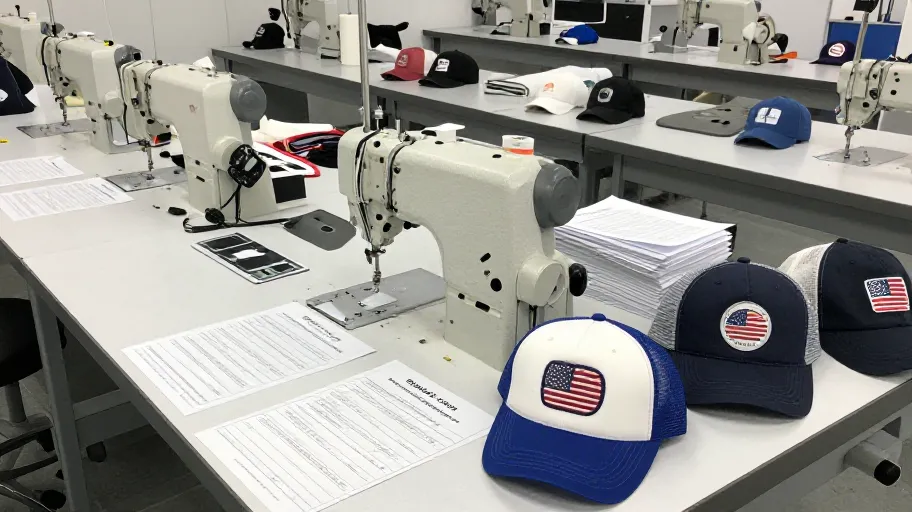
Searching for a "hat manufacturer in usa" means you are weighing domestic production against overseas OEM/ODM options — and the right answer depends on verifiable facts, not slogans. Evaluate every candidate, wherever they are located, against the same documented criteria: capability, samples, compliance, process control and written terms. A disciplined comparison beats a geographic shortcut.
Why geography is the wrong first filter
Buyers searching for a US-based hat manufacturer are chasing legitimate goals: shorter communication loops, domestic accountability, "Made in USA" labelling considerations. Those are valid. But choosing by country first, and evaluating second, inverts the decision. A manufacturer in Shenzhen and one in Texas can both be excellent or both be unsuitable — and you cannot tell which from their website.
What separates a workable private-label partnership from a costly one is whether the supplier can pass a structured evaluation. That evaluation should be identical for every candidate, regardless of location, so your final comparison rests on documented evidence rather than marketing language. As a Shenzhen-based OEM/ODM custom cap and headwear manufacturer serving overseas brands, importers and wholesalers, we encourage buyers to hold us to exactly the same standard they would apply to any other factory — that is the only comparison worth making.
The VERIFY Framework for supplier evaluation
Use the VERIFY Framework to structure your assessment of any hat manufacturer, US-based or otherwise:
- V — Verify capability. Confirm the manufacturer can actually produce your product category (structured caps, bucket hats, beanies, performance headwear) with your construction details: crown types, closure systems, sweatband materials, decoration methods (embroidery, patches, printing, laser appliqué). Ask for evidence of comparable work, not just a product catalogue.
- E — Evaluate samples. Request physical samples of relevant construction and decoration work, then evaluate them against a written spec sheet — your own, not the supplier's. Document stitch density expectations, panel alignment, decoration durability, lining and sweatband finishing in writing before you approve anything.
- R — Review compliance. Ask what compliance documentation the supplier can provide for your target markets, and what they cannot. Confirm labelling requirements for your intended country-of-origin claims with your own compliance adviser — do not accept a supplier's verbal assurance on regulatory matters.
- I — Inspect process. Understand how the factory controls quality during production: in-line checks, final inspection procedures, AQL criteria (yours, proposed by you), and how defects are documented and corrected. Decide whether you will use a third-party inspection service and state it in your terms.
- F — Flags and the Y/N decision. Score each candidate on identical criteria and record red flags: vague answers, refusal to put terms in writing, inability to name a single accountable contact, or pressure to skip sampling. A pattern of soft answers is data.
- Y — Yield terms. Only after capability, samples, compliance and process are documented should you negotiate commercial terms: pricing structure, tooling or setup arrangements, payment milestones, IP ownership of your designs, and rework responsibility.
Decision table: comparing candidates on verifiable dimensions
Score each supplier on each row using your own evidence-gathering. The table deliberately contains questions, not answers — because claims you have not verified are worth zero in a comparison.
| Dimension | What to document for a US manufacturer | What to document for a China OEM/ODM manufacturer | Evidence to demand from both |
|---|---|---|---|
| Product capability | Categories, constructions and decoration methods they produce in-house vs subcontract | Same distinction — which processes happen in their own facility vs externally | Named production sites, equipment list, comparable product references you may contact |
| Sampling | Sample policy, what it covers, current costs and turnaround — confirm directly | Same questions, plus how revisions are handled and who approves final samples | Written sample agreement and approved counter-sample signed by both sides |
| Quality control | In-line and final inspection procedures, defect handling | Same, plus whether third-party inspection is accepted | Inspection criteria you define, in writing |
| Compliance | Documentation available for your market and labelling rules | Same, plus country-of-origin labelling accuracy | Copies of current documentation for review with your adviser |
| Communication | Single accountable contact, response expectations, spec-sheet discipline | Same, plus language clarity on technical terms and timezone protocol | Written communication trail from day one |
| Commercial terms | Pricing structure, payment milestones, tooling ownership, IP terms | Same, plus Incoterms and shipping responsibilities you define | Signed quotation and contract before any deposit |
| Scalability | Ability to flex volume across reorder cycles — confirm current capacity | Same question, evidenced by production plan rather than promise | Production schedule commitment in writing |
Approval questions to send every candidate manufacturer
Send this set to each supplier, in the US or in China, and compare the quality of the answers — not just the answers themselves:
- Which of our specified construction and decoration methods do you produce in-house, and which do you subcontract?
- What quality-control checkpoints exist during production, and how are defects recorded and corrected?
- What compliance documentation can you currently provide for our target markets?
- Who is the single accountable contact for our project, and what is the agreed communication and approval workflow?
- How do you handle design IP for private-label clients, and who owns tooling, patterns and digitised embroidery files?
- What are your payment milestones, and what remedies apply if the approved counter-sample is not matched in bulk?
- Do you accept third-party inspection to criteria we define?
- What are your current MOQ, pricing structure and production schedule? (These are project-specific — request a written quotation.)
- How do you manage reorders so consistency is maintained against the approved sample?
Suppliers who answer precisely, in writing, and without pressure are demonstrating how the entire relationship will run. Suppliers who deflect are answering your question too.
Stage-gate checklist for a private-label headwear project
Work through this checklist in order. Do not move to the next gate until the previous one is documented:
- Shortlist 2–3 candidate manufacturers and apply the VERIFY Framework to each
- Send the ten approval questions and compare written responses
- Create a detailed spec sheet: materials, construction, decoration, finishing, packaging
- Request and physically evaluate samples against the spec sheet
- Approve and sign a counter-sample held by both parties
- Define your AQL/inspection criteria and decide on third-party inspection
- Confirm all commercial terms in a signed quotation and contract
- Agree the approval workflow for bulk production sign-off
- Document reorder references so future production matches the approved sample
FAQ
Is a US hat manufacturer better than a China-based OEM/ODM manufacturer? Neither is inherently better. What matters is verifiable capability, documented quality control, compliance readiness and clear terms. A structured evaluation — the same one for every candidate — will surface the better fit for your specific project.
What should I ask a hat manufacturer before placing a private-label order? Ask about in-house versus subcontracted processes, sampling policy, quality checkpoints, compliance documentation, IP ownership of your designs, payment milestones and inspection acceptance. Compare written answers across candidates.
How do I verify a manufacturer's quality without visiting the factory? Use physical samples evaluated against your own spec sheet, define your inspection criteria, engage a third-party inspection service, and require written quality procedures. A factory's willingness to accept these controls is itself evidence.
What documents should I require before approving a supplier? A signed sample approval, a detailed spec sheet, a written quotation, a contract covering terms and IP, and any compliance documentation relevant to your market — all confirmed directly with the supplier as current.
How do I keep quality consistent across reorders? Keep a signed counter-sample with the manufacturer, maintain documented spec sheets, restate inspection criteria on every order, and verify each shipment against the approved reference before it ships.
Run your comparison with the right tool
Comparing a US manufacturer with a China-based OEM/ODM partner is only as good as your evaluation discipline. [下载 Supplier Scorecard] and score every candidate — including us — on identical, verifiable criteria before you commit.
Not ready to score suppliers yet? Start with the ten approval questions above: copy them, send them, and compare the written answers. That single step filters more risk than any brochure.
#cap manufacturers china, #headwear manufacturers china, #cap factory