


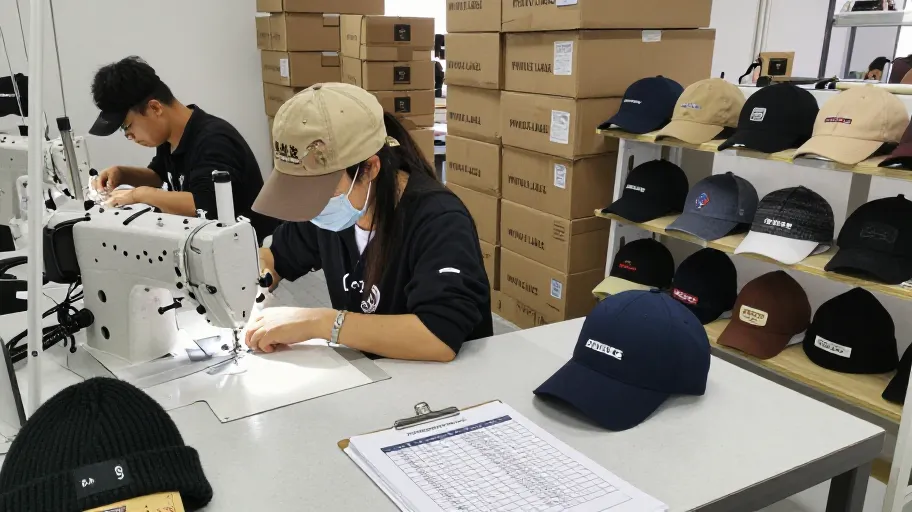
Evaluating headwear manufacturers in China for a wholesale private-label project means verifying four things in order: who you are dealing with, what they can actually produce, how they prove quality, and what terms they will put in writing. Use a structured framework — we recommend PAVE — and score every candidate supplier against identical criteria so your comparison rests on documented answers, not marketing claims.
The PAVE framework
P — Provenance. Confirm the legal entity behind the website. Is it a registered manufacturer, a trading company, or both? Ask for the business licence, the factory address, and who holds final responsibility for production decisions. A trading intermediary can be a valid partner, but you should know which model you are engaging, because it affects communication, pricing transparency and accountability.
A — Artistry and capability. Capability in headwear is specific: panel construction, crown shapes, closure types, embroidery density, flat embroidery vs. 3D puff, printing methods, woven labels, private-label trims and packaging. Ask each candidate what they produce in-house versus subcontract, and request photos or videos of the actual processes relevant to your product.
V — Verification. Quality claims need evidence you can inspect. Ask how the supplier controls incoming materials, in-process production and final inspection; who signs off on defects; and how rework is handled. If certifications matter to your market, ask which ones they hold, request document numbers, and verify them against the issuing body rather than accepting a PDF.
E — Engagement terms. Every commercial condition — MOQ, sampling policy and costs, payment structure, lead time, tooling ownership, IP and design rights — must be confirmed in writing for your specific project before you commit. Do not rely on any figure or policy quoted to another buyer or published elsewhere; ask for your own written quotation.
Decision table: scoring candidate manufacturers
Score each candidate 0–3 on every row and compare totals. Keep the completed table in your sourcing file.
| Criterion | What to check | Score (0–3) | Evidence collected |
|---|---|---|---|
| Legal entity and factory address | Business licence, plant location, entity type confirmed | ||
| Production ownership | In-house vs. subcontracted processes for your product type | ||
| Construction capability | Panels, crowns, closures, trims demonstrated for your spec | ||
| Decoration capability | Embroidery/printing methods relevant to your artwork | ||
| Quality control process | Documented IQC, in-process and final inspection steps | ||
| Compliance documents | Certifications listed with verifiable document numbers | ||
| Sampling process | Current sample policy and cost confirmed in writing | ||
| Commercial terms | MOQ, payment, lead time quoted for your project | ||
| IP protection | Willingness to sign NNN/design ownership terms | ||
| Communication quality | Response speed, clarity, willingness to answer directly |
Capability questions to approve before shortlisting
- Which parts of my cap's construction and decoration would you handle in-house, and which would be subcontracted?
- Can you show photos or video of recent production for a construction similar to my spec?
- What artwork formats do you accept, and how do you confirm decoration placement before bulk production?
- Who inspects the goods before shipment, and can I appoint a third-party inspector?
- What is your current sampling policy — cost, shipping responsibility and timing — for a first sample of my design? Confirm this directly, as policies vary by project and change over time.
- How do you document and approve a pre-production sample before bulk runs?
Verification tactics beyond the website
A polished catalogue proves nothing about production. Cross-check each candidate's entity registration through official Chinese corporate registries, ask for a live video walkthrough of the workshop floor, and — where budget allows — commission a third-party factory audit. Request references from buyers in a comparable product category, and verify claimed certifications against issuing bodies rather than against the supplier's own brochure. Every claim you accept without verification becomes a risk you carry into production.
Commercial and IP questions to put in writing
- What MOQ applies to my specific construction and decoration mix?
- What deposit and payment structure do you require, and at which milestones?
- Who owns the patterns, digitised embroidery files and tooling after payment?
- Will you sign an NNN agreement (non-disclosure, non-use, non-circumvention) before receiving my designs?
- How are defects and rework handled contractually?
- What is the quoted lead time for the first order, and what is the penalty or remedy if it is missed?
Do not accept verbal answers on any of these. Policies on sampling fees, refunds and reorders vary by supplier and by project — confirm the current terms in your own written quotation and purchase agreement.
Frequently asked questions
How do I know if a headwear manufacturer in China is a factory or a trading company? Ask for the business licence and registered address, then cross-check against official corporate registries. Request a live video walkthrough of the production floor. A trading company may still be a good partner, but you should document which entity is responsible for production quality.
Should I visit the factory before placing a wholesale order? A visit is the strongest verification available, but where travel is impractical, a scheduled video walkthrough plus a third-party audit covers most of the same ground. Whatever method you choose, document what you saw and when.
What should I verify before approving a pre-production sample? Confirm construction, decoration placement, colour matching against your Pantone references, labelling and packaging against your specification sheet — then have that approved sample signed or photographed and referenced in the purchase order so bulk production is measured against it.
How many manufacturers should I compare before choosing? Shortlist enough candidates to make your scorecard meaningful — scoring three to five suppliers against identical criteria gives you leverage in negotiation and a fallback if your first choice fails verification.
Can I trust certifications displayed on a manufacturer's website? Treat them as claims until verified. Ask for certificate numbers and issuing bodies, then check them at the source. This applies equally to sustainability and compliance claims.
Score every candidate the same way
The single biggest evaluation mistake buyers make is comparing suppliers on different criteria — one judged on price, another on responsiveness, another on a good website. The Supplier Scorecard below gives you one documented standard for every candidate, from first inquiry to final approval.
[Download Supplier Scorecard]
Before you send your first inquiry: 5-point checklist
- Define your product spec: construction, materials, decoration, labelling, packaging
- Confirm your target market's compliance requirements
- Prepare your PAVE scorecard and question list
- Draft your NNN agreement for designs you will share
- Decide your verification method: video walkthrough, third-party audit or visit
[Download the Supplier Scorecard] — or start with the checklist above and document every answer a supplier gives you. Written answers are your protection.
#cap manufacturers china, #headwear manufacturers china, #cap factory








