


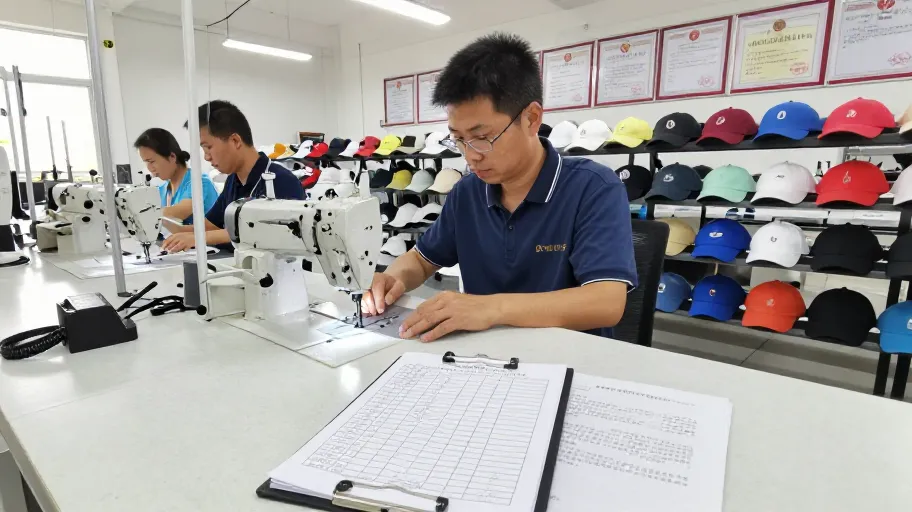
Shortlisting men cap manufacturers in China comes down to evidence, not claims: verify business registration, confirm whether you are dealing with the actual production site, request documentation of construction and finishing ability for your specific cap styles, and lock sample, MOQ, tooling, inspection and rework terms in writing before any deposit. Compare candidates side by side using a fixed scorecard so the decision survives internal review.
Why comparison fails without a framework
Most sourcing teams lose weeks because they evaluate manufacturers asynchronously: one email thread about samples, another about pricing, a chat log about logos. Nothing is comparable, and nothing is auditable. When a private-label project scales — more styles, more colourways, repeat seasons — the gaps in your early evaluation become the expensive problems.
The fix is to run every candidate through the same set of verification lenses before emotions, timelines or a persuasive salesperson narrow your options.
The CAP-VERIFY framework for evaluating cap manufacturers
CAP-VERIFY turns a vague "are they good?" into eight documented checks:
- C — Certificates and registration. Confirm the legal entity, business licence and any certifications relevant to your markets. Ask for documents you can verify independently, and ask which certifications apply to your specific product and destination market — requirements differ, and only the supplier can confirm current status.
- A — Ability for your product. A manufacturer's general capability tells you little. Ask directly: which of your cap constructions — six-panel structured, unstructured dad cap, trucker, snapback, bucket — have they produced for private-label buyers, and can they show verifiable references or physical examples you can inspect?
- P — Process transparency. Can the supplier walk you through cutting, embroidery or printing, panels, sweatbands, brims, closure attachment and final finishing? A supplier who cannot describe their own process in detail is a risk regardless of their catalogue.
- V — Verifiability of claims. Every claim in a sales deck should map to a document, a sample, or a reference you can contact. Anything that maps to nothing gets crossed off the scorecard.
- R — Roles and ownership. Confirm whether you are working with the factory, a trading company, or a hybrid OEM/ODM structure. Neither is inherently wrong, but you must know who controls production, who answers for defects, and who you escalate to.
- I — Inspection rights. Agree in writing on third-party or buyer inspection before shipment, what the inspection standard is, and what happens when goods fail it. A supplier resistant to inspection is answering your question for you.
- Y — Yield and corrective action. Ask how defects are handled: replacement, rework, credit, or dispute. Get the answer in the agreement, not in a WeChat message after the container ships.
Decision table: comparing shortlisted manufacturers
Score each candidate 0–3 per row (0 = no evidence, 3 = documented and verified). Weight rows to your project's risk profile.
| CAP-VERIFY lens | What to request | What "verified" looks like | Weight (adjust) |
|---|---|---|---|
| Certificates & registration | Business licence, relevant certificates for your markets | Documents checked by you or your agent | High |
| Ability for your styles | Construction-specific references or physical samples | Samples inspected in hand | High |
| Process transparency | Written or walkthrough process description | You can trace your product through every stage | Medium |
| Verifiability | Documentary evidence per claim | No unsupported claims remain on the sheet | High |
| Sample evidence | Pre-production sample with agreed specs | Approved golden sample signed by both sides | High |
| Roles & ownership | Clear statement of factory vs trading role | Named responsible party in the agreement | Medium |
| Inspection rights | Written inspection and AQL terms in the contract | Inspection clause you can enforce | High |
| Yield & corrective action | Defect handling and rework terms | Documented remedy path | Medium |
No supplier should be advanced on a row where the only evidence is a verbal assurance.
Approval questions to send before any commitment
Send these in writing and keep the answers attached to your project file:
- What are your current MOQ, sampling terms, tooling or setup charges, and production lead times for this exact specification? (Confirm current policy directly — terms are project-specific.)
- Are you the manufacturing factory, and if not, who is and who is contractually responsible for quality?
- Which certifications currently apply to this product for my destination market, and can I see the documents?
- Can you provide references or verifiable examples of this exact cap construction produced for private-label buyers?
- What are your inspection terms — can I appoint a third-party inspector before shipment, and what is the agreed standard?
- How are defects and reworks handled, and what is the documented remedy path?
- Who is my named contact for production approvals and escalations?
Any answer that arrives as "don't worry" rather than a document is a data point on your scorecard.
Pre-commitment checklist
- Business registration and relevant certificates verified
- Factory vs trading role confirmed in writing
- Construction-specific capability evidenced
- Golden sample approved and signed
- MOQ, tooling, sampling and lead-time terms confirmed in writing for this project
- Inspection rights and standard in the agreement
- Defect and rework remedy documented
- Named escalation contact recorded
FAQ
Should I choose a factory or a trading company for private-label caps? Both models exist in China's headwear supply base. What matters is clarity: know who physically makes your caps, who is contractually responsible for quality, and whether the margin structure still works for you. Verify rather than assume — ask directly and require the answer in the agreement.
How many manufacturers should I shortlist before deciding? Enough to create real comparison pressure — enough candidates to complete a full scorecard each — but few enough that you can send approval questions and evaluate samples properly. The scorecard, not the count, drives the decision.
What role does the pre-production sample play? It is your primary quality instrument and your reference standard for the production run. Inspect stitching, decoration, alignment, closure and labelling against your spec sheet, and approve it formally before production begins.
Can I rely on certifications shown on a supplier's website? Treat them as leads, not proof. Ask for current documents applicable to your product and destination market, and verify them independently where possible.
How do I evaluate a manufacturer I cannot visit in person? Combine document verification, a third-party inspection appointment clause, reference checks, and a disciplined sample approval. A supplier's willingness to accept all three is itself evidence.
Where New Generation fits
New Generation is a Shenzhen-based OEM/ODM manufacturer of custom caps and headwear serving overseas brands, importers and corporate buyers. We work through the same verification logic described above: you define the specification, we confirm current terms in writing, you approve the sample, and production proceeds against agreed inspection rights. Every project-specific detail — MOQ, sampling, lead times, certifications for your market — is confirmed directly with our team before you commit, because we would rather be verified than believed.
Download the Supplier Scorecard and run your next shortlist through CAP-VERIFY before you send a single enquiry — or start lighter with the pre-commitment checklist above and tick off the first three items this week.
#cap manufacturers china, #headwear manufacturers china, #cap factory








