

Search "who are some major cap manufacturers in china?" and you will find long lists of factory names — but a list does not answer the question a private-label buyer is really asking: which manufacturer can reliably deliver my product, at my volumes, to my specification, under terms I have verified? This article gives you an evaluation method — the SCORE Frame — plus a decision table, approval questions and a checklist so you can compare any group of Chinese cap suppliers on documented evidence rather than marketing claims.
Why "major" is the wrong first question
Scale is not capability. A factory with a large footprint may not take your order size, may not work with your construction method, or may not support the level of customisation your private-label range requires. Conversely, a mid-sized OEM/ODM specialist may be a strong fit because it matches your category, your materials and your development needs.
The better question is: which manufacturer's verified capability profile fits this specific project? That shifts your research from name collection to evidence collection.
The SCORE Frame: a five-part evaluation method
Use the SCORE Frame to structure your comparison of any candidate manufacturer, including manufacturers you identify through trade directories, exhibitions or referrals.
S — Scope alignment. Does the manufacturer's product scope match your category (structured/unstructured caps, snapbacks, bucket hats, beanies, performance headwear, and so on)? Ask what construction methods, closure types, decoration techniques (embroidery, printing, patches, laser appliqué) and materials they work with in-house versus subcontracted. Every subprocess that is subcontracted is a variable you must document.
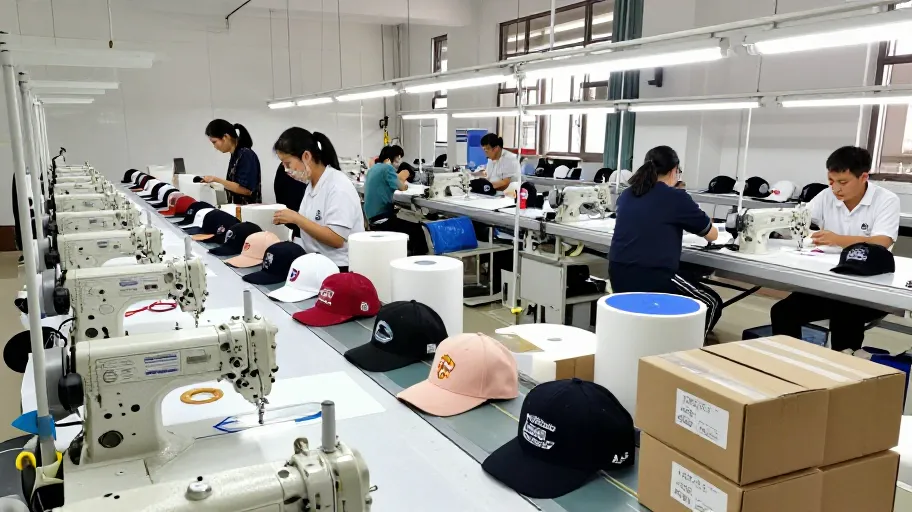
C — Capability evidence. Ask for verifiable evidence: business licence, export record references you can check, equipment lists, photos or video walkthroughs of the production floor, and third-party audit reports if any exist. Do not accept claims without documentation. Where a claim cannot be evidenced, record it as "unverified" in your comparison file.
O — Order terms. You must confirm directly, in writing, each supplier's current MOQ, unit pricing structure, sample policy, tooling or pattern charges, payment terms and production timeline for your specific product. Do not rely on published figures or third-party summaries — these change and apply differently per project. Treat any number you cannot get in a written quotation as unknown.
R — Reliability and communication. Test responsiveness before committing: send a detailed technical enquiry and measure whether the reply addresses your specification or deflects it. Ask who your project contact will be, how revisions are handled, and what the documented escalation path is when a production issue arises.
E — Evidence of quality systems. Ask how in-process inspection works, what inspection points exist, how defects are recorded, and whether you or your appointed third party can inspect before shipment. Ask for the current defect-handling and rework policy in writing. Confirm the current policy directly — do not assume terms.
Decision table: comparing candidate cap manufacturers
Score each supplier on each row using your own written evidence. The table is a comparison tool, not a ranking supplied by us.
| Evaluation dimension | What to request or verify | Score 1–5 | Notes / evidence reference |
|---|---|---|---|
| Category and construction fit | Confirmed product scope in writing; sample of comparable work | ||
| Customisation depth | In-house vs subcontracted decoration and materials; development support | ||
| Business verification | Business licence, export experience, audit reports where available | ||
| Quotation transparency | Itemised written quote: unit price, tooling, decoration, packaging | ||
| Sample process | Current sample policy and terms — confirm directly, in writing | ||
| MOQ and volume flexibility | Written MOQ for your exact SKU list — confirm directly | ||
| Lead time commitment | Written production schedule per order — confirm directly | ||
| Quality control | Inspection points, AQL or equivalent criteria if applied, records | ||
| IP protection | NDA willingness, pattern/tooling ownership terms in contract | ||
| Communication reliability | Response quality test; named project contact; escalation path |
Total the scores, but read the notes column first: a single unverified critical claim (for example, a certification no one can document) matters more than a five-point spread.
Verification steps before you commit
- Shortlist by scope, not size. Filter candidates by whether they build your category at all.
- Request documents. Licence, facility evidence, and any audit or compliance documentation the supplier currently holds. If a document does not exist, note that honestly — absence is information.
- Run a paid or complimentary development sample — terms to confirm. Whether sampling is charged, what it includes and how long it takes must be confirmed directly with each supplier, in writing, before you rely on it.
- Audit, in person or third party. An on-site or third-party inspection of the actual facility closes the gap between claimed and observed capability. Ask the supplier how audits are arranged and who bears the cost — confirm current policy directly.
- Contract the specifics. Put specification, tolerance expectations, inspection criteria, IP ownership and dispute handling into the purchase agreement. Anything verbal is unverified.
Approval questions to send every supplier
Copy these into your first technical enquiry. A supplier's willingness to answer precisely is itself a signal.
- Which construction methods and decoration techniques do you perform in-house, and which do you subcontract?
- Please provide an itemised written quotation for the attached specification, including all tooling, pattern and decoration charges.
- What is your current MOQ and sample policy for this product? Please confirm in writing.
- What does your in-process quality control cover, and what documentation will I receive per order?
- Can a third-party inspection be arranged before shipment, and how is that scheduled?
- Who owns the patterns, tooling and tech packs developed for my private-label range?
- What is your documented process if a delivered batch does not meet the approved specification?
- Which export markets do you have documented experience supplying, and what product-testing documentation, if any, can you currently provide for my destination market's requirements?
If answers are vague, deflective, or arrive without documentation, record the gap in your comparison file and weigh it in your decision.
Red flags worth pausing on
- Refusal to put commercial terms in writing.
- Claims of certifications or clients that cannot be evidenced.
- Reluctance to allow third-party or in-person inspection.
- No named project contact or escalation path.
- Pressure to skip development samples or pre-shipment inspection.
None of these proves bad faith on their own — but each is an unverified variable, and your job in a private-label project is to eliminate unverified variables before money moves.
FAQ
How do I find candidate manufacturers to evaluate in the first place? Combine channels: B2B directories, trade fairs, sourcing agents, embassy trade services and referrals from buyers in adjacent categories. Then apply the SCORE Frame to every candidate regardless of how you found them — the discovery channel does not verify capability.
Is a bigger factory better for a private-label brand? Not automatically. Fit depends on your volumes, category, customisation depth and development needs. A manufacturer whose verified scope matches your project will serve you better than a large one that does not. Confirm each supplier's current MOQ and capacity situation directly.
Should I work with a factory or a trading company? Both can be legitimate. What matters is transparency: know exactly which factory will build your product, and verify that factory's capability directly or through an audit. If an intermediary cannot or will not disclose the production site, treat that as an unverified variable.
How many suppliers should I compare before deciding? A workable shortlist is three to five candidates scored with the same decision table. Comparing fewer limits your options; comparing many more with shallow diligence creates false confidence.
What should be in the contract to protect my private-label designs? At minimum: confidentiality terms, explicit ownership of patterns, tooling, tech packs and artwork, restrictions on producing your designs for other buyers, and a documented process for specification disputes. Have counsel review before signing.
Put the comparison on paper
[下载 Supplier Scorecard] — a structured template covering every SCORE Frame dimension, the approval questions above and space to log written evidence for each candidate manufacturer, so your final supplier decision is documented, repeatable and defensible.
Not ready to download yet? Use this quick pre-qualification checklist first:
- Confirmed each candidate builds my category and construction method
- Received itemised written quotations for my specification
- MOQ, sample policy and timeline confirmed in writing per supplier
- Quality control and inspection process documented
- IP ownership terms reviewed by counsel
- Third-party or in-person audit arranged or scheduled
#cap manufacturers china, #headwear manufacturers china, #cap factory