


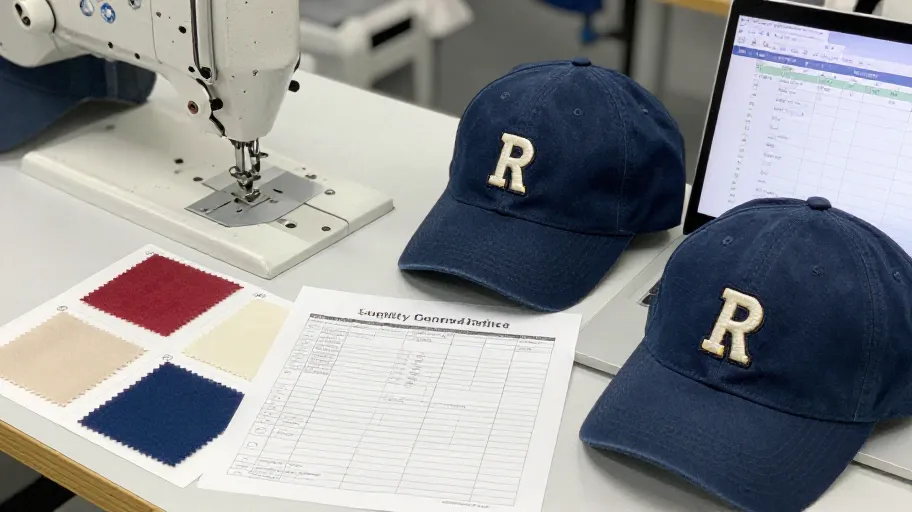
Evaluating wholesale hat manufacturers — whether USA-based or China-based OEM/ODM partners — comes down to four checks: verify Capability (equipment, construction methods, materials), Accountability (IP terms, quality responsibility), Process (sampling, QC, communication), and documentation of each answer. Compare every candidate on the same written criteria, then approve only what you have confirmed in writing.
Why the search itself needs a framework
Many buyers searching for wholesale hat manufacturers usa are not only comparing factories in one country. They are comparing sourcing models: a domestic wholesaler or decorator, a USA-located manufacturer, and an overseas OEM/ODM factory in a production hub such as Shenzhen. These three models quote differently, sample differently and take responsibility differently — which makes an apples-to-apples comparison difficult without a fixed set of questions.
The solution is not to guess which model is superior. It is to hold every candidate to the same evidence standard. That is what the CAP-Vet framework below is designed to do.
The CAP-Vet framework
C — Capability. Can the manufacturer actually produce your product category? Baseball caps, bucket hats, beanies, structured vs. unstructured crowns, embroidery vs. woven patches, private-label branding inside the sweatband and care label — each requires specific machinery and pattern expertise. Ask which construction methods they run in-house versus subcontract, and how they document both.
A — Accountability. Who is responsible when something goes wrong? Read the terms covering artwork ownership, NDA coverage, tooling ownership (embroidery digitizing files, custom trims, molds) and remedy for defective goods. If these terms are verbal only, treat the account as unmanaged risk.
P — Process. How does an order move from tech pack to shipment? Ask about sampling stages, pre-production approval, in-process inspection, final AQL-style inspection parameters (define your own acceptance criteria rather than accepting an unstated one), and how revisions are handled. A supplier who can narrate their own process clearly is easier to audit than one who answers with reassurance.
V — Verification. Nothing is approved until it is documented. Certifications, compliance declarations for your destination market, material test reports — request current documents issued by named bodies, and confirm their validity directly. A claim without a document is a conversation, not evidence.
Decision table: comparing sourcing options on identical criteria
Score each candidate 1–5 per row. Do not compare on price alone before rows 1–5 are scored.
| # | Evaluation criterion | USA-located manufacturer / wholesaler | China-based OEM/ODM (e.g., Shenzhen) | Evidence to request |
|---|---|---|---|---|
| 1 | Product-category capability | Confirm which constructions and branding methods are in-house | Confirm in-house vs. subcontracted processes | Equipment list, process walkthrough, sample references |
| 2 | Private-label services | Confirm label, packaging and branding support scope | Confirm full OEM/ODM scope: design support, tech pack, custom trims | Service scope sheet in writing |
| 3 | Sampling process | Ask stages, cost policy and approval gates | Ask the same; require pre-production sample sign-off | Written sampling procedure |
| 4 | IP and accountability | Review NDA and artwork ownership terms | Review the same; add tooling/file ownership clauses | Draft agreement before any artwork transfer |
| 5 | Quality control | Define inspection points and acceptance criteria | Define identical criteria; ask for inspection reports | QC checklist and sample report format |
| 6 | Compliance verification | Request current market-specific documentation | Request the same documents, verified directly | Named certificates and test reports |
| 7 | Communication cadence | Note response quality and single point of contact | Note timezone handling, English documentation quality | Contact matrix, escalation path |
| 8 | Commercial terms | Confirm MOQ, pricing structure, payment milestones — in writing | Confirm the same; compare total landed cost logic | Formal quotation and pro forma terms |
Rows 1–6 qualify a supplier; rows 7–8 decide between qualified ones. A low unit price on row 8 cannot rescue a failed score on row 4 or 6.
Concrete approval questions to send every shortlisted manufacturer
Send these before you transfer artwork or pay any fee. Ask all candidates the same questions so answers stay comparable.
- Which hat constructions and decoration methods do you produce in-house, and which do you subcontract?
- What is your current MOQ per style and per colorway, and how does it change with custom trims or private-label labels?
- What is your sampling procedure — what stages exist, what does each cost, what is the current policy on sample fees and shipping, and who approves the pre-production sample?
- Will you sign an NDA covering artwork and tech packs, and who owns embroidery files, patterns and custom tooling after the project?
- What inspection points exist during production, what acceptance criteria do you apply, and can we set our own?
- Which current certifications or test reports can you provide for our destination market, and can we verify them with the issuing body?
- What is your current lead time from approved pre-production sample to shipment, and what remedies apply if a batch fails final inspection?
- Who is our single point of contact, and what is the escalation path if a decision is blocked?
Record every answer in writing. Where a supplier declines to document an answer, note that in your scorecard — the absence of documentation is itself a score.
Red flags worth pausing on
- Reassurance instead of process. “Don’t worry, we always do it well” is not a process description; a stage-by-stage answer is.
- Reluctance to put MOQ, pricing structure or sampling policy in a written quotation.
- Certificates sent as screenshots without issuing-body names or document numbers you can verify.
- No named contact person or clear escalation path.
- Pressure to skip the pre-production sample approval to “save time.”
None of these observations condemns a supplier by themselves. They mark the points where you must confirm current policy and evidence before committing.
About New Generation
New Generation is a Shenzhen-based B2B OEM/ODM manufacturer of custom caps and headwear serving overseas brands, importers, wholesalers and corporate buyers. As an original-equipment and original-design partner, we work through the same questions listed above: capability scoping, sampling gates, QC checkpoints and documented commercial terms. Because sampling policies, MOQs, lead times and compliance documentation change by project and season, we confirm every one of these in writing per project rather than quoting them in general terms — and we encourage buyers to hold us to the CAP-Vet standard alongside every other candidate on their shortlist.
FAQ
Is a USA-based manufacturer better than a China-based OEM/ODM for private-label hats? Neither is better by default. USA options may offer closer coordination for domestic distribution; China-based OEM/ODM factories may offer broader customization scope. Compare candidates on the CAP-Vet rows — capability, accountability, process, verification — and on total landed cost, not on location alone.
What documents should I collect before approving any hat manufacturer? At minimum: a written quotation covering MOQ and commercial terms, a sampling procedure with approval gates, an NDA and IP/tooling ownership clause, a QC procedure with inspection points, and current, verifiable compliance documentation for your destination market.
How do I verify a manufacturer’s compliance claims? Ask for the certificate name, issuing body, document number and validity dates, then confirm with the issuing body or an accredited verifier. Treat any credential you cannot trace as unverified.
How many samples should a private-label hat project require? Define that with the supplier rather than assuming. Ask what stages they run (e.g., concept sample, revised sample, pre-production sample), what each costs under the current policy, and which sample must be signed off before bulk production starts.
Should I ask about defect remedies before placing the order? Yes. Agree in writing what happens if a batch fails final inspection: rework, replacement, or another remedy — and who decides. Defining this before production is far easier than negotiating it after shipment.
Download your Supplier Scorecard
Turn this framework into a working comparison tool. 下载 Supplier Scorecard to score every wholesale hat manufacturer — USA-based or China-based — on the same eight criteria, with space to log each written confirmation and flag every answer a supplier refuses to document.
Before you go: if you are not ready to download, take the low-friction first step — copy the eight approval questions above into an email and send them to your current shortlist. The quality of the written replies will tell you most of what you need to know.
#cap manufacturers china, #headwear manufacturers china, #cap factory








