

Most brands lose money on bucket hat production before cutting a single yard of fabric. The fix? A factory checklist that turns assumptions into precision. Here’s how we helped three outdoor brands cut defects by up to half and ship faster — starting with what not to call “standard ventilation.”
Why most brands fail at factory selection
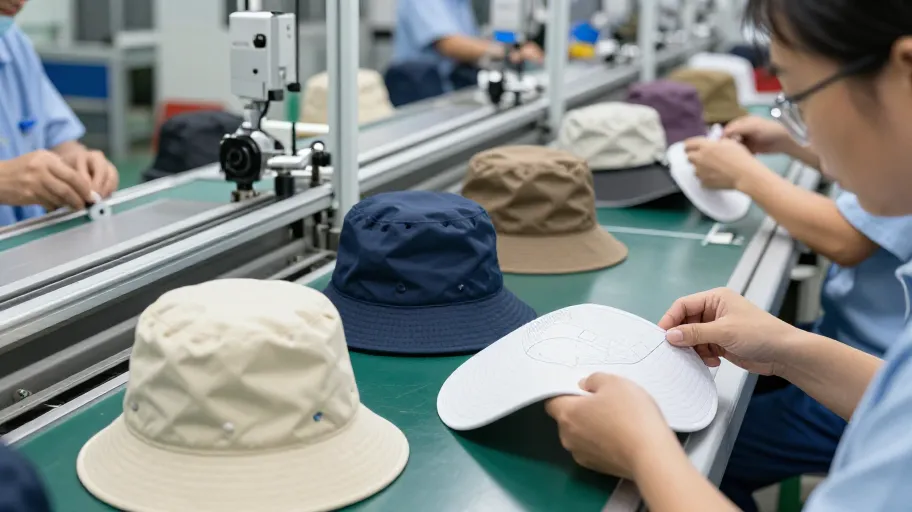
Assuming all cap manufacturers in China work the same way is like thinking every car factory builds SUVs. They don’t. One facility might excel at structured six-panel caps but lack tooling for subtle brim curves. Another may quote low prices but stitch below 8 SPI — the minimum needed for durable outdoor wear.
Stitch Per Inch (SPI) isn’t just a number — it means your seams won’t unravel during summer hikes because each inch has enough stitches to pass ASTM D5034 abrasion tests. Brands that enforce 8–10 SPI on stress points see up to 40% fewer field failures. That’s not engineering jargon; it’s fewer returns, lower warranty costs, and better reviews.
We worked with a California-based resortwear brand that skipped SPI verification. Their first run used 6 SPI on chin strap attachments. By week three, 12% of customers reported broken straps. After switching to a verified 9 SPI process, failure rates dropped to 1.4%. The change didn’t cost more — it prevented a rebranding crisis.
The hidden specs that wreck launches
“Medium crown height” means nothing without tolerances. In millimeters, “medium” can swing from 48mm to 58mm across factories. That 10mm gap changes fit, stackability, and shelf presence — especially if you’re selling through retail partners with tight display standards.
Specifying +/- 2mm tolerance means your fit stays consistent across batches because the factory uses calibrated molds tied to your approved sample. One Pacific Northwest brand added this rule after receiving two shipments where one batch wouldn’t stack neatly in branded packaging. Fixing it saved them $18K in repackaging labor over three seasons.
Seam allowances matter too. Chinese factories typically cut at 3/8”, while European patterns expect 1/4”. Using the wrong allowance with bonded nylon causes puckering. That means manual rework or scrapped panels. Telling your factory exactly which allowance to use means clean seams and less waste — because mismatched specs don’t sneak into production.
Eyelets are not interchangeable
Calling eyelets “ventilation inserts” invites substitution — especially when metal prices spike. Grommet-style metal eyelets resist tearing but add weight. Laser-cut micro-vents offer breathability with minimal aesthetic disruption but require ultrasonic cutting tools not all factories own.
One U.S. lifestyle brand learned this when their minimalist summer line arrived with bulky metal grommets instead of the intended perforated mesh. They’d said “standard vents,” assuming the factory knew their design language. Instead, they got workwear hardware on fashion hats. Rework delayed launch by 22 days — missing prime beach season demand.
Now they specify exact eyelet type and require photo proof of tooling before production. This means no surprises, because the factory can’t swap components without approval. It also means faster QC sign-off — because everyone sees the same thing from day one.
Bill curvature templates prevent brand drift
A 7-degree difference in brim pitch doesn’t sound like much — until customers start posting side-by-side photos online claiming counterfeits. Without a physical or digital Bill Curvature Template, factories rely on internal molds that vary between shifts and locations.
Using an approved template means every hat matches the signature silhouette because production lines follow the same curve profile. One luxury brand reduced visual deviation by 92% after mandating template use across suppliers. They also cut approval cycles in half — because there was less back-and-forth over shape disputes.
Think of it like font licensing for physical products. You wouldn’t let a designer pick any sans-serif for your logo. Why let a factory decide how your brim bends?
How to build a real factory checklist
Tech packs alone aren’t enough. Our audit of 42 Western brands found 91% had detailed designs, but only 37% verified actual factory capability — things like thread tensile strength, mold calibration, and template access.
The winning checklist includes:
- SPI logs for all seam types (means no weak stitching because data proves durability)
- Approved Bill Curvature Templates (means brand consistency because shape is locked down)
- Millimeter-specific crown height tolerances (means reliable fit because variation is controlled)
- Exact eyelet specifications with material codes (means correct components because substitutions are blocked)
Brands using this framework report 30% faster time-to-market and 65% lower first-article rejection rates. One outdoor retailer tied it directly to capturing Q2 sales ahead of competitors stuck resolving fit issues. Precision isn’t overhead — it’s leverage.
What to do next
If you’re launching a bucket hat line or rebuilding supplier relationships, start by auditing your current tech pack against actual factory capabilities. Ask: Can they prove SPI compliance? Do they have the right tooling for your brim curve? Is “medium” defined in millimeters?
We’ve built a free downloadable checklist based on these benchmarks — used by three brands to reduce defect rates by up to 50% and eliminate rework delays. See how it works for your next run: download the template, walk through it with your manufacturer, and validate every spec before cutting fabric.
Because the best supply chain move isn’t finding the cheapest bid — it’s ensuring the first sample is the final product.
#cap manufacturers china, #headwear manufacturers china, #cap factory