


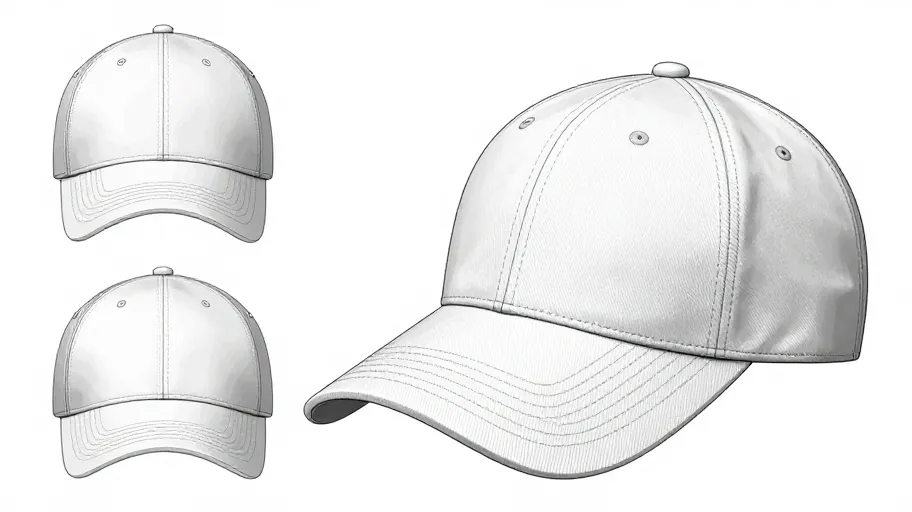
Most brands lose thousands on misaligned embroidery and warped brims because their tech packs don’t speak the factory’s language. This guide shows you how to build a production-ready hat tech pack that cuts sample rounds, speeds up time-to-market, and keeps quality consistent across Chinese factories.
Why first samples fail—and it’s not the factory’s fault
A U.S. streetwear brand once shipped its debut hat line only to find every cap had crooked embroidery and an unintended brim curve. The launch stalled. They ate $47,000 in rework and air freight. The problem wasn’t the factory—it was the tech pack. 68% of first samples fail not because of poor craftsmanship, but because specs are unclear (Sourcing Journal, 2023 supply chain audit).
Vague sketches, missing tolerances, and unstandardized material names leave room for interpretation. A 2mm difference in front panel curvature might seem minor, but it changes how a hat shadows the face—a detail influencers notice and customers photograph. That’s why leading brands now use a Tech Pack Completeness Score, an eight-dimension checklist covering stitching density, thread types, placement tolerances, fabric shrinkage, and approval workflows. Each dimension is scored 0–5. Factories with a score below 32/40 get flagged for review—cutting assumption-based errors by up to 70%.
One DTC label cut sample rounds from five to one after adopting this system. They saved 41 days per style and $18 per unit in logistics and corrections. Precision doesn’t slow you down—it prevents waste before it starts.
What separates pro tech packs from basic design sheets
Eighty percent of emerging brands send flat visuals or mood boards. That’s like handing a chef a photo of lasagna and expecting dinner. Professional hat tech packs go further—they include 12+ structured components that eliminate guesswork. Where basic sheets say “curved bill,” pros specify exactly which curve using a Bill Profile Template Library, a set of pre-validated specs tested across fabrics and production runs.
This isn’t cosmetic—it’s engineering. One outdoor brand slashed prototype rounds from five to one after integrating these templates, avoiding $18K in sampling costs per style. A 2024 benchmark found that brands using standardized measurements hit markets 30% faster than peers stuck in revision loops.
Beyond shape, top-tier packs define stitch types (e.g., 401 chainstitch for durability), fabric shrinkage (±2% for cotton twill), and 360° measurement diagrams with pressure points mapped. These aren’t overhead—they’re scalability levers. When every technician reads the same data, batch consistency becomes predictable, not aspirational.
The result? Fewer revisions, higher repeatability, and the ability to scale across multiple Chinese factories without quality drift. For a brand launching 12 styles a year, that efficiency gain means two extra collections delivered on time—every year.
How to structure your tech pack for Chinese manufacturers
You need more than a document—you need one that speaks directly to China’s manufacturing ecosystem. The China Factory Communication Protocol replaces ambiguous terms like “crown height” with bilingual equivalents such as “顶高,” so pattern makers in Guangdong read your intent exactly. Factories processing ISO-aligned documents report 50% faster intake times (Asia Pacific Sourcing Consortium, 2024), because clarity speeds decisions at every handoff.
Start with material swatch tagging: label each fabric sample with lot numbers and performance ratings so QC teams can verify upon receipt. Then annotate seam allowances down to the millimeter—critical for curved crown panels where 2mm variance distorts fit. Implement PMS-to-Pantone cross-referencing; dyes shift across regions, but calibrated codes lock in color accuracy.
Embed QR codes linking to digital swatches and 360° trim views. Remote QC teams can validate materials in real time. One U.S. outdoor brand reduced approval cycles by 40% after adding this layer. Your tech pack stops being static and becomes a living communication tool.
The outcome? Higher first-pass yield, fewer physical samples, and lead times shortened by up to three weeks. That’s not just efficiency—it’s supply chain resilience built through precision.
#cap manufacturers china, #headwear manufacturers china, #hat tech pack








