


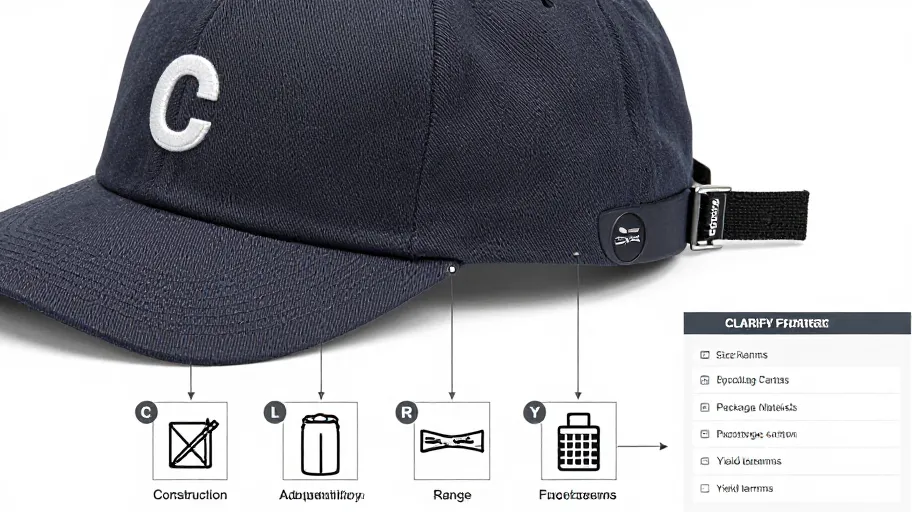
A useful New Generation cap quote should make construction, logo application, sizing, quantity ranges, incoterms, packaging and acceptance criteria explicit enough that you can compare it line by line against any other supplier. Use the CLARIFY Framework to test it: Construction, Logo application, Adjustability, Range, Incoterms, Finish and packaging, Yield terms. If any element is missing, ask before you approve.
Why vague quotes are a sourcing risk
A quotation is not just a number. It is a written statement of scope. When a quote specifies "custom embroidered cap, 500 pieces" and nothing else, every material choice, decoration method, packaging decision and shipping term remains open to interpretation. Two suppliers can appear identical on price while differing in fabric grade, stitch density, closure type, carton markings and delivery basis. The cheaper quote on paper may become the more expensive project in practice.
For importers and corporate buyers, the quotation stage is also your first structured negotiation window. It is far easier to align on tolerance language, approval samples and acceptance criteria before a deposit is paid than after production begins. A supplier's willingness to answer precise questions at this stage also tells you something about how they will communicate during production.
That is the purpose of this article: to give you a framework and a set of questions so that the quote you receive — and the one you approve — leaves nothing important undefined.
The CLARIFY Framework: seven elements a complete cap quote must cover
C — Construction
The quote should state the cap model, panel count, crown structure, visor type (flat or curved, and whether pre-curved), eyelet style, button, sweatband material and closure type (for example, snapback, strapback, fitted or hook-and-loop). Fabric and composition should be named specifically — not just "cotton cap" but the weave, weight and blend, subject to what the supplier confirms is currently available. Ask New Generation to state every construction element in the quote so you can compare like with like.
L — Logo application
Decoration drives a large share of cap cost and quality risk. The quote should specify the method (embroidery, 3D embroidery, screen print, heat transfer, patch, woven label or a combination), the number of placements, the position of each, the number of colours or thread shades, and for embroidery, the stitch count or coverage the supplier has assumed. If the quote says only "logo included," ask for the assumption behind that figure. A design with a dense chest-height embroidery on the front panel is a different project from a small single-colour side print.
A — Adjustability and sizing
For adjustable caps, the quote should name the closure and back style. For fitted caps, it should state the size range being produced and how sizing will be confirmed. If your market spans head sizes significantly different from the supplier's default pattern blocks, ask whether pattern adjustments are available and how they are quoted. Confirm what measurement reference the supplier uses for size approval.
R — Range (MOQ and quantity tiers)
Minimum order quantity, available quantity breaks, and how pricing changes across tiers must be in writing. Ask whether the MOQ can be split across colours or styles, whether different logo variations count as one style or several, and whether blank samples, pre-production samples and production runs are quoted under the same or different thresholds. Confirm all of this directly with New Generation, as quantity policy is project-specific.
I — Incoterms and logistics
A quote without a named Incoterm is incomplete. Confirm whether the quoted price is EXW, FOB, CIF or another term, and which port or airport applies. Ask who arranges export clearance, what carton and packaging specifications are included, how goods are palletised or carton-marked for your market, and what documentation accompanies the shipment. Whether air or sea freight is available, and how that choice is reflected in the quote, is something to confirm for your specific project rather than assume.
F — Finish and packaging
Finishing includes washing or pressing treatment, final inspection scope, tagging, hangtags, polybags, and retail or bulk packaging. Ask the supplier to state in the quote what packaging is included and what is optional. If your retail channel requires specific barcodes, price tickets or compliance labelling for your destination market, the quotation stage is when to raise it — and to confirm in writing that any legal or labelling requirements for your market are understood and can be met, rather than assumed.
Y — Yield terms (quality, tolerance, acceptance)
This is the most frequently omitted section and the most valuable. The quote should reference the approval basis: what sample must be approved before production, what happens if the production output differs from the approved sample, and what inspection arrangements are available. Ask how dimensional variation, colour fastness and stitching quality are assessed, and agree in writing on an acceptance process — for example, third-party inspection or a jointly defined inspection standard. Do not rely on verbal assurances; document the acceptance criteria in the quotation or the subsequent order confirmation.
Decision table: comparing two cap quotes
Use this table to score any two quotes side by side. Score each element 0 (absent), 1 (partially specified) or 2 (fully specified in writing).
| CLARIFY element | What "fully specified" looks like | Quote A score | Quote B score |
|---|---|---|---|
| Construction | Model, panels, fabric, visor, closure all named | ___ | ___ |
| Logo application | Method, placements, colours, stitch count stated | ___ | ___ |
| Adjustability & sizing | Closure type or size range and measurement basis stated | ___ | ___ |
| Range | MOQ and quantity breaks in writing | ___ | ___ |
| Incoterms & logistics | Incoterm, port, documentation and carton specs stated | ___ | ___ |
| Finish & packaging | Included packaging and optional extras itemised | ___ | ___ |
| Yield terms | Approval sample basis and acceptance criteria documented | ___ | ___ |
| Total | ___ / 14 | ___ / 14 |
A low score does not automatically mean a weak supplier — but it means you are being asked to approve an undefined scope. Either close the gaps in writing before proceeding, or compare against a quote that defines them.
Approval questions to put in writing before confirming an order
Before you approve any quotation from New Generation — or any custom headwear supplier — send these questions and require written answers that are reflected in the quote or order confirmation:
- Please list every construction element included in the quoted cap model, including fabric composition and closure type.
- Please state the logo application method, number of placements, colours and — for embroidery — the stitch count assumed in this quote.
- What quantity tiers are available, and can the order be split across colours or logo variations?
- Which Incoterm is this price based on, and which port or airport does it apply to?
- What packaging, tagging and labelling are included, and what is optional?
- What sample must be approved before production, and how is that approval documented?
- If production output differs from the approved sample, what is the agreed resolution process?
- What inspection arrangements are available, and how will acceptance criteria be recorded?
- What is your current sample policy, including any fees and shipping arrangements? (Confirm directly — policies change and are project-specific.)
- What are the current production and shipping timelines for this specification? (Confirm directly for your order.)
FAQ
Should I ask for a sample before approving a quote?
Yes — and the quotation stage is the right time to ask about the current sample policy, including any fees, shipping arrangements and how samples relate to the final order. Because these terms are project-specific and subject to change, confirm the current policy directly with New Generation rather than relying on past experience or general expectations.
How do I compare quotes when suppliers specify things differently?
Normalise them. Take each quote and rebuild it against the CLARIFY Framework so every element — construction, decoration, sizing, quantity, Incoterms, packaging, acceptance — has a stated value. Where a supplier leaves something blank, request it in writing. Only then are the numbers comparable.
Is it reasonable to ask about acceptance criteria before paying a deposit?
Yes. Agreeing in advance on what sample governs production, how output is inspected, and how discrepancies are resolved protects both parties. Suppliers who engage seriously with these questions demonstrate the communication discipline you want across the whole production run.
What if the quote is lower than others but less detailed?
Treat an undefined low quote as a question, not a bargain. Ask the supplier to match the specification level of the more detailed quote — same fabric, same decoration method, same Incoterm, same packaging — and then compare. A price is only meaningful when the scope behind it is identical.
Can New Generation handle my market's labelling requirements?
Raise this during quotation. State your destination market and the labelling or compliance documentation you need, and ask the supplier to confirm in writing what they can provide. Do not assume capability without confirmation, and verify requirements with your own compliance advisers for your market.
Prepare your RFQ with the CLARIFY checklist
Getting a comparable, complete quote starts with a complete enquiry. We have prepared a downloadable checklist that walks you through every CLARIFY element — construction, logo application, sizing, quantity, Incoterms, packaging and acceptance terms — so you can assemble your RFQ and evaluate the responses line by line.
Once you have the checklist filled in, you are ready to request a quote with a fully defined scope — and to compare New Generation's response against any alternative on equal footing.
Request a quote for your custom cap project
#cap manufacturers china, #headwear manufacturers china, #cap factory








