

The best sustainable custom caps are defined by evidence, not labels: a documented substrate (such as recycled or organic fibre content you can verify), a supplier who states in writing how sustainability claims are supported, and a sample-approval process that locks specifications before bulk production. Compare candidates with the SPEC-APPROVE framework below, confirm every policy directly, and approve against documentation rather than assurances.
Use the SPEC-APPROVE framework to compare "sustainable" claims
When importers compare custom cap quotations, marketing language creates noise. A named framework helps you score every candidate on the same five dimensions:
- S — Substrate. What exact fibre, blend or recycled content is proposed? Ask for the material composition in writing, fibre origin where relevant, and how the supplier documents recycled or organic content.
- P — Proof. What evidence supports the sustainability claim? Ask whether documentation exists for the material lot used in your production run, and how it will be attached to your order file. Do not assume any credential; require the supplier to state what they can currently evidence and what they cannot.
- E — Execution. How is the claim carried through construction — trims, sweatbands, thread, closures, packaging? A recycled shell paired with non-documented components weakens the position you can defend to your own customers.
- C — Compliance. Which destination-market requirements apply to your product, and which of them does the supplier confirm they can meet for your order? Compliance is order-specific; ask for written confirmation per market.
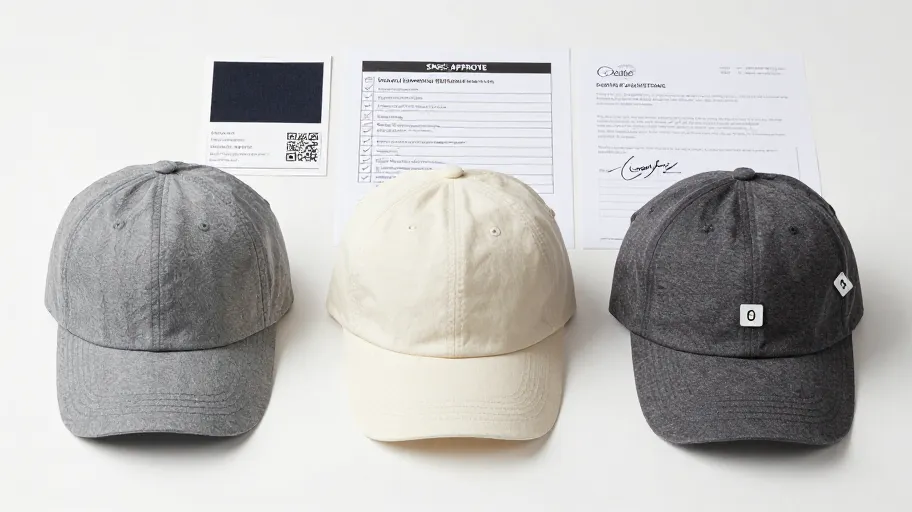
- A — Approve. What does the approval chain look like — pre-production sample, revision round, bulk reference sample — and what does each stage sign off?
SPEC-APPROVE converts a vague comparison into a documented one. A supplier who answers all five dimensions precisely is easier to evaluate than one who answers only with a catalogue.
Decision table: comparing candidate caps and suppliers
| Criterion | What to ask | Strong signal | Weak signal |
|---|---|---|---|
| Substrate definition | Exact fibre/recycled content in writing | Named composition tied to your order | "Eco material" with no composition |
| Evidence handling | How sustainability documentation is provided per lot | Supplier explains their current evidence process and its limits | Vague references to credentials without specifics |
| Component coverage | Trims, thread, closure, packaging composition | Full bill of materials offered for review | Only the shell fabric discussed |
| Sample process | Stages, revisions and what each approval locks | Clear written approval chain | "We'll send a sample" with no defined sign-off |
| Order-specific compliance | Written confirmation per destination market | Supplier asks which markets you sell into | Generic assurance without order linkage |
| Change control | What happens if material must be substituted | Written change-approval requirement stated up front | No substitution policy articulated |
No row in this table assumes any supplier's actual policy — every cell is a question to put to the vendor and document in your order file.
Specifications worth documenting before you request samples
Before sampling, write a specification sheet that both parties sign. For sustainable custom caps, the sheet should capture:
- Material composition for every component, including how recycled or organic content is described and evidenced.
- Construction details: crown panels, brim structure, closure type, sweatband material.
- Colour reference method and tolerance basis — agree in words how colour will be judged, without inventing numeric tolerances here; the supplier should state theirs.
- Logo application method (embroidery, printing, patch, laser) and the material of the applied element itself.
- Packaging: whether recycled or reduced packaging is available, and how it is documented.
- Marking and labelling requirements for your destination market.
This sheet becomes the reference your sample approval is measured against. Without it, "approve the sample" has no defined meaning, and disputes at bulk stage have no anchor.
Sample and approval questions to put to the supplier
Ask these in writing and keep the replies in your order file:
- What sample stages do you offer for a custom cap order, and what does each stage approve?
- What is your current sample policy — including any fees, who covers delivery, and the terms attached? (Confirm directly; policies change and must be stated by the supplier, not assumed.)
- How will the material in my pre-production sample be linked to the material used in bulk production?
- If a documented material becomes unavailable mid-order, what is your substitution and re-approval process?
- What evidence can you provide with the shipment that supports the material claims for my specific order?
- Which of my destination-market requirements can you confirm in writing for this order, and which can you not?
- Who signs off the final approval, and what happens if the bulk run deviates from the approved reference?
These questions are deliberately neutral. Their value is that the answers become part of your contract file — whatever the answers are.
Pre-production approval checklist
Before authorising bulk production, confirm every line:
- Signed specification sheet covers all components, not just the shell fabric.
- Material composition and sustainability-claim evidence are documented for your order.
- Pre-production sample received and compared against the specification sheet line by line.
- Logo application method, placement and material approved in writing.
- Colour reference basis agreed and recorded.
- Substitution and change-control process confirmed in writing.
- Destination-market compliance points confirmed or explicitly excluded, in writing.
- Packaging specification approved alongside the cap itself.
- Bulk reference sample (where offered) retained by both parties.
- Final approval issued in a traceable written form.
FAQ
Are recycled-material caps comparable in quality to conventional ones? Quality depends on the specific yarn, construction and finishing — not the recycled content itself. Ask for the fibre specification and judge the pre-production sample against it, exactly as you would for any cap.
How do I verify a sustainability claim before ordering? Ask what documentation the supplier can attach to your specific order and material lot, and how it travels from sourcing to shipment. If the supplier cannot evidence a claim, treat it as a marketing statement and plan accordingly.
What should a cap sample approval actually lock in? At minimum: material composition, construction, colour basis, logo execution, sizing behaviour, trims and packaging. Anything not approved in writing remains open to interpretation at bulk stage.
Should I request samples from multiple suppliers? For a commercial comparison, yes — compare candidates on the SPEC-APPROVE dimensions first, then sample from the shortlist so your sampling budget follows your analysis rather than replacing it.
What if the supplier changes material after approval? That is why change control belongs in your written terms. Agree before ordering that any substitution requires your written re-approval, and that the evidence pack is updated to match.
Your next step
Get the sourcing brief and run every candidate supplier through the same documented comparison:
[获取采购 Brief]
If you are not ready for that yet, start smaller: copy the pre-production approval checklist above into your next supplier conversation and see which vendors answer in writing.
[Download the pre-production approval checklist]
#cap manufacturers china, #headwear manufacturers china, #cap factory