


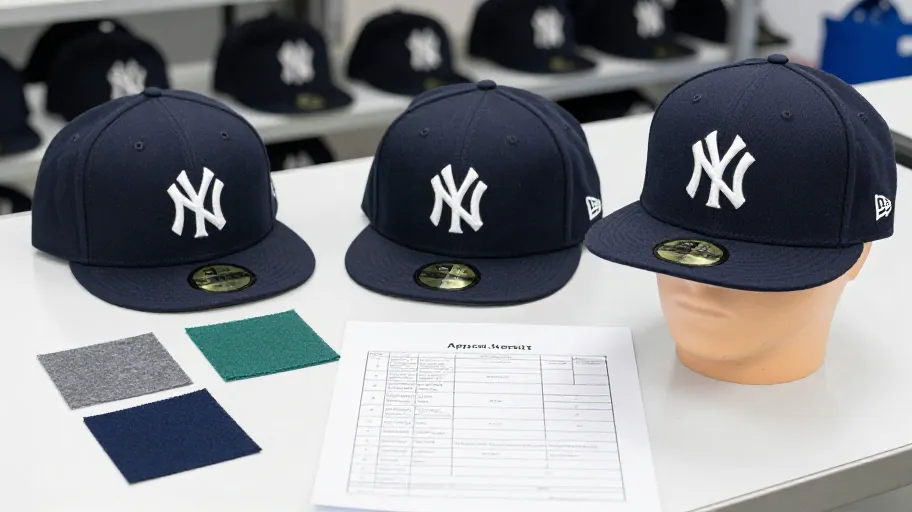
Ordering custom fitted hats — including new era–style six-panel fitted constructions — comes down to three things: a written spec, a verified sample, and a documented approval process before mass production. Because fitted caps have no size adjuster to hide errors, buyers who skip any of these steps carry the correction cost themselves. This guide walks you through a 5-Gate approval framework you can apply to any supplier conversation, whether you are sourcing your first run or switching manufacturers.
Why fitted hats punish vague briefs
A snapback forgives a loose crown spec; the wearer adjusts it. A fitted cap does not. Head circumference, crown height, brim curvature, and fabric stretch all have to land correctly across every size in your run. That is why experienced buyers treat the fitted hat as one of the most spec-sensitive products in headwear — and why the approval process matters more than any single quotation.
The good news: you do not need deep manufacturing knowledge to protect your order. You need a framework, a short list of questions, and the discipline to get answers in writing before you commit.
The 5-Gate Fitted Hat Approval Framework
Use these five gates with any supplier you are evaluating:
- Gate 1 — Spec. Define the hat on paper: panel construction, fabric, closure type (fitted means no closure — size range instead), embroidery or patch placement, brim profile, sweatband and inner materials.
- Gate 3 — Fit test. Wear-test the sample in every size in your run, not just a single size. Fitted hats fail at the size extremes first.
- Gate 4 — Pre-production approval. Sign off a pre-production sample as the physical reference standard for the order. Photograph it and reference it in your purchase documents.
- Gate 5 — Mass production approval. Agree in advance how in-line and final quality checks will reference the approved pre-production sample, and what happens if output does not match it.
Buyers who move through all five gates convert supplier conversations into a documented trail — which is exactly what you need if a production issue ever needs to be resolved.
Spec decision table: what to fix in writing
| Spec element | Decision you must make | Why it matters for fitted hats | Question to confirm with the supplier |
|---|---|---|---|
| Size range | Which sizes, and in what size run distribution | Fitted caps cannot be adjusted; errors surface at return time | Which size standards do you build against, and can you hold our size chart? |
| Crown construction | 6-panel structured vs unstructured | Affects fit, shape retention and embroidery surface | What crown constructions can you produce, and which suits our artwork? |
| Fabric | Wool blend, cotton twill, performance blends | Fabric stretch and recovery change how a fitted size feels | Which fabrics do you recommend for our climate and use case, and can we see swatches? |
| Brim | Flat vs curved, stiffness | Defines the silhouette buyers associate with fitted styles | Can you match our target brim profile on a sample? |
| Decoration | 3D vs flat embroidery, woven labels, patches | Placement and height interact with panel seams | What decoration methods do you offer, and can you digitise from our artwork files? |
| Packaging | Polybag, head form, carton spec | Protects crown shape in transit | What packing configuration do you propose for our destination market? |
The approval questions that separate suppliers
Before you compare prices, compare answers. Send the same question set to every supplier on your shortlist so the comparison is like-for-like:
- Can you produce a sample to our exact spec, and can you confirm the current sample policy for our project type?
- Will the pre-production sample be signed off as the reference standard, and how is it documented?
- How do you handle fit feedback between the sample stage and pre-production?
- What quality checks run during production, and how does output get compared against the approved sample?
- What information do you need from us to quote accurately — artwork, size chart, fabric targets, quantity bands?
- What is your process if we want changes after pre-production approval?
A supplier who answers with specifics — even where the answer is "let's confirm for your project" — is easier to work with than one who answers in generalities. The goal is not a perfect answer sheet on day one; it is a supplier who engages with your approval process rather than around it.
Comparing suppliers on equal terms
Once responses come back, build a simple comparison matrix: spec coverage, sample engagement, willingness to document approvals, and responsiveness. Keep price for last. Two quotes built on different assumed specs are not comparable; two quotes built on the same written spec and the same approved sample approach are.
For corporate buyers, add one more column: documentation. If your procurement process requires an approval trail, weight suppliers who already work that way. New Generation, as a Shenzhen-based OEM/ODM cap manufacturer, structures engagements around written specs and staged approvals — but you should verify that the workflow matches your own documentation requirements before committing.
FAQ
Is a "new era–style" fitted hat something a Chinese OEM/ODM manufacturer can produce? Style references such as structured six-panel fitted constructions are widely used as design briefs. The practical step is to describe the construction elements — panels, brim profile, fabric, size range — and ask the supplier to demonstrate them on a sample. Confirm directly what constructions a given manufacturer can produce before you build a quote around one.
What should a first sample round include?
How many fitted sizes should we order per design? That is a merchandising decision, not a production one. Ask your supplier which size runs they can hold, and plan your size distribution against your own market data. The key approval step is fit-testing a sample in every size you intend to sell.
What if mass production does not match the approved sample?
Can we get embroidery and interior branding together? Most sourcing conversations can combine exterior embroidery with interior labels or printed branding — but confirm the decoration methods, artwork file requirements and interior options directly with the manufacturer for your design.
Your next step
Turn this guide into a supplier-ready brief. Send us your design direction, target market and size plan, and we will respond with the spec questions, sample steps and approval gates mapped to your project — so your first conversation starts with a written spec, not a guess.
Get a Sourcing Brief →
Quick checklist before you request any fitted hat quotation:
- Written size chart with target size distribution
- Crown construction and brim profile defined
- Fabric direction and swatch request noted
- Decoration files and placement described
- Sample and pre-production approval steps agreed in writing
- Packing spec for your destination market included
#cap manufacturers china, #headwear manufacturers china, #cap factory








