
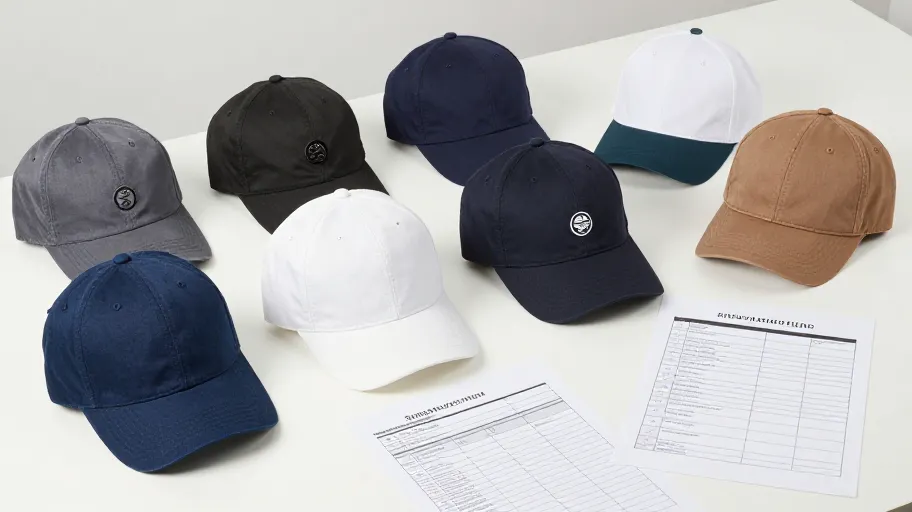
Custom logo hats with no minimum let brands test a headwear line, outfit a small team, or trial a new supplier before scaling. But "no minimum" alone tells you nothing about sample terms, decoration method, spec control, or what happens when a sample misses the mark. This guide gives you a spec framework, a sample approval workflow, and the questions to put in writing — so you can compare suppliers on evidence, not adjectives.
Why "no minimum" changes your sourcing job, not your standards
When you order a large production run, quantity gives you leverage: detailed contracts, inspection stages, and room to absorb problems. A small or single-unit custom order removes that cushion. Everything you would negotiate into a big contract — specs, sample approval, revision terms — has to be documented before you pay anything.
That is the core shift. "No minimum" is an entry point, not a quality statement. Your job as a buyer is to move from browsing listings to a documented approval chain.
The SPEC-APPROVE ladder
Use this six-step ladder to sequence every small-quantity custom headwear project:
- S — Scope: define the hat style, logo artwork, decoration method, target use and destination market.
- P — Prototype: request a sample (or pre-production sample) before any batch commitment.
- E — Evaluate: inspect the sample against a written spec sheet, not memory.
- C — Confirm: log revisions in writing and re-sample if changes are material.
- -APPROVE: sign off the approved sample as the reference standard for any future order.
The ladder matters most at low quantities because there is no batch to dilute a mistake. One wrong thread colour on a single custom cap is a hundred percent defect rate from your perspective.
Spec table: define these before requesting any quote
| Spec field | What to define | Why it matters |
|---|---|---|
| Hat style | Structured/unstructured, five-panel/six-panel, snapback, dad hat, bucket, beanie, trucker | Determines tooling, panels and cost drivers |
| Fabric and composition | Cotton, poly, blends, wool, weight class | Affects print vs embroidery compatibility and hand feel |
| Closure and sizing | Snapback, strapback, fitted range, elastic | Impacts fit across your end users |
| Decoration method | Embroidery (stitch count), patch, screen print, heat transfer, woven label | Changes artwork requirements and durability expectations |
| Logo artwork | Vector file, placement, size, colour codes (e.g., Pantone) | Prevents interpretation gaps between buyer and factory |
| Colour specification | Pantone or physical colour standard for both hat and logo | Screens differ; physical standards do not |
| Labelling and branding | Woven label, hangtag, interior taping, private label placement | Central for private label programs |
| Packing | Polybag, hangtag attachment, carton marking | Matters for retail-ready delivery |
None of these fields require a supplier claim — they are your inputs. A supplier who responds to a complete spec sheet with precise, itemised answers is demonstrating the communication discipline you want; one who replies with vague reassurance is telling you something too.
Sample evaluation: what to inspect, what to document
When a sample arrives, evaluate it against your written spec, and record the result. Useful inspection points for headwear include:
- Crown shape and structure retention after handling
- Seam alignment across panels
- Embroidery or print registration against your artwork
- Colour match against your specified standard
- Closure function and adjustability range
- Interior finish: sweatband, taping, label attachment
- Overall consistency between the sample and the spec sheet you sent
Photograph the sample next to your spec sheet. If a dispute arises later, contemporaneous records are worth more than recollection.
Approval questions to put in writing before ordering
Ask these directly, in writing, and keep the answers:
- What is your current minimum order policy for this specific style and decoration method, and does it apply to reorders?
- What is your current sample policy — sample charge, revision charge, and shipping arrangement — and under what conditions, if any, do terms change?
- How many sample revisions are included before additional charges apply?
- Does the approved sample become the reference standard for future production, and how is that documented?
- What inspection or quality checkpoints exist on small orders, and can I or a third party inspect before dispatch?
- What are your current production and dispatch arrangements for this order size, and what documentation do you provide at dispatch?
- How are defects in a small batch handled — what is your stated remedy process?
You are not looking for a "good" answer so much as a clear, current, written one. Terms that a supplier will not put in writing are terms you cannot rely on.
Supplier comparison decision table
Use this table to score competing "no minimum" offers side by side:
| Evaluation criterion | Supplier A | Supplier B | Supplier C |
|---|---|---|---|
| Confirms MOQ policy in writing for this exact style | |||
| Provides current sample terms in writing | |||
| Responds to full spec sheet item by item | |||
| Offers revision terms before payment | |||
| Explains inspection process for small orders | |||
| States dispatch documentation provided | |||
| Answers defect-remedy question directly | |||
| Quality of sample vs spec sheet |
Score each row on evidence, not promises. A blank cell is a finding.
Pre-order checklist
Before you pay for any small-quantity custom order, confirm:
- Spec sheet completed and sent (style, fabric, decoration, colours, sizing)
- Vector artwork supplied with placement and colour codes
- Supplier's MOQ policy for this style confirmed in writing
- Sample charge, revision terms and shipping arrangements confirmed in writing
- Sample received and evaluated against the spec sheet, with photos
- All revisions logged in writing
- Approved sample designated as reference standard for future orders
- Inspection arrangement for the order confirmed
- Dispatch documentation and destination-market responsibilities confirmed
- Defect-remedy process stated in writing
Frequently asked questions
Is "custom logo hats no minimum" a genuine offer or a marketing term? Both exist in the market. The only way to distinguish them is to request the policy in writing for your specific style, decoration method and reorder scenario. A supplier confident in its policy will confirm it; hesitation is itself information.
Should I order a sample before a small custom order? A sample (or pre-production sample) is the single strongest risk control you have at low quantities. Confirm the supplier's current sample policy directly — charge, revision handling and shipping arrangements vary and must be verified per project.
How do I keep colours consistent between sample and production? Specify colours with a physical or coded standard (such as Pantone references) for both the hat body and the logo, and make the approved sample the documented reference. Ask the supplier how colour is checked against that standard.
What decoration method should I choose for a logo? It depends on artwork complexity, fabric and desired durability — embroidery, patches, screen printing and heat transfer each behave differently. Ask the supplier which methods they execute for your exact artwork and fabric, and to show a sample of that combination before you commit.
Can I use a no-minimum order to test a private label program? A small first order is a reasonable way to test communication, spec discipline and sample quality before scaling. Evaluate the supplier on the SPEC-APPROVE ladder, then decide whether to expand the relationship.
Next step
If you are comparing suppliers for custom logo hats with no minimum, get your sourcing questions in order first.
获取采购 Brief — request the purchasing brief to structure your spec sheet, sample evaluation and approval questions before your next RFQ.
Prefer to start smaller? Use the pre-order checklist above as your first message to any supplier — it is a low-friction way to test how each one responds to a documented, professional enquiry.
#cap manufacturers china, #headwear manufacturers china, #cap factory