

Before you commit to any headwear clothing order, lock three things: a written specification covering materials, construction and decoration; a sampling stage where physical samples are compared against that specification; and a documented approval that both parties sign. Most sourcing disputes trace back to a skipped gate, not a bad factory. Treat specification, sample and approval as separate decisions, and never let production begin on a verbal "yes."
The Spec–Sample–Approve framework
The SSA framework is a three-gate process designed for buyers sourcing custom caps, hats and headwear clothing from overseas manufacturers. Each gate produces a document. If a document does not exist, the gate has not been passed.
- Gate 1 — Spec. Convert your design intent into measurable, verifiable statements. A colour name is not a spec; a referenced colour standard is. A photo of stitching is not a spec; a named stitch type and placement diagram is.
- Gate 2 — Sample. Request the correct sample type for the decision you are making, then compare it physically against the spec sheet, not against memory.
- Gate 3 — Approve. Record what you approved, what you rejected, and what changed. Any change after approval requires a new sample cycle.
The framework's value is asymmetry: it costs you very little to run, but it protects you from the most expensive failure modes in custom headwear — disputed quality, silent material substitution and unclear rework responsibility.
Building the headwear clothing specification
A specification for caps and headwear clothing should cover, at minimum, the following families of attributes. For each, write a question rather than an assumption if the supplier has not documented it.
- Shell and lining materials: fibre content, weight, weave or knit structure, and finish. Ask the supplier to state the material in writing per component — crown, visor, sweatband, lining, closure.
- Construction: panel count, seam type, eyelet treatment, visor structure, buckram or reinforcement, closure type and adjustability range.
- Decoration: embroidery stitch count and thread type, patch material and attachment method, print method, placement coordinates on a numbered diagram.
- Colour management: reference each colour to a named colour standard and state the substrate it applies to, since the same dye reads differently on different fabrics.
- Labelling and packaging: care labels, origin marking, brand labels, tagging, and carton packing rules for your market.
- Tolerances and inspection criteria: measurable acceptance criteria for stitching, decoration and assembly, defined as project-specific numbers you agree with the supplier — do not accept vague "good quality" language.
Every numerical tolerance, dimensional rule and acceptance limit should be negotiated and written into your tech pack. Do not rely on what a supplier describes as acceptable practice; define it yourself and get it countersigned.
Sampling stages and how to compare them
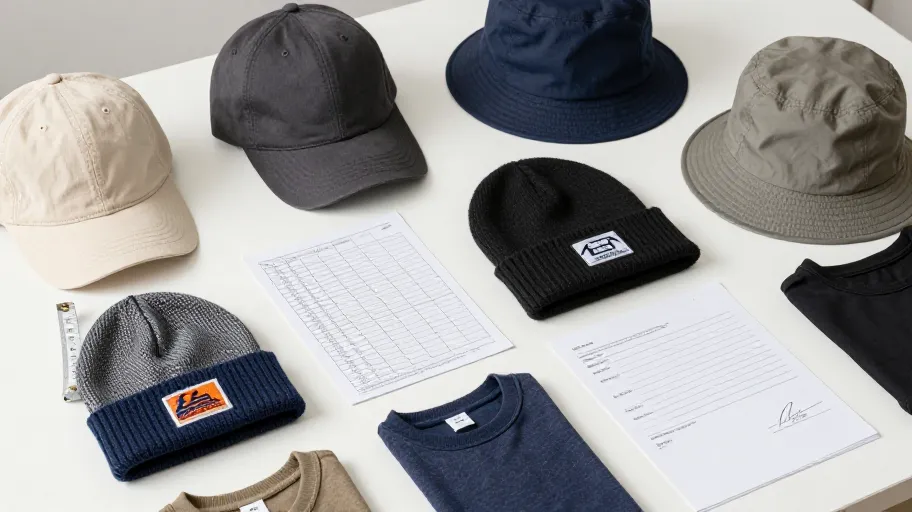
Different sample types answer different questions. Before requesting anything, ask the supplier to confirm in writing which sample types they offer for your program, what each includes, the current cost, and how revisions are handled — sample policy varies by program and must be confirmed directly.
When samples arrive, run a structured comparison rather than an impression:
- Compare each sample against the spec sheet, line by line, in consistent lighting.
- Photograph everything, including labels and inner construction.
- Record deviations in writing, even small ones, because small deviations at sample stage become larger deviations at bulk.
- Wear-test or handle-test the sample for its real use case — a cap that looks right but sits wrong is a rejected sample.
- Confirm which sample becomes the sealed approval reference and who holds it.
Approval decision table
| Situation | Risk if you approve | Recommended action |
|---|---|---|
| Sample matches spec, deviations logged and accepted | Low | Approve in writing, seal the reference sample, proceed to Gate 3 |
| Sample matches but spec sheet is incomplete | Medium — disputes later cannot be judged against anything | Return to Gate 1, finish the spec, re-approve |
| Supplier says "same as before" without a new sample | High — silent substitution goes undetected | Require a fresh sample for any material, factory or process change |
| Deviations noted verbally, no written response | High — no evidence trail | Hold approval until deviations are confirmed in writing |
| Deadline pressure to skip sample approval | Highest — no reference for bulk inspection | Escalate internally; re-negotiate the timeline rather than the gate |
Approval questions to put in writing
Put these questions to your supplier before approving production, and keep the answers on file:
- Which sample exactly is the approval reference, identified by date and version?
- Which materials, by written description, are confirmed for every component?
- What happens if a specified material becomes unavailable mid-production — substitution requires written consent or not?
- How will bulk be inspected against the approved sample, and can you or a third party verify before shipment?
- What documentation accompanies shipment — packing lists, material declarations, and any compliance paperwork your market requires?
These questions are deliberately supplier-neutral. Their purpose is not to test the manufacturer but to create a shared record that protects both sides.
FAQ
What is the difference between OEM and ODM for headwear clothing? OEM means you supply the design and specification and the manufacturer produces to it; ODM means you select or adapt an existing manufacturer design. Both models still require the SSA gates — an ODM base design still needs a written spec and physical sample approval for your colourways and decoration.
How many sample rounds should I plan for? Plan for the number your project needs, not a fixed figure. First samples reveal deviations; revisions confirm corrections. Approve only when a sample matches the spec with all deviations documented and accepted. Confirm with the supplier how revisions are quoted and handled before you begin.
Can I approve production based on photos of the sample? Photos support a record but cannot verify weight, hand feel, fit or construction. For a first production run of headwear clothing, physically inspect the approval sample. Thereafter, decide with your supplier what photo-based approval covers and what it does not.
What should I do if the bulk differs from the approved sample? Your written spec, sealed sample and approval record are the reference points. Raise the deviation in writing with evidence, and refer to the inspection criteria you agreed at Gate 1. This is why approval documents matter more than any verbal assurance.
How do I compare multiple headwear suppliers fairly? Give each supplier the same written spec and request the same sample type, then compare outputs against the same criteria. Also compare how each supplier handles documentation — a manufacturer that answers precisely in writing is easier to hold accountable at scale.
获取采购 Brief — request the sourcing brief to structure your next headwear clothing program around the SSA gates before you contact any supplier.
Low-friction CTA: Download the one-page Spec–Sample–Approve checklist and run it against your current tech pack before your next sample request.
#cap manufacturers china, #headwear manufacturers china, #cap factory