


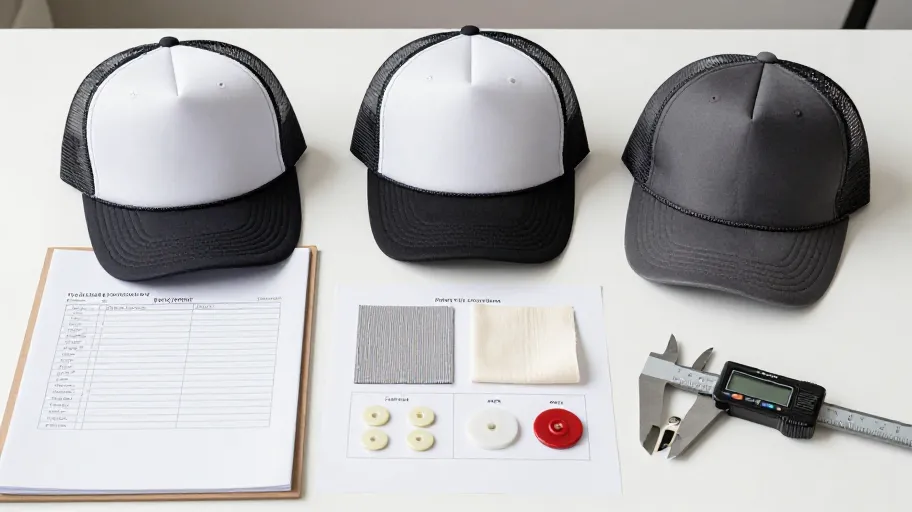
Buying high-quality trucker hats wholesale comes down to three things: a written specification that removes ambiguity, a staged sampling process that verifies that specification, and a documented approval gate before bulk production begins. Buyers who skip any of these steps hand quality control to the factory. This guide gives you the framework, the spec checklist and the approval questions to keep it in your hands.
Start with a specification, not a price
When importers and brand buyers approach a Shenzhen OEM/ODM manufacturer, the first request matters. A conversation that opens with "what is your price" produces a quote built on assumptions — assumptions about materials, structure, decoration and finishing that you have not agreed. A conversation that opens with a specification produces a quote you can actually compare.
That is why this guide is built around a simple framework.
The Spec–Sample–Sign-off framework
Stage 1 — Spec. You and the supplier agree a written specification covering materials, construction, decoration, labelling and packaging. Nothing proceeds on verbal agreement.
Stage 2 — Sample. The supplier produces samples at defined stages so you can verify the spec physically, not just on paper.
Stage 3 — Sign-off. You approve a reference sample in writing. That approved sample becomes the acceptance standard for the bulk run. If bulk goods do not match the approved sample, the discrepancy is documented and resolvable.
This framework does two things for a B2B buyer. First, it makes quality measurable — you approve against a physical reference, not a feeling. Second, it makes disputes narrow and factual, because both sides signed the same standard.
Building the spec sheet: what to document
Use this as a working checklist when you brief any custom headwear manufacturer. Every line should end in a documented answer, confirmed by the supplier in writing.
Structure and materials
- Crown structure: structured or unstructured? Which interlining?
- Front panels: which fabric and weight? Foam-backed or flat?
- Mesh back: panel count, mesh density and fibre — ask the supplier to specify exactly what they will use
- Brim: material, pre-curved or flat, and any edging detail
- Sweatband and inner seam finishing
Fit and closure
- Closure type and adjustability range — ask the supplier to confirm the fit range in writing for your target market
- Sizing basis: adult, youth or women's cut, and how the pattern differs
Decoration
- Method: embroidery, heat transfer, patch, screen print or woven label
- For embroidery: stitch type, coverage density and backing — request a sew-out for approval
- Artwork files, thread colours and Pantone or vendor references
Labelling and packaging
- Main label, care label, size tag, origin marking and any market-specific labelling your destination requires — confirm obligations with your own compliance adviser
- Individual polybagging, carton quantities and carton marking
Open questions you must confirm directly with the supplier
The following are project-specific and policy-dependent. Do not rely on any general assumption — ask and document the current answer:
- Minimum order quantity per colourway and per style
- Sample policy: cost, turnaround and whether revisions are included — confirm the current terms directly
- Lead time from approved sample to bulk shipment, and what the supplier commits to in writing
- Production capacity and how your order fits their scheduling
- Defect tolerance and how non-conforming goods are handled contractually
- Any certifications or test reports they can evidence for your materials or destination market
- Shipping terms and who arranges export logistics
Sampling stages: what each one verifies
A disciplined sampling sequence separates decisions so problems surface one at a time, not all at once in the bulk shipment.
- Concept or proto sample. Confirms silhouette, proportion and basic materials. Decoration may be mocked.
- Pre-production sample. Made on the actual materials, actual pattern and actual decoration. This is where you measure against the spec sheet line by line.
- Golden sample (approved reference). The pre-production sample, corrected and formally signed off. It travels into the production file as the acceptance standard.
Ask your supplier which stages they support, what each stage costs under their current policy, and how revisions are handled. These terms vary by supplier and by project — confirm them directly rather than assuming.
Approval questions to ask before bulk production
Before you sign off, run through these questions with the supplier and record the answers:
- Is this sample made on the same materials, pattern and machines that will run the bulk order?
- Which elements, if any, are substitutions or placeholders, and what will change in production?
- Can the supplier hold the approved sample on file as the reference standard for inspection?
- What inspection arrangements apply to the bulk run, and can a third-party inspector access an approved sample?
- What is the documented process if bulk goods deviate from the approved sample?
- Which certifications or test reports, if any, can the supplier provide for the exact materials in your spec?
- How are decoration issues — stitch density, colour shift, placement — flagged and corrected during the run?
A supplier's willingness to answer these questions in writing tells you as much about their reliability as the sample itself.
Supplier comparison decision table
Score each candidate supplier from 1 (weak) to 5 (strong) on each row. Total the scores to structure your comparison — then verify the top results with a sample order before committing to volume.
| Evaluation criterion | Supplier A | Supplier B | Supplier C |
|---|---|---|---|
| Completeness and clarity of spec response | |||
| Sample matched spec exactly (line-by-line check) | |||
| Written answers to all seven approval questions | |||
| Communication quality and responsiveness | |||
| Documented handling of deviations and inspection | |||
| Evidence provided for materials and claims | |||
| Willingness to hold a golden sample on file | |||
| Total |
No single row should decide the choice on its own; the pattern across rows is what matters.
FAQs
What defines "high quality" in a wholesale trucker hat? A consistent, documented match between an approved sample and bulk production. Quality is not a mood or a price point — it is conformity to an agreed specification covering structure, materials, decoration and finishing, verified through sampling and inspection.
How many sample rounds should I plan for? Plan for at least a concept sample and a pre-production sample, with a final approved reference. The exact number depends on design complexity and how many revisions your artwork requires — agree the sampling sequence and costs with the supplier in advance and confirm current policy directly.
Should I approve the sample myself or use a third-party inspector? Both serve different purposes. You, or your designer, should approve aesthetics and brand elements. A third-party inspector is well suited to verifying bulk conformity against the golden sample. Confirm with the supplier how inspector access works.
What documentation should I keep for every order? The signed spec sheet, the approved golden sample reference, all written answers to the approval questions, and the agreed inspection and deviation-handling terms. This file is your protection if anything in the bulk run needs resolution.
How do I compare suppliers quoting different specifications? Normalise the quotes onto one spec sheet. Ask each supplier to re-quote against your specification, then score them using the decision table above. Comparing quotes built on different assumptions is the fastest route to a quality surprise.
Download the Sourcing Brief
Before your next enquiry, get the 获取采购 Brief — a structured document covering spec-sheet fields, sampling stages, approval questions and supplier scoring, built for buyers sourcing custom headwear from China. Request it and start your next project with the specification in hand.
Low-friction next step: Use the spec-sheet checklist in this guide for your very next supplier conversation — it costs nothing and will immediately show you which suppliers can work to documentation.
#cap manufacturers china, #headwear manufacturers china, #cap factory








