


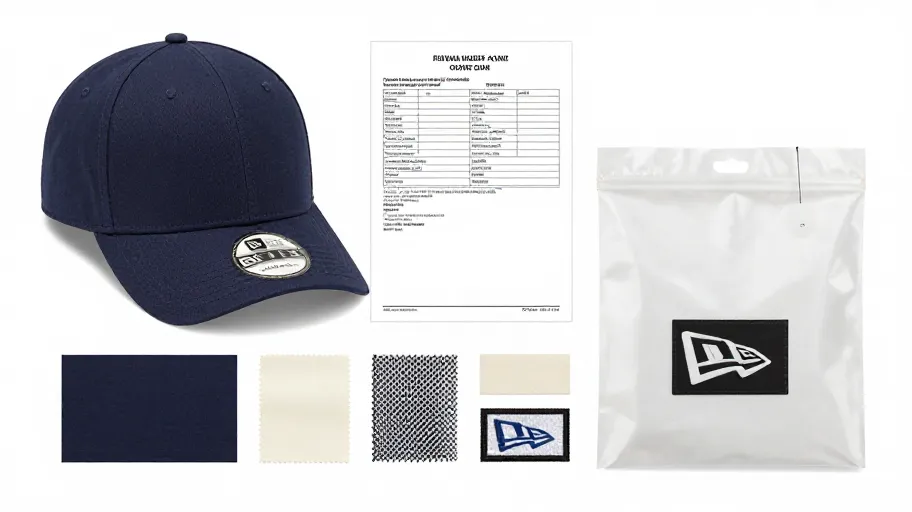
If you searched for a new era cap philippines price list as a buyer, here is the direct answer: a fixed list price cannot serve an OEM/ODM sourcing decision, because custom headwear pricing moves with construction, materials, decoration, quantities and packaging. What you need instead is a Spec–Sample–Approval (SSA) Ladder: lock specifications first, confirm a physical sample second, and document approvals third — then request a quotation against that locked baseline. This guide shows you how to build one, and what to confirm with any supplier before committing.
A note on framing: New Era is a third-party brand. New Generation is an independent OEM/ODM cap manufacturer in Shenzhen, China, serving overseas brands, importers, wholesalers and corporate buyers. This article does not describe New Era's products, pricing, distribution or authorisation — those must be verified with the brand or its authorised channels. What this guide can do is help you structure any custom-cap enquiry, whether you are benchmarking against a licensed reference cap or developing your own private-label programme.
The SSA Ladder: a three-step decision framework for custom cap sourcing
The SSA Ladder keeps price where it belongs — at the end of the process, not the beginning.
| Step | What you do | What it prevents |
|---|---|---|
| 1. Spec | Write a full specification sheet: crown and panel construction, fabric and weight, visor form, closure type, sweatband, lining, decoration method, colour references, sizing, labelling and packaging. | Comparing quotes that describe different products. |
| 2. Sample | Request a physical sample against the spec sheet and evaluate construction, embroidery or print quality, fit and colour match. | Committing to production based on images or descriptions. |
| 3. Approval | Sign off a golden sample and document every approved detail in writing, including any revisions and their revision numbers. | Disputes when bulk goods differ from what you expected. |
Only after these three steps is a quotation meaningful — because every line in the quote maps to something you have physically approved.
Why a fixed "price list" search doesn't answer a B2B question
Retail price lists tell a consumer what a finished cap costs on a shelf. As a sourcing buyer, your question is different: what will this exact construction cost, at my quantities, with my decoration and my packaging, delivered to my market? No static list can answer that, and any that appears to should be verified rather than relied on.
The Philippines angle matters for a different reason. If you are selling into the Philippine market — or comparing landed costs across Southeast Asian markets — your price question becomes a landed-cost architecture question: unit price, tooling or setup charges, sample charges, packaging, freight terms, insurance and destination charges. Each of these is a line you must request and confirm in writing; none can be assumed. Ask your supplier which trade terms they quote under (for example, EXW, FOB or CIF as defined by Incoterms), and confirm the current policy for every commercial item directly — do not infer it from past projects with other suppliers.
The spec layer: what to lock before requesting a price
Use this decision table as your pre-quote checklist. Each row is a choice that moves cost and lead risk — so decide it before the word "price" enters the conversation.
| Spec decision | Options to compare | Buyer question to answer first |
|---|---|---|
| Crown construction | Structured, unstructured, mid-profile profiles | How should the cap hold its shape out of the box and after washing? |
| Panel count and seam style | Fewer panels with cleaner seams vs. more panels for complex shapes | Does the silhouette require shaping seams, and how visible should they be? |
| Fabric | Cotton twill, brushed finishes, performance synthetics, blends | What climate and wear conditions will the cap face in the destination market? |
| Closure | Snapback, strapback, fitted, hook-and-loop, elastic | Is the cap sized, adjustable, or for a uniformed programme? |
| Decoration | Flat embroidery, 3D embroidery, appliqué, printing, woven labels, patches | How complex is the logo, and how many colours and stitch layers? |
| Sweatband and lining | Standard band, moisture-management materials | What comfort expectation does your price tier set? |
| Trims and labelling | Woven brand label, care label, hangtags, custom packaging | What retail-ready or corporate-gift presentation do you need? |
Write the answers into a one-page spec sheet and attach it to every enquiry. Suppliers can quote a document; they cannot quote a mood board.
The sample layer: what to request and what to document
Once your spec sheet is complete, request a physical sample built to it. When the sample arrives, inspect it against the spec line by line — not as a whole impression. Photograph every element: crown shape, visor curvature, closure function, embroidery density and stitch direction, label placement and packaging. Note deviations in writing, even small ones, and ask for the deviation to be corrected or formally accepted.
The approval layer: concrete questions to put in writing
Before authorising production, work through these approval questions with your supplier. They are written to be sent as-is.
- Please confirm this sample is the golden sample and that bulk production will match it in materials, construction and decoration.
- Please confirm the spec sheet revision number this sample corresponds to, and that any further changes require a new revision and our written re-approval.
- Please confirm in writing your inspection process before shipment, and whether we or our appointed third party can inspect goods before they leave the factory.
- Please confirm the current policy on quantity tolerance, replacement of defective units, and how discrepancies are documented and resolved.
- Please confirm your current capacity, lead time and any tooling or setup requirements for this specification — as verified figures for this project, not as general estimates.
- Please confirm which trade terms the quotation is issued under, and which destination charges are outside the quoted price.
- If certifications or test reports matter for your market, please request the specific documents applicable to this product and market, and verify their scope and currency.
Every answer belongs in your project file. An approval chain you can produce later is worth more than any verbal assurance now.
Commercial-terms confirmation checklist
Print or copy this checklist and attach it to your enquiry. Each unchecked box is an open risk.
- Full spec sheet written and attached to the enquiry
- Physical sample received and inspected against the spec, line by line
- Deviations photographed, documented and either corrected or accepted in writing
- Golden sample signed off and referenced by spec revision number
- Sample policy (what is included, charges, courier arrangement) confirmed in writing for this project
- MOQ, lead time, capacity and tooling confirmed in writing for this project
- Trade terms and destination charges confirmed
- Inspection rights and process confirmed
- Defect, replacement and discrepancy-resolution process confirmed in writing
- Any required certifications or test reports requested, received and their scope verified
Frequently asked questions
Is there an official Philippines price list for New Era caps that B2B buyers can use? Any retail or distributor price list tied to the New Era brand must be verified with the brand or its authorised channels. New Generation is an independent manufacturer and does not publish or represent New Era pricing. For sourcing decisions, replace list-price research with the SSA Ladder: spec, sample, approval, then quotation.
How do I compare quotes from different cap manufacturers fairly? Send every supplier the identical spec sheet and ask each to quote against the same trade terms and packaging instructions. Any quote that omits a spec line is not comparable — ask for the gap to be filled before you score it.
What should I ask about samples before ordering? Confirm in writing what the sample will be made from, how it relates to bulk materials, what charges apply, how courier costs are handled, and what happens to any sample fee if you proceed. Policies differ by supplier and project; confirm the current terms directly rather than relying on assumptions.
Can I sell caps "inspired by" a branded style? Brand names, logos and certain design elements can carry legal protection that varies by market. Do not rely on a supplier's informal assurance; have your own legal counsel review any design that references a third-party brand before you commit to production or importation.
What documentation should I keep after approval? Keep the spec sheet with revision numbers, the golden sample or reference to it, all written confirmations of commercial terms, inspection reports, and the signed approval for production. This file is your reference if any question arises during or after shipment.
获取采购 Brief
Ready to turn this framework into an enquiry? 获取采购 Brief — request our sourcing brief, a structured template that walks your team through spec, sample and approval documentation before you ask for a price. It is the same structure described above, formatted so you can send it to any supplier — including us — and get back a comparable, document-backed quotation.
Prefer to start smaller? Use the Commercial-terms confirmation checklist above as your first enquiry document: copy it, attach your spec sheet, and send it. No commitment required — just better questions, answered in writing.
#cap manufacturers china, #headwear manufacturers china, #cap factory








