


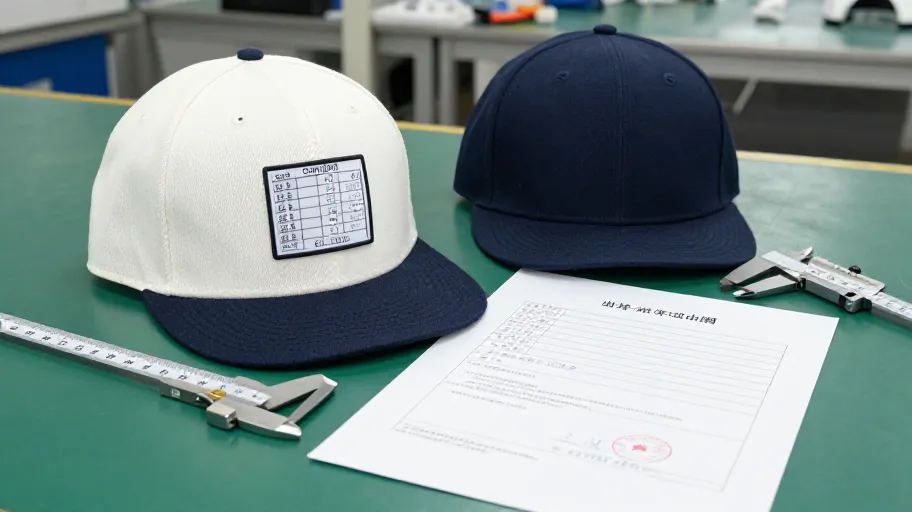
A Pacific Headwear fitted hat size chart is best treated as a starting reference rather than a final production standard: when you source custom fitted caps from a Chinese OEM/ODM factory, the chart tells you which sizes to order, but only a written specification and a signed-off physical sample confirm how each size will actually measure. This guide walks through the Size-Spec-Sample Loop — reference chart, written spec, physical sample, documented approval — so you can compare suppliers on process quality, not just price.
Why a fitted hat size chart is a reference, not a guarantee
Fitted hats have no adjustment strap, so every size in the run must hit its measurement target on its own. A published size chart gives you circumference ranges per size, but several variables sit between the chart and the finished cap:
- Construction and blocking. The crown height, panel count, visor curvature and brim stiffness all influence how a hat measures and how it feels on the head.
- Materials. Stretch content in the fabric, the sweatband and the closure-free back panel can change how a given circumference reads once the hat is worn.
- Measurement method. Circumference can be measured at different points, with different tension, on a flat hat or on a head form. Two charts that look identical may reflect different methods.
This is why experienced buyers never approve a fitted run against a chart alone. The chart is step one of a loop; the sample is where the real decision happens.
The Size-Spec-Sample Loop
Use this four-step loop on every fitted cap project:
- Reference chart. Start from the supplier's or brand's published size chart to define the size run — for example, which sizes from small through extra large you intend to offer.
- Written spec. Convert the chart into a specification: target measurements per size, measurement method, tolerance band, materials, and labeling. State the tolerance band as an agreed figure in your own spec conversation — do not assume it; confirm what the factory can commit to and document it.
- Physical sample. Request pre-production samples in the smallest and largest sizes of your run, at minimum. Wear them, measure them with the agreed method, and record results.
- Documented approval. Sign or email-approve the sample as the bulk reference, attaching photos and measurements, so any later dispute has a written anchor.
Repeat the loop if the sample misses the spec. A supplier's willingness to iterate here tells you more about the partnership than any brochure.
Decision table: comparing sizing references before you commit
| Comparison point | What to ask the supplier | Red flag to watch for |
|---|---|---|
| Chart source | "Is this chart based on your own production blocks, or a reference you adapted?" | A chart with no stated origin or measurement method |
| Measurement method | "Where and how is circumference measured — flat, on a form, and at what tension?" | Vague answers; method changes between sample and bulk |
| Size run coverage | "Which sizes can you produce in fitted construction, and in what size-to-size grade steps?" | Only part of the size run available; grade steps left undefined |
| Tolerance | "What measurement tolerance will you commit to in writing for bulk?" | Refusal to put a tolerance in the spec or contract |
| Sample sizes offered | "Can I get pre-production samples in my smallest and largest size, not just the middle size?" | Samples offered only in one size for a fitted run |
| Approval record | "Will you accept a signed sample approval as the bulk standard?" | No formal approval step between sample and bulk |
What to put in your written size spec
Before samples are made, send the factory a one-page spec covering:
- Full size run with target circumference per size, taken from the reference chart you have chosen
- The agreed measurement method (where the tape sits, on what surface)
- The tolerance band you expect per size, confirmed with the factory
- Crown height, panel count, visor type and closure-free back construction per size
- Sweatband, fabric and any stretch content that affects fit
- Label placement: size sticker, care label and brand label positions
- Packaging: how hats will be blocked, stacked and boxed so shape survives transit
Keep the spec in English and, where useful, request the factory confirm receipt in writing. Ambiguity at spec stage becomes cost at bulk stage.
Sample stage: questions to approve before bulk
Bring these questions to the sample review, and record the answers:
- Does each sample size measure within the agreed tolerance using the agreed method?
- Does the hat fit a real head in your target market, not just measure correctly — try it on at least one wearer per size range?
- Are the crown shape, visor curve and brim stiffness consistent across the smallest and largest sizes?
- Do size labels and stickers match the actual measured size of each sample?
- Has the factory confirmed in writing that this approved sample is the bulk reference, including any swatch or sample ID?
- If a correction is needed, what is the process and responsibility split for a revised sample?
If any answer is unclear, do not move to bulk. The sample stage exists precisely so that open questions are cheap to resolve.
Approval documentation checklist
- Reference chart selected and saved with source noted
- Written spec sent, with size run, measurement method and tolerance band
- Factory written confirmation of spec received
- Pre-production samples received in smallest and largest sizes
- Samples measured and fitted; results recorded with photos
- Corrections (if any) requested and re-sampled
- Signed or emailed sample approval, referencing sample ID and date
- Bulk spec pack archived: chart, spec, approval, correspondence
FAQ
Q1. Can I rely on a single universal fitted hat size chart across suppliers? Treat any chart, including the Pacific Headwear fitted hat size chart, as a starting reference. Construction, materials and measurement methods differ between makers, so always validate the chart against your own spec and sample rather than assuming it transfers directly.
Q2. Which sample sizes should I request for a fitted cap program? Ask for pre-production samples in the smallest and largest sizes of your run, and any size you consider commercially critical. Confirm with your supplier what sample options they can provide and what the current sample and shipping arrangements are — verify the current policy directly rather than assuming it.
Q3. What tolerance should I accept for fitted hat measurements? Tolerance is a negotiated commitment, not a given. Propose a band that suits your market and fit positioning, then confirm in writing what the factory can commit to for bulk. Never approve a run where tolerance is only stated verbally.
Q4. What happens if bulk goods measure outside the agreed tolerance? This depends entirely on the terms documented with your supplier — inspection criteria, remedies and responsibilities should be written into the purchase agreement before production starts. Raise it at spec stage, not after delivery.
Q5. How do size charts work for structured versus unstructured fitted caps? The size run logic is similar, but structured crowns and stiffer brims can change how a circumference reads in wear. Request samples in the specific construction you intend to order, and measure with the same method you will use for bulk inspection.
Ready to lock in your size spec?
Send us your 采购 Brief with your target size run, construction and market, and our team will come back with the reference chart, spec questions and sample plan your project needs.
获取采购 Brief →
Quick start — before your next supplier call:
- Size run and reference chart chosen
- Measurement method agreed
- Tolerance band to propose
- Sample size list ready
#cap manufacturers china, #headwear manufacturers china, #cap factory








