


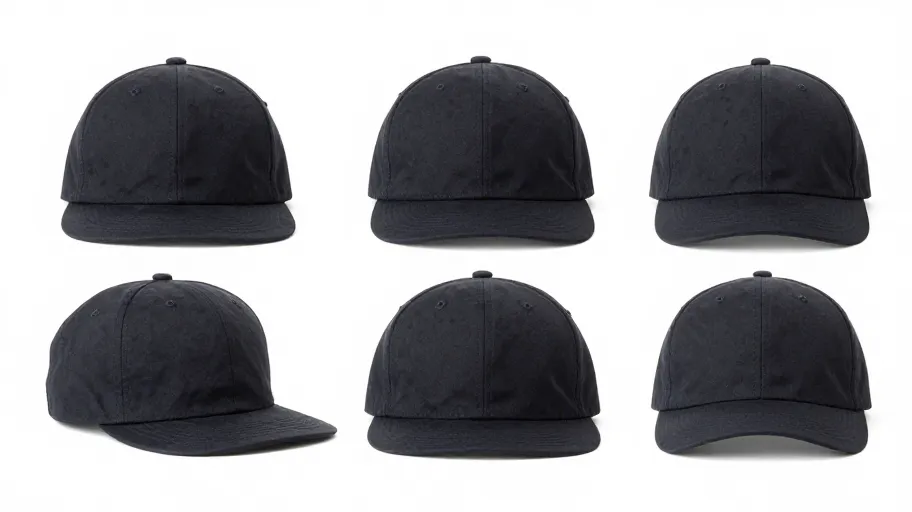
What is the difference between a 5-panel cap and a baseball cap? The difference is panel construction: a 5-panel cap has five fabric panels with a single front panel and no centre seam across the front, giving a clean uninterrupted surface for prints. A baseball cap is a category; its widely produced form is the 6-panel cap, whose front is split by a centre seam and topped with a structured button. For sourcing, panel count changes decoration fit, crown shape and how you must write the spec sheet — not simply the "style" of the product.
Why the question matters more to buyers than to consumers
A consumer asking "5-panel or baseball cap?" is asking about looks. An importer or brand buyer is asking something sharper: which structure carries my artwork, my construction tolerance requirements and my sampling budget without forcing a second round? That is a specification question, and specification questions deserve a framework rather than a preference.
The PANEL-SELECT framework
Before you issue a cap brief to any OEM/ODM partner, walk these nine checks:
- P — Panel count. Confirm the exact panel layout (5-panel, 6-panel, or another construction) in writing, with the front panel configuration stated.
- A — Application method. Decide how the logo will be applied — screen print, embroidery, woven label, patch — because panel layout determines the available uninterrupted surface.
- L — Logo fit. Map your logo dimensions against the front panel area. On a 5-panel front, the artwork sits on one continuous panel; on a 6-panel front, the centre seam can intersect artwork and embroidery registration.
- E — Environment of use. Where will the cap be worn — retail, uniform, promotional giveaway? This shapes material and closure choices you must document.
- L — Longevity expectation. Structured vs unstructured crowns, and how the crown holds shape over the product's expected life, should be defined in the brief and verified at sample stage.
- E — Entry barrier. Ask what the minimum order and sampling requirements are for each construction. Confirm the current policy directly.
- C — Cost structure questions. Ask which construction affects material usage, cutting complexity and decoration cost, and request a quotation that separates these lines. Confirm the current policy directly.
- T — Target user. Fit range, closure type (strapback, snapback, fitted) and sizing approach must be specified per market.
This framework does not tell you which cap is "better." It forces every variable into the spec sheet before a sample is cut, which is where re-sampling costs are actually prevented.
Decision table: 5-panel cap vs 6-panel baseball cap
| Axis | 5-panel cap | 6-panel baseball cap | What the buyer must document |
|---|---|---|---|
| Panel construction | Five panels; single continuous front panel | Six panels; front split by a centre seam meeting at a button | Exact panel layout and seam positions in the tech pack |
| Decoration surface | Uninterrupted front panel suited to large prints | Centre seam can intersect artwork; suited to embroidered centre-front logos | Artwork placement drawing relative to seams |
| Crown appearance | Flatter, lower-profile front | Classic structured dome when paired with buckram | Structured vs unstructured crown specification |
| Logo application fit | Prints and patches benefit from the seam-free front | Embroidery placement must account for the seam and button | Decoration method and registration tolerances agreed in writing |
| Visual category read | Streetwear and skate-heritage associations | Classic sport and uniform category read | Brand-positioning fit, not construction quality |
| Closure and fit | Confirm available closure options per style | Confirm available closure options per style | Closure type and size range per destination market |
| Sampling considerations | Confirm sampling requirements for this construction | Confirm sampling requirements for this construction | Confirm the current policy directly |
Note what this table does not claim: that one construction is more durable, cheaper to produce, or easier to source. Those outcomes depend on the specific factory, materials and programme — verify them per project rather than accepting category-level assumptions.
Construction terms to write into the spec sheet
Ambiguous terms cause re-sampling. When you brief a 5-panel or 6-panel programme, define:
- Panel layout — number of panels and the front configuration.
- Crown structure — structured (with buckram) or unstructured (soft).
- Button — present or absent; matched or contrast.
- Seam style — how panel seams are finished and stitched.
- Brim/visor — pre-curved or flat; material; stitching rows.
- Closure — snapback, strapback, fitted or other; size range.
- Eyelets — embroidered or punched; quantity and placement.
- Sweatband — material and construction method.
Ask your supplier to confirm each line item in writing before samples are cut, and attach the confirmed sheet to the approval record.
Sample approval: questions to ask before you sign off
Whether you approve a 5-panel or 6-panel sample, the same approval questions apply. Put these to your OEM/ODM partner in writing:
- Please confirm the exact panel construction of this sample matches the spec sheet line by line.
- Please confirm how the logo placement will be measured against the front panel or centre seam in production.
- For embroidery, please confirm how the seam and button areas are handled at registration.
- Please confirm the crown structure (structured vs unstructured) and the interlining used.
- Please confirm what happens if the pre-production sample differs from the approved sample, and how differences are documented.
- Please confirm the sampling terms for this construction and any revisions. Confirm the current policy directly.
- Please confirm which inspection points you check at final inspection, and whether the approved sample travels with the inspection file.
Sample approval checklist
Before approving, physically verify:
- Panel count and front configuration match the spec sheet
- Seam positions and stitching match the approved drawing
- Logo placement measured against the documented reference points
- Crown structure and shape match the confirmed specification
- Closure function and size range verified
- Brim shape and stitching verified against the spec
- Sweatband, eyelets and trims match the bill of materials
- All deviations from spec documented and approved in writing
A sample approved without a documented deviation list is not an approval — it is an opinion. Insist that every difference between sample and spec sheet is written down and either corrected or formally accepted before production is authorised.
FAQ
Which is better for a large printed logo — 5-panel or 6-panel? For large front prints, the 5-panel's uninterrupted front panel avoids seam interruption. A 6-panel front places a centre seam through the decoration area, which can affect print continuity. Verify the artwork-to-panel relationship with your supplier's sample before committing.
Is a baseball cap always a 6-panel cap? No. "Baseball cap" names a category defined by crown and brim shape; panel count is a construction detail within it. Confirm the exact panel layout in the spec sheet rather than relying on the category name.
Which construction suits embroidery better? Both constructions can carry embroidery, but placement differs. On a 6-panel cap, centre-front embroidery must account for the seam and button. Ask your supplier to confirm registration handling at sample stage rather than deciding from category assumptions.
How do I avoid re-sampling rounds when ordering from a China OEM/ODM manufacturer? Document panel layout, crown structure, closure, decoration placement and all trims in a written spec sheet; require line-by-line confirmation before sampling; and approve against the checklist above with deviations recorded in writing. Sampling terms themselves vary by project — confirm the current policy directly.
Do 5-panel and 6-panel caps require different bills of materials? They may differ in panel fabric quantities, interlining and trim placement, but the exact bill of materials depends on your chosen materials and construction details. Request the BOM per construction and compare quotations line by line.
Next step
If you are briefing a custom cap programme and want the construction, decoration and approval variables captured in one document before you contact a factory, 获取采购 Brief — request our sourcing brief and turn the 5-panel vs baseball cap question into a verified specification.
Prefer something lighter first? Download the one-page sample approval checklist above and take it into your next supplier call — it works for any panel construction.
#cap manufacturers china, #headwear manufacturers china, #cap factory








