


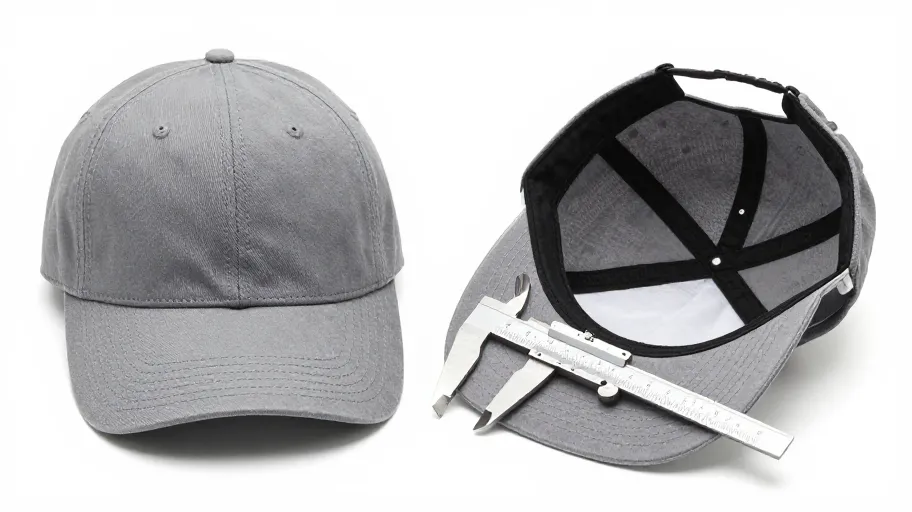
When you send your first brief to a baseball cap manufacturer, the measurements buyers leave out are the ones that decide fit and cost: crown height, visor length and curvature, panel count, closure type and sweatband placement. A structured brief built around the C.A.P. Framework — Crown specs, Assembly details, Profile and fit — lets you compare suppliers on technical rigour instead of promises. Every policy question below must be confirmed directly with each manufacturer, because none of those terms were supplied for this article.
Why the first brief decides whether quotes are comparable
Most sourcing teams have experienced this: three suppliers return three quotes for "the same" cap, and the samples that follow fit three different ways. The root cause is rarely dishonesty. It is a brief that never specified what "the same" means in millimetres and materials.
A baseball cap is a small product with a long specification tail. A single style can vary across panel count, crown construction, visor shape, eyelet treatment, sweatband width, closure type, stitching density and finishing method. When your brief names only colour and logo, each manufacturer fills the gaps with its own house defaults. The result is three different products wearing the same description — and a comparison exercise that collapses before it starts.
The fix is not a longer brief. It is a brief structured so that every measurement that affects fit, appearance and unit cost is either specified or explicitly flagged as "supplier to propose, buyer to approve."
The C.A.P. Brief Framework: Crown, Assembly, Profile
Use this framework to audit your first brief before it leaves your desk.
C — Crown specifications. Crown height at front and side, panel count, seam treatment, buckram or lining choice, eyelet style and placement. These measurements define the silhouette and how the cap holds shape after washing or shipping.
A — Assembly details. Visor length and width, visor curvature, visor material layers, sweatband material and width, stitching count per inch, button construction, and closure type — snapback, strapback, buckle, elastic or fitted. Assembly choices drive cost and durability more than fabric choice does.
P — Profile and fit. Structured versus unstructured crown, low versus mid versus high profile, brim break, head-size range the pattern is graded for, and how the closure adjusts within that range. Profile is what your end customer feels; it cannot be corrected after production.
Decision table: what to specify, and what happens if you don't
| Measurement group | Approval question to answer in the brief | Risk if left unstated |
|---|---|---|
| Crown height and panel count | Have you stated exact crown heights at front and side, and the panel count? | Each supplier defaults to its own block; samples fit differently |
| Visor length, width, curvature | Is visor geometry specified, including pre-curve angle? | Re-sampling rounds to correct shape; timeline and cost drift |
| Closure type and adjustability | Is the closure named, with the size range it must cover? | Fit range mismatches your market's head sizes |
| Sweatband material and width | Is the sweatband spec written, including attachment method? | Comfort and moisture behaviour differ across samples |
| Stitching and seam finishing | Are seam types and stitch density documented per seam? | Visible quality differences you cannot claim against later |
| Logo application | Is the decoration method, placement coordinates and scale defined? | Logo size and position vary; branding consistency lost |
| Materials and colour standards | Are fabrics referenced to a physical standard or reference swatch? | Colour disputes with no documented benchmark |
Every row in this table is a written specification or a written question. None of it assumes any supplier's capability — it assumes you document what you approve.
Concrete approval questions to send any baseball cap manufacturer
Before you release a brief, send these questions and require written answers:
- What measurements do you need from us that are missing in this brief — and what will you propose if we leave them open?
- Which measurements can you hold to a documented tolerance, and how will that tolerance be recorded on the spec sheet?
- How many measurement points do you check on the first sample, and will you send the measurement sheet with the sample?
- What is your current policy on sampling charges, revisions and re-sampling — who bears what, and under which conditions?
- What are your current MOQ, lead time and capacity terms for this specification, and what would change them?
- Which certifications or test reports can you provide current evidence for, applicable to our destination market?
- What happens in production if a measurement falls outside the agreed spec — what is the documented escalation and remedy path?
Question 1 is the most revealing. A manufacturer that reads your brief and asks precise follow-up questions about crown height, visor curve and closure grading is demonstrating the technical rigour you are paying for. A supplier that answers "no problem, we can do everything" without a single measurement question has told you something too.
Reading supplier responses as a selection signal
Comparing manufacturers on claims is weak. Compare them on behaviour:
- Spec discipline. Does the reply restate your measurements in writing, or only acknowledge them? Restatement creates the paper trail you need if a dispute arises.
- Tolerance honesty. Does the supplier state what it can and cannot hold precisely? A supplier that names its limits is easier to work with than one that promises everything.
- Policy transparency. Sampling, revision, MOQ, lead time and remedy terms must be confirmed in writing for your specific project. Do not rely on assumptions from prior projects or other buyers — policies change and are project-specific.
- Question quality. The best technical questions back are a stronger signal than the best brochure.
Document every answer. A Supplier Scorecard turns these behaviours into comparable entries across your candidate list, so the final award decision rests on evidence.
Pre-sample approval checklist
Run this checklist before you approve any first sample:
- Crown height, panel count and structure stated in writing
- Visor length, width and curvature specified
- Closure type and size-adjustment range documented
- Sweatband material, width and attachment method documented
- Stitching and seam finishing described per seam
- Logo method, placement and scale defined with coordinates
- Materials referenced to a physical colour standard
- Measurement sheet requested alongside the physical sample
- Sampling, revision, MOQ, lead time and remedy policies confirmed in writing
- All open items flagged "supplier to propose, buyer to approve"
FAQ
Which measurement causes the most re-sampling with baseball cap manufacturers? No single answer applies to every project, and no external data was supplied for this article. From a brief-structure perspective, visor geometry and closure grading are the specifications buyers most frequently leave open — and each supplier then applies its own defaults. Specify both in your first brief to keep samples comparable.
How do I compare two manufacturers when both say "we can do it"? Ask both the seven approval questions above and compare the written answers. Focus on whether each supplier restates your measurements, names its tolerance limits, and confirms current policies in writing. Behaviour under technical questioning is more comparable than marketing language.
Should I send a reference sample with the brief? A physical reference can reduce ambiguity, but it does not replace a written spec. Send the reference together with a documented measurement sheet so the supplier must confirm values rather than interpret a sample visually.
What tolerance should I demand on cap measurements? This article deliberately states no numerical tolerance, because the right tolerance depends on the construction, material and your market's expectations. Ask each baseball cap manufacturer what tolerance it can document per measurement point, then approve a written figure for your project.
How do I handle a measurement dispute after production? Prevention beats remedy: a spec sheet with approved measurements, written tolerances and a documented escalation path is what you rely on. If a dispute arises, your leverage is the paperwork — which is why every approval in the brief stage must exist in writing.
Get the comparison tool
Download the Supplier Scorecard and turn the questions above into a side-by-side evaluation of every baseball cap manufacturer on your shortlist — measurement discipline, policy transparency and response quality in one document.
Not ready for the full scorecard? Start small: copy the pre-sample approval checklist above into your next brief and confirm the open items with your supplier in writing.
#cap manufacturers china, #headwear manufacturers china, #cap factory








