

A baseball cap tech pack is the document that converts your design intent into measurable, approvable production terms. Before you request a quotation, it should lock down component construction, written tolerances, finish standards, colour references, closure behaviour and packaging specification. Without those, every disagreement becomes opinion rather than evidence. This guide gives you a framework to build one that holds up across revisions, samples and shipment approval.
Why tolerances, finish and packaging carry the weight
Most sourcing friction around custom caps is not about the design sketch. It is about what happens when the produced article sits next to the approved one. Three areas decide whether you can document a difference or merely argue about it:
Tolerances. A cap is a soft product assembled from panels, visor, sweatband, closure and trim. Every one of those components can drift in cutting, stitching and assembly. If your tech pack does not state measurable acceptance limits for the dimensions that matter to your brand — crown height, visor length, visor shape, closure span, stitch density per unit length — then you have no documented benchmark to approve or reject against. The exact numeric limits are yours to set and negotiate with the supplier; what matters is that a number exists and both parties have signed it.
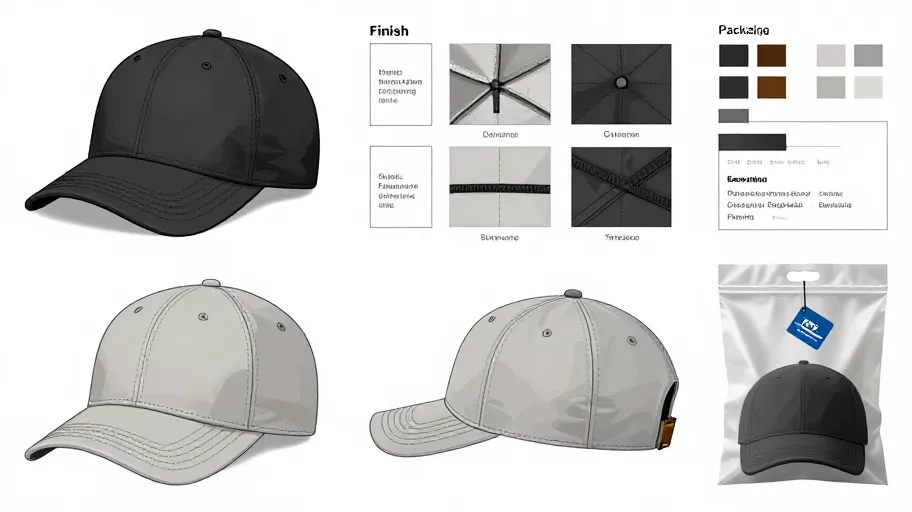
Finish. Finish is where visual quality is won or lost: thread trimming, seam neatness, embroidery or print registration, visor edge binding, eyelet cleanliness, button attachment, pressing and final presentation. Finish defects are the hardest to argue about after shipment because "neat" and "acceptable" mean different things to different people. Your tech pack should attach a physical or photographic approved reference for each finish element, and state that the reference governs.
Packaging. Packaging belongs in the tech pack, not in a later email. If it is unspecified, someone else decides how your product reaches your warehouse: whether caps are crushed flat or shaped, what inner protection is used, how cartons are marked, and what happens for e-commerce single-unit shipping versus wholesale bulk. Packaging faults discovered at destination are expensive precisely because the caps themselves may be flawless.
The SPECS Gate framework
Before any production commitment, walk your baseball cap tech pack through five gates. Each gate produces a document, a measurement or a reference sample — something you can point to later.
S — Structure. Define construction: panel count and pattern, visor layers and stitching rows, sweatband type, eyelet style, button construction, buckram or lining choices. Attach the pattern file or graded spec if your brand owns it.
P — Panel and pattern evidence. Approve a physical counter sample per colourway, photographed against the tech pack. Record which revision the sample represents and the date it was approved.
E — Edge and finish. For every visible edge and seam — visor binding, seam allowances, thread ends, closure attachment — name the finish method and attach the approved reference. State who inspects finish and at which stage.
C — Colour and closure. Lock colour via a physical standard (such as a swatch or Pantone reference confirmed by the supplier) and specify closure type, adjustment range and behaviour. Colour disputes are unwinnable without an agreed physical reference; closure failure is a functional defect, not a cosmetic one.
S — Specification of packaging. Specify inner packing, shape retention, carton quantity, labelling, barcode placement and any retail or e-commerce presentation requirement. Packaging is a deliverable with acceptance criteria, equal in status to the cap.
Decision table: what to lock down versus what to leave open
| Tech pack element | Lock down before quotation | Reason to fix or leave open | Risk if left vague |
|---|---|---|---|
| Construction and pattern | Yes | Defines the product and tooling | Supplier substitutes a different pattern |
| Dimensional tolerances | Yes | Creates the acceptance benchmark | No measurable basis to approve or reject |
| Finish references | Yes | Removes subjective judgement | Visual disputes with no evidence |
| Colour standard (physical) | Yes | Screen colour cannot govern | Entire shipment in the wrong shade |
| Closure and sizing | Yes | Functional, safety and fit critical | Returns and fit complaints |
| Packaging and carton spec | Yes | Determines condition on arrival | Crushed, mislabelled or unscannable goods |
| Test requirements | Decide case by case | Must be confirmed as available with the supplier | Assumed testing that never happens |
| Delivery method and incoterms | Confirm separately | Commercial, not technical, terms | Cost surprises at destination |
Approval questions to send your supplier
Turn every unknown into a written question before you commit. Send this list, and file the answers inside the tech pack:
- Which dimensional tolerances can you commit to in writing for crown height, visor length and closure span on this style?
- Can you work from our physical colour reference, and how do you verify colour match before bulk production?
- What inspection stages exist for finish and construction, and what documentation will we receive?
- Can you produce and approve a counter sample per colourway, and what is your current sample policy, including any fees? (Confirm the current policy directly.)
- What are your current minimum order quantities and lead times for this construction? (Confirm directly — do not rely on earlier quotations.)
- What packaging options can you supply — polybag, shaped inner, retail header card, e-commerce-ready single-unit — and how should we specify carton marking?
- How do you handle version control, and who signs off each revision on your side?
- What testing or compliance documentation can you provide for the materials in this cap, and what would you need from us to obtain it?
- If a shipment fails an agreed tolerance or finish check, what is your correction process?
None of these questions assumes an answer. Their purpose is to move every material fact from conversation into the document where it can be audited.
Version control: the quiet discipline that saves programmes
A baseball cap tech pack that changes by chat message is not a tech pack; it is a rumour. Keep a revision log on the front page: revision number, date, what changed, who approved it on each side. Every sample should reference a revision number. When a dispute arises, the question becomes "which revision does this article represent?" — a question with an answer, rather than an argument.
FAQ
How detailed should tolerances be in a cap tech pack? Detailed enough that a third party could measure the cap and rule pass or fail without asking your opinion. Decide with your supplier which measurable dimensions govern the style — you set the limits together, and both parties sign them. Avoid relying on any single numeric value until your supplier has confirmed what it can hold in production.
Can I use photos instead of physical samples for finish approval? Photos help communicate intent, but a physical approved reference removes ambiguity about texture, sheen and stitching quality. Where shipping a reference is impractical, photograph the approved sample in defined lighting and state that the image governs; just document whichever standard you choose inside the tech pack.
Should packaging really sit inside the tech pack? Yes. Packaging determines the condition in which your customer first encounters the product, and packaging faults at destination are among the hardest to resolve after the fact. Specify inner protection, shape retention, carton quantity, marking and any retail presentation requirement exactly as you specify stitching.
What if my supplier pushes back on written tolerances? Treat that as diligence information. A supplier that resists measurable acceptance criteria is telling you how future disputes will be resolved. Compare suppliers on their willingness to document commitments, not only on their samples.
How do I keep colour consistent across reorder seasons? Retain the physical colour standard, reference it by revision in every order, and ask your supplier to verify match before bulk cutting for each order. Confirm with them directly how colour verification is documented on their side.
Your next step
Build the document before you build the product. A disciplined baseball cap tech pack shortens sampling rounds, reduces disputes and gives both parties a shared definition of "approved".
[下载 Tech Pack Checklist] — get the full SPECS Gate checklist and start your tech pack today.
Prefer to start smaller? Download the one-page tolerance and finish question list and send it to your supplier this week — no commitment required.
#cap manufacturers china, #headwear manufacturers china, #cap factory