


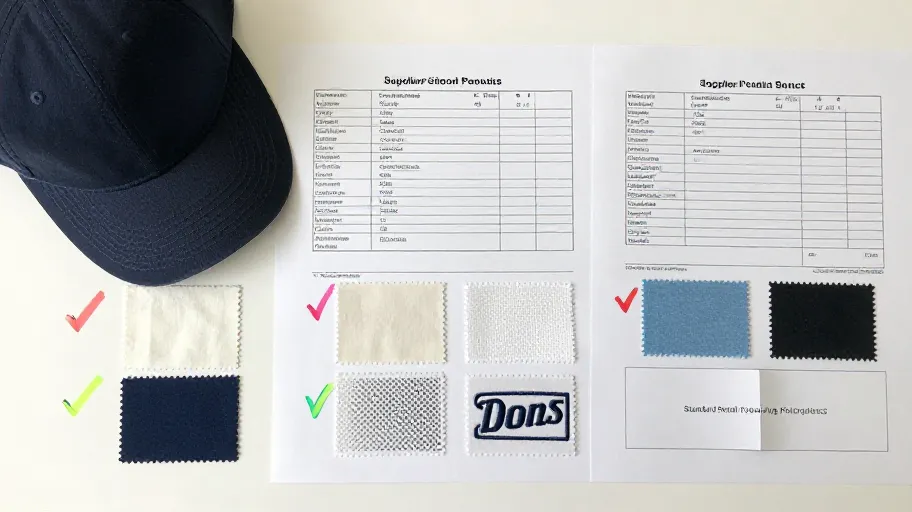
A baseball cap tech pack is the only neutral reference that lets you compare two supplier quotes line by line. Instead of judging totals, you map each quotation back to your documented spec — crown panels, brim, closure, materials, branding method, packing — and flag every line where the two suppliers are quoting different things. The method below turns that comparison into a repeatable audit you can run before any deposit moves.
Why two quotes are never directly comparable without a tech pack
When two quotations arrive, the totals invite a decision the totals cannot support. One supplier may have quoted a different closure, a different embroidery count, a different fabric weight or a different packing arrangement. Without a baseball cap tech pack acting as the single reference document, you have no way to know which lines differ, or why.
The problem is not dishonesty. It is ambiguity. Two suppliers reading a loose brief will each fill the gaps differently, and those interpretations surface as price differences that look like savings or overcharging but are in fact scope differences.
The Line-by-Line Quote Audit (LQA) framework
The LQA framework has three steps:
Step 1 — Anchor. Freeze your tech pack at a named version (for example, "Tech Pack v2, dated") and require both suppliers to quote against that exact version in writing. If a supplier rewrites your spec in their own format, treat their rewrite as a new document to reconcile, not as your spec.
Step 2 — Normalise. Build a single table with one row per spec attribute and one column per supplier. For every row, record what each supplier actually quoted — not what you assumed. Where a supplier is silent on a line, write "not specified" rather than guessing.
Step 3 — Interrogate. Every mismatch becomes a written question to the supplier. Every answer becomes a documented amendment. You approve only when both columns align with the tech pack or when you have consciously accepted a documented deviation.
The comparison table
| Tech pack line | Supplier A quote says | Supplier B quote says | Audit question to ask |
|---|---|---|---|
| Crown construction | Stated panel count | Different panel count | Which panel count matches tech pack v2, and is the change quoted as equal or as a deviation? |
| Brim / visor | Material named | Material not named | Confirm brim material, interlining and stitching to match tech pack |
| Closure | One type quoted | Different type quoted | Confirm closure type, adjustability range and branding on the strap |
| Main fabric | Fibre and construction named | Fibre named, construction not specified | Confirm fabric construction and finish; request the mill reference used for the quote |
| Branding method | Embroidery, stitch count stated | Embroidery, no stitch detail | Confirm stitch count, placement measurements and thread colours by reference |
| Secondary trims | Listed | Absent from quote | Confirm eyelets, sweatband, taping, buttons and labels are inside or outside the quoted scope |
| Packing | Described | Not specified | Confirm inner packing, carton quantity and labelling requirements |
| Sample stage | Referenced | Not referenced | Confirm how pre-production samples are handled and approved before bulk |
| Tooling / setup | Listed as separate line | Not shown | Confirm whether setup or digitising is charged, and under what terms |
| Freight | Excluded | Unclear | Confirm Incoterms, port and who arranges freight for this project |
Treat any row where a supplier will not confirm in writing as an open risk, not a settled line.
Costs that sit outside the unit price
Several cost categories can sit outside the quoted unit price, and every one of them is project-specific. Do not assume — ask each supplier directly:
- Sampling: what the current sample policy is, and what it covers
- Setup and digitising: whether it exists, what it covers, and whether it recurs on repeat orders
- Freight and Incoterms: which terms the quote is based on, and which charges sit outside it
- Payment milestones: what deposit and balance structure applies to this project
- Amendments: how a change after approval is priced and documented
None of these can be stated as a rule here. They vary by supplier and by project, so the only safe number is the one written into your quotation.
Specification lines that drift most easily
Construction details are where scope quietly shifts. Pay particular attention to:
- Panel count and seaming style, which changes the silhouette and the labour content
- Brim construction, including interlining layers and binding, which changes hand feel and shape retention
- Closure hardware, where substitute types alter both fit range and perceived quality
- Branding execution: stitch count in embroidery, ink coverage in printing, and the exact placement coordinates from your tech pack
- Sweatband and internal taping, which buyers rarely see in photos but will feel in the product
Each of these belongs in your tech pack as a measurable, checkable attribute, and each deserves its own row in your comparison table.
Approval discipline: confirm in writing before anything moves
A quote audit only protects you if the outcome is documented. Before approving:
- Both suppliers have confirmed the tech pack version in writing.
- Every mismatch row has a written answer, and the answer is attached to the quote.
- Any deviation you accept is described, priced and dated — not agreed verbally.
- Your internal approver signs off on the reconciled table, not just the winning total.
The purpose is not paperwork for its own sake. It is that when a dispute, delay or substitution appears later, your position rests on a documented chain: tech pack version → quoted lines → written confirmations → approved sample.
Frequently asked questions
Should I send the same tech pack to both suppliers? Yes — the identical version, unchanged. If a supplier requests changes, log them as proposed deviations so both quotes remain comparable.
What if one supplier's quote is noticeably lower on the same spec? Ask, in writing, which line they priced differently: fabric grade, trim sourcing, branding density, packing or something outside the unit price. A lower total on the same nominal spec means the scope is not the same somewhere.
How detailed does a baseball cap tech pack need to be for quote comparison? Detailed enough that every line in the table above can be checked without interpretation. If a supplier has to assume a value, the tech pack has a gap.
Should I decide based on the sample or the quote audit? Both, in sequence. The quote audit decides which supplier you proceed to sampling with; the approved sample then becomes the reference for bulk. Skipping either step leaves you comparing different things.
What if a supplier won't answer line-by-line questions? That is itself an audit result. A supplier's willingness to confirm scope in writing is part of what you are evaluating.
Before you compare your next two quotes
Run both quotations through the same audit: anchor to one tech pack version, normalise every line, interrogate every mismatch, and approve only against written confirmations.
[Download the Tech Pack Checklist] and use it as the working document for your next supplier comparison — every line item, every confirmation question, every approval gate in one place.
Prefer to start smaller? Skim the checklist and mark just the five lines that matter most to your first order — that alone will make your next two quotes comparable.
#cap manufacturers china, #headwear manufacturers china, #cap factory








