


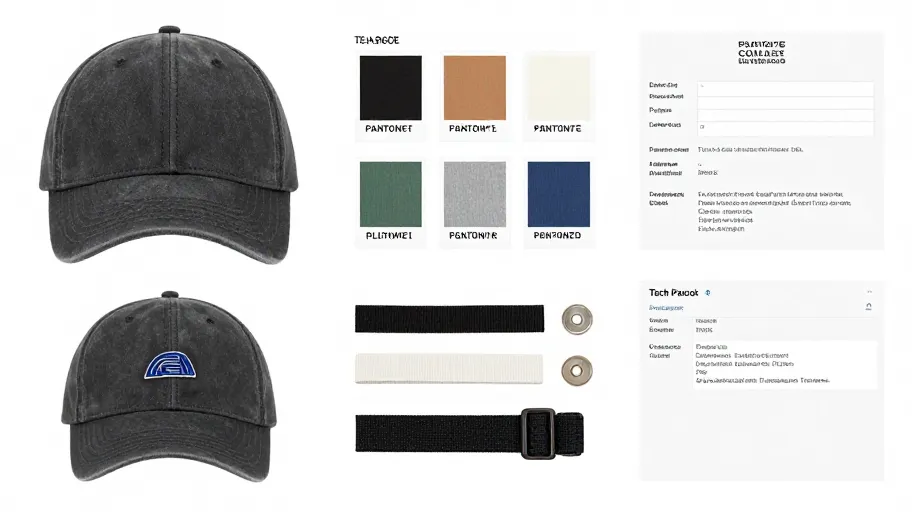
Before you sign off on a baseball cap tech pack, keep three things on file: a version-controlled specification (panels, brim, closure, materials, embellishment method), physical references such as approved counter-samples and colour standards, and a dated written trail confirming the supplier accepted each revision. If any of these is missing, your approval rests on assumptions rather than evidence.
This article walks through a practical framework for that final gate. It is written for product developers and brand founders preparing to place a custom headwear order with an OEM/ODM manufacturer, and it deliberately avoids assuming any policy on pricing, samples, minimums or timelines — those must be confirmed directly with your supplier for your specific project.
The Lock–Trace–Approve framework
Final sign-off is not a single moment; it is the end of a documented sequence. The framework below keeps the decision auditable:
- Lock — Freeze every specification in a numbered version. Any change after the freeze date requires a new version, not an edit.
- Trace — Attach evidence to each locked element: approved samples, swatches, trim cards, and written supplier confirmations.
- Approve — Sign off only when every line item in the spec has at least one piece of traceable evidence behind it.
The value of this approach shows up when something changes after approval — a material substitution, an embellishment adjustment, a packaging update. With a locked and traced record, the conversation is about a specific document version, not competing recollections.
Core components of a cap tech pack
Use the decision table below when assembling your spec. The right-hand column tells you what evidence to demand for each element before you approve it.
| Tech pack element | What to specify | Evidence to keep before sign-off |
|---|---|---|
| Crown and panels | Panel count, construction method, seam placement | Approved sample or reference photo matched to a spec version |
| Brim (visor) | Shape, curvature intent, structure material | Physical counter-sample labelled and dated |
| Closure | Closure type (e.g., strap-and-buckle, snap, elastic) and adjustment range | Approved trim card or component reference |
| Sweatband and lining | Material, stitching method, attachment | Sample or material swatch referenced in writing |
| Fabric and colour | Fibre content, weight, finish, colour standard | Colour standard (e.g., named reference) plus supplier's written confirmation of the dye lot basis |
| Embellishment | Method (embroidery, printing, appliqué, patch), placement, dimensions expressed as proportions or on a scaled drawing | Digitised artwork file with revision number; approved embellishment sample |
| Labels and branding | Woven/care labels, placement, language content | Approved label artwork and placement photo |
| Packing | Folding method, inner packing, carton marking | Written confirmation tied to a spec version |
Note that specific dimensional tolerances, defect criteria and inspection levels are project-specific. Ask your supplier to state in writing which tolerances and acceptance criteria they will work to, and record that statement in the tech pack rather than assuming a shared default.
Evidence to retain at each stage
Documentation falls into three buckets. Keep all three.
Documents. The numbered spec versions themselves; artwork files with revision numbers; any supplier-issued technical drawings; written acceptance criteria; and correspondence in which the supplier explicitly confirms a version, not just acknowledges receipt of a file.
Physical references. Approved counter-samples, embellishment samples, fabric and trim cards, and colour standards. Label each with the spec version it corresponds to and the date of approval. Physical references matter because words like "navy" or "medium brim" mean different things to different people.
The communication trail. Dated confirmations, meeting notes summarising agreed changes, and a simple change log: what changed, why, who approved it, and in which version. If approvals happen in a chat tool, export or summarise them into the change log so the record does not live only in an app.
Approval questions to ask before sign-off
Run these questions with your supplier before you approve. Their answers — in writing — become part of the record:
- Which spec version do you confirm as the production basis, and who at your company has authority to confirm it?
- Which tolerances and acceptance criteria will you apply, and will you state them in the tech pack?
- What is your current policy on pre-production samples and counter-samples, including how they are approved and retained? Confirm directly, as policies differ and change.
- How will you handle a requested change after a version is locked, and how will that change be documented?
- What inspection and reporting will you provide relative to the locked spec, and can the acceptance criteria be referenced in that reporting?
- What are your current terms regarding samples, fees, revisions and order-specific policies? These must be confirmed for your project rather than assumed.
None of these questions presumes any particular answer. Their purpose is to convert unknowns into documented commitments before your signature makes them binding.
Red flags that justify delaying approval
Delay sign-off if you encounter any of the following:
- The supplier confirms "everything is fine" without referencing a specific spec version.
- Physical samples and the written spec disagree, and no one has decided which governs.
- Embellishment artwork has been revised but the revision number and approval trail have not.
- Colour is described only in words, with no standard or swatch anchored to the file.
- Policy questions (samples, fees, revisions) are answered verbally with nothing in writing.
- Changes are made directly in shared files with no change log.
Any of these can be resolved quickly — but resolving them before sign-off costs a message, while resolving them after production starts costs far more.
Frequently asked questions
What is the difference between a baseball cap tech pack and a purchase order? A tech pack defines what to make — construction, materials, embellishment, tolerances and evidence. A purchase order defines the commercial terms. The tech pack should be referenced by the purchase order so the technical record carries contractual weight.
Who owns the tech pack once it is sent to the manufacturer? Ownership of the documents is something to state in writing before sharing files, especially for original artwork and branding. Confirm intellectual-property terms directly with the supplier for your project.
How detailed should embellishment specifications be? Detailed enough that a third party could verify the result without asking you: method, placement, proportions, thread or ink references where applicable, and the approved sample tied to a version number.
Should I approve from photos alone? Photos help track progress, but for final sign-off retain physical references where possible. Confirm with your supplier how approved samples will be created, shared and retained under their current policy.
Can a tech pack be changed after sign-off? It can, through a new version with a documented change log. What creates risk is undocumented change — edits without revision numbers or approvals that cannot be traced to a version.
Pre-sign-off evidence checklist
- Every tech pack element has a version number and lock date
- Physical samples/swatches labelled with the matching spec version
- Colour standards referenced, not described in words only
- Embellishment artwork filed with revision numbers
- Supplier has confirmed the governing version in writing
- Tolerances and acceptance criteria stated by the supplier, in the document
- Change log current; no undocumented edits
- Sample, fee and revision policies confirmed directly for this project
Download the Tech Pack Checklist and run it against your spec before your next sign-off. Prefer to start with a conversation? Reach out and we will walk through your baseball cap tech pack together — bring your current spec version and we will review the evidence gaps with you.
#cap manufacturers china, #headwear manufacturers china, #cap factory








