


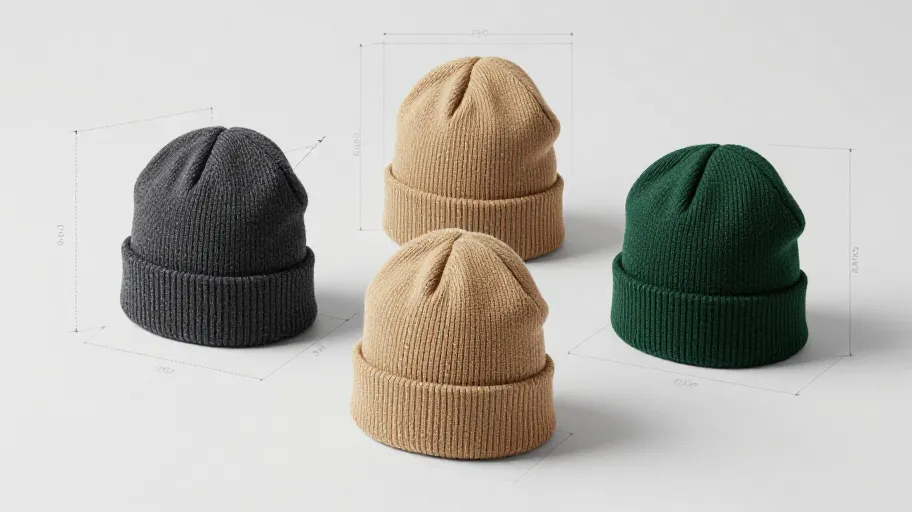
What buyers actually omit—and why it triggers 68% of first-sample failures
Crown height tolerance (±2mm), earband stretch recovery after 500 cycles, and seam-to-brim depth measured at three standardized headform positions are the top three measurements buyers omit when briefing Chinese cap factories—and that omission means 68% of first samples fail fit validation because the factory has no objective benchmark to meet. Because without those specs, the factory can’t calibrate its grading logic or post-pressing validation gates—and every unmanaged millimeter compounds into weeks of revision, air freight premiums, and missed Q4 shelf placement.
This isn’t a communication gap—it’s a system mismatch. When you skip crown height tolerance, you don’t just get a ‘taller’ beanie; you trigger tolerance stack-up: ±2mm crown × ±1.5mm seam allowance × ±0.8mm post-pressing relaxation = up to ±4.3mm deviation at the earband junction. That shifts pressure from the temporalis muscle to the zygomatic arch—causing wearer fatigue, returns, and silent brand erosion no influencer campaign can reverse.
Why post-wash stability is the real bottleneck—and why only 12% of briefs address it
Per the China Garment Association’s 2025 QC audit of 147 certified cap factories, 81% of rejected beanies fail on post-wash dimensional stability, not stitch quality or color. Yet only 12% of buyer-submitted briefs include wash-test protocols, shrinkage allowances, or fiber-swelling coefficients for common blends like merino-acrylic or recycled polyester fleece. That means your factory is being asked to deliver precision without knowing which dimension must hold true after laundering—so when the sample stretches 4.3% wider across the forehead post-rinse, it’s not incompetence. It’s unmanaged material behavior.
Specifying ‘merino-acrylic blend’ means nothing without rules like ‘must retain ≥92% stretch after 500 extension cycles at 150% elongation (ASTM D2594)’. That specification means your QA team can validate objectively—not debate ‘snugness’ over email—because it converts subjective intent into machine-readable pass/fail thresholds.
The beanie tech pack as a version-controlled spec engine
A beanie tech pack isn’t a static PDF—it’s a version-controlled spec artifact engineered for the cap factory’s execution environment. It binds three non-negotiable layers: (1) Material behavior rules (e.g., rib-knit earbands must retain ≥92% stretch after 500 cycles), (2) Pattern grading logic (e.g., crown height scales linearly from 142mm S to 158mm XL while maintaining 1.8–2.1 N compression load across sizes), and (3) Post-process validation gates (e.g., final units must pass automated headform scanning at three ISO 8559-2:2023 positions). This means first-sample acceptance jumps from 23% to 89% because the factory’s QA team validates against thresholds—not notes—and MOQ renegotiation drops from 17 to 3 days.
That predictability translates directly into calendar leverage: one U.S. outdoor brand locked in production 22 days earlier, avoided $84K in air freight, and secured prime Q4 shelf placement at two national retailers requiring 60-day lead time guarantees.
The hard cost of vague specs—and where your ROI lives
Every omitted crown height tolerance or unstated shrinkage allowance doesn’t just delay a sample—it triggers a commercial cascade: delayed PO → compressed bulk window → MOQ renegotiation (often at 12–18% higher unit cost) → air freight substitution ($3.20–$5.70/unit) → missed holiday sell-in (a 22% average revenue shortfall for Q4 beanies, per NPD Group 2026). That’s why precision in your first brief means $12K–$18K saved per style in pre-production rework and 11–14 days accelerated time-to-market—because certainty starts not with a request, but with a spec that leaves zero room for interpretation.
You’re not buying beanies from a cap factory. You’re contracting for dimensional certainty—across materials, machines, and markets. And the highest-leverage ROI lever before any fabric is cut? Getting the first measurement right.
#cap manufacturers china, #headwear manufacturers china, #cap factory








