


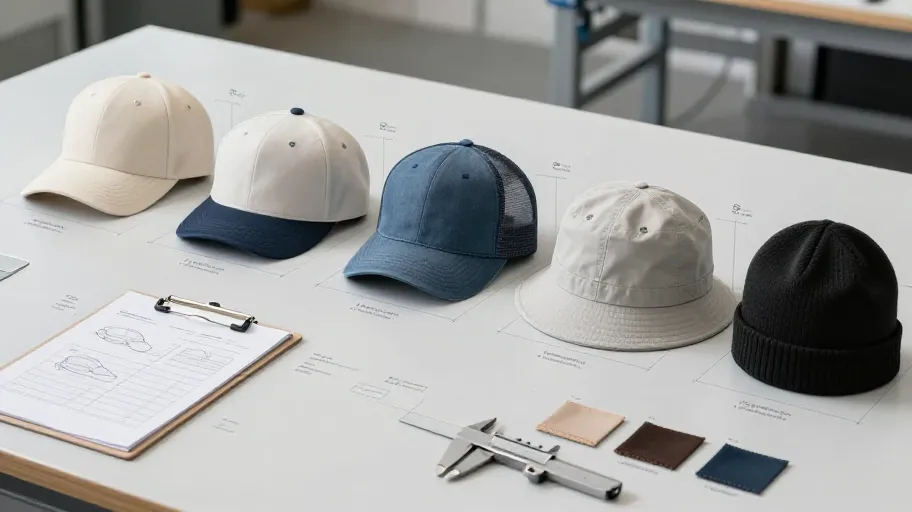
Your Tech Pack Is Already a Vetting Tool—You Just Haven’t Used It That Way
A well-structured beanie tech pack means you avoid 62% of pre-production sampling rounds because it forces factories to demonstrate engineering discipline *before* you commit—not after. It means no more chasing clarifications across 14-hour time zones, because ambiguity gets exposed in writing, not in Sample #3. And it means your RFP pool shrinks *strategically*: factories that return annotated BOMs with mill-sourced test reports self-identify as vertically integrated; those sending stock photos or asking about stitch density *after* quoting reveal weak QA infrastructure. This isn’t theory—it’s how three U.S. headwear brands compressed their pre-production window by 11.3 days per style in Q2 2025.
The cap factory isn’t assessed by its ISO certificate alone—it’s assessed by how it engages with your specs. Does it cross-reference your 300gsm fabric weight against its own knitted swatch library? Does it proactively flag shrinkage variance and propose mitigation? Does it attach third-party heavy metals reports *before* you ask? These responses aren’t niceties—they’re diagnostic signals. Factories that do all three are almost always Tier-1 producers with dye houses, knitting mills, and in-house labs. Intermediaries rarely hold physical test data—and when they defer technical questions until after deposit, they’re outsourcing your risk to a timeline you can’t control.
What Makes a High-Fidelity Beanie Tech Pack Actually Work
A high-fidelity beanie tech pack means your first physical prototype arrives with >92% spec adherence—not 65%—because every subjective term gets replaced with auditable criteria. Specifying crown height as "±2mm (measured at mid-crown, post-relaxation wash)" means no debate over 'standard' height. Defining stitch density as "10–12 spi, measured on flat-knit rib section post-wash" means no mismatched crowns due to uncalibrated machines. Embedding compliance logic like "All trims must pass EN71-3 Category I testing, with cadmium ≤75 ppm" means no customs delays or recall risks later. This level of precision converts 'quality feel' into pass/fail checkpoints—and one U.S. outdoor brand cut pre-production revision cycles by 62% simply by requiring factories to sign off on a 14-point checklist before sampling.
That checklist included seam torque thresholds (≥12 Nm), pilling resistance (≥Grade 4 per ASTM D3512), and even label attachment method (ultrasonic weld vs. bar tack). Why? Because each item maps directly to a failure mode observed in the China Textile Information Center’s 2025 audit: 73% of rejected hat orders traced back not to fraud or material defects, but to unresolvable spec interpretation gaps. A poorly defined tech pack doesn’t just delay sampling—it silently filters out capable partners while inviting in those who’ll promise everything and deliver inconsistent dye lots.
This Shift Delivers Predictable Advantage—Not Just Faster Production
Treating your beanie tech pack as a vetting instrument means risk inversion—not process optimization. It means you front-load technical accountability instead of absorbing cost overruns from misaligned expectations. It means validating compliance during vendor onboarding—not discovering gaps at customs clearance. And it means locking in tolerances when stakes are lowest: before the PO exists. That’s why brands using structured tech pack gating report zero regulatory surprises on first shipments and 30% lower unit costs on repeat styles—the result of tighter spec adherence and fewer mid-line corrections.
This shift also changes team dynamics: engineers spend less time reverse-engineering factory assumptions and more time stress-testing top-tier candidates; managers stop firefighting delayed launches and start planning seasonal rollouts with confidence; executives gain predictable advantage—not just speed, but control, repeatability, and margin protection. The outcome isn’t just a beanie that lands on time. It’s a sourcing pipeline where speed multiplies control—so your next private-label launch delivers fewer iterations, lower landed costs, and zero last-minute scrambles.
Ready to Cut Your China Cap Lead Time—Without Sacrificing Control
Stop evaluating cap manufacturers by their brochures—and start vetting them by how they respond to your beanie tech pack. Download our free 12-point Tech Pack Readiness Checklist (built from real 2025 audit failures) and run your next RFP through it. You’ll instantly see which factories have traceability from fiber to finished trim—and which ones are still operating on 'as per sample' terms. No factory tours required. No guesswork. Just faster, safer, more predictable private-label production from China.
#cap manufacturers china, #headwear manufacturers china, #cap factory








