


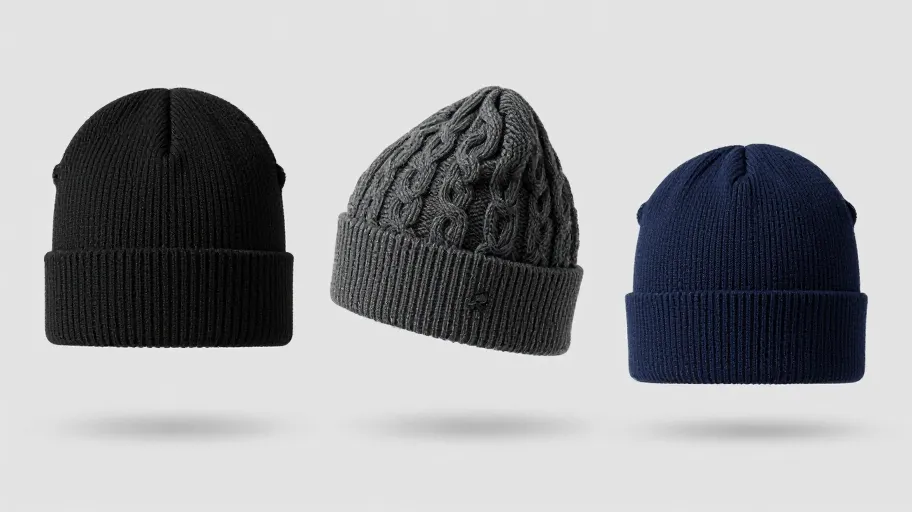
Why factory self-reports are expensive fiction
A factory claiming ‘full beanie expertise’ means nothing—until you test it against a version-controlled beanie tech pack. That claim means your first production run arrives on time and to spec, because every stitch, shrinkage tolerance, and logo embossing depth is pre-validated—not debated mid-sampling. The 72% spec deviation rate among U.S. brands stems not from dishonesty, but from untestable claims: when a cap factory (OEM infrastructure) is confused with a cap manufacturer (brand-facing entity with compliance ownership), accountability vanishes. That confusion means your QC team spends 3× longer reconciling interpretations instead of verifying outcomes—because ‘rib height’ isn’t defined, and ‘flame-retardant yarn’ isn’t batch-certified or traceable.
This isn’t theoretical. One DTC outerwear brand screened three Guangdong facilities using 17 non-negotiable checkpoints from a validated tech pack—and disqualified two within 48 hours. No interviews. No site visits. Just measurable alignment. That’s not faster vetting. That’s precision filtering: turning subjective confidence into objective pass/fail criteria before fabric is cut.
Tech packs aren’t design docs—they’re stress tests
A beanie tech pack means fewer engineering change orders and no last-minute air freight surcharges, because it forces verification *before* production—not after. It defines stitch density *and* ±0.3mm tolerance bands, so your cap factory can’t substitute a looser knit ‘to save time’. It specifies yarn lot tracking *and* dye migration thresholds, so recycled polyester batches don’t shift hue between samples and bulk. It maps seam allowances *and* ultrasonic bonding timing (if used), so thermal shrinkage doesn’t warp the crown post-packaging.
Crucially, it assigns ownership: ‘QC lab verifies shrinkage at 60°C/30min’ or ‘cap manufacturer submits third-party FR certification prior to bulk’. That means your team spends less time chasing emails—and more time scaling what works. The 2025 China Textile & Apparel Sourcing Report confirms this: orders with a tech pack average just 1.2 sampling rounds, versus ≥3 without. One round means confirmation. Two means correction. Three means crisis mode—and your product manager is already drafting the delay notice to marketing.
Trust is obsolete—testability is mandatory
‘Trust but verify’ fails because verification after engagement is too late. Thermal shrinkage in blended knits, tension variance across circular knitting machines, humidity-driven elasticity shifts during packing—these aren’t edge cases. They’re documented root causes behind the 65% defect reduction seen in post-tech-pack implementations. That drop means your first shipment arrives as a predictable outcome—not a gamble—because the variables were exposed, measured, and controlled upfront.
This shift—from ‘Can you do this?’ to ‘How do you prove you did it—before we cut fabric?’—means your supplier evaluation stops being qualitative and starts being quantitative. It’s not about vetting more factories. It’s about standardizing how you interrogate them: requiring auditable evidence, not verbal assurance. And it’s achievable without internal textile engineers. A lean, modular tech pack built around 12 core checkpoints—yarn specs, construction diagrams, compliance mapping, and verification ownership—can be deployed across 50+ cap manufacturers and cap factories in under 72 hours. That’s not process overhaul. That’s leverage.
Your next step isn’t another RFP—it’s your first live tech pack
You don’t need perfect specs to start. You need a living artifact that evolves with each supplier interaction. Build your first beanie tech pack around four pillars: (1) dimensional tolerances mapped to wear function (e.g., ‘crown height ±2mm ensures fit retention after 50 washes’), (2) material certifications tied to specific lots (not just ‘FR-compliant’), (3) construction diagrams with seam type, stitch count, and thread weight, and (4) verification ownership clearly assigned per checkpoint. Deploy it as a scoring engine: suppliers earn points only when they submit auditable proof—not claims.
That’s how you cut sampling time by 40%, reduce defects by 65%, and stop outsourcing quality control to luck. Ready to turn your next China sourcing cycle from reactive firefighting into repeatable execution? Download our free beanie tech pack starter kit—pre-built for Tier-2 Guangdong factories, compliant with ASTM F2951 and EN 14682, and editable in Google Sheets.
#cap manufacturers china, #headwear manufacturers china, #cap factory








