

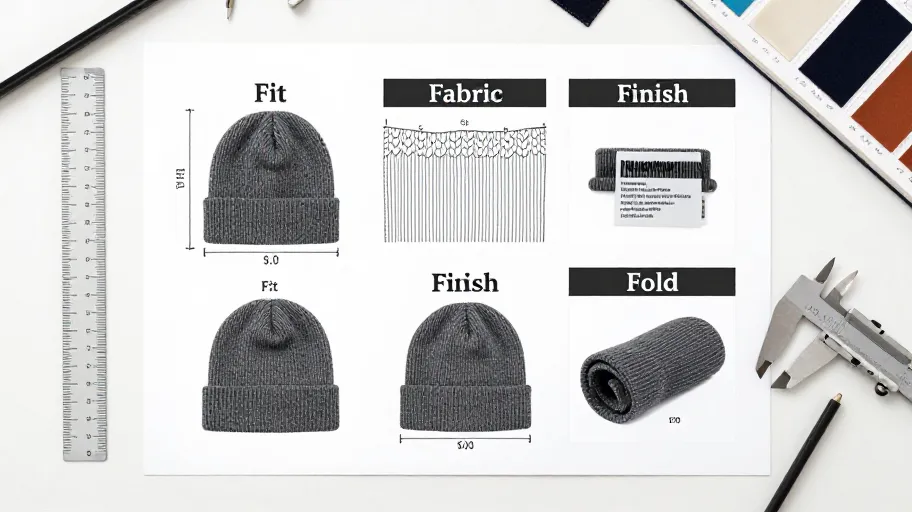
Most beanie rework traces back to a handful of specification gaps in the tech pack: unstretched versus stretched dimensions left undefined, knit structure and yarn unspecified, finishing and fold method undocumented, and measurement conditions never agreed. Audit your beanie tech pack through four lenses — Fit, Fabric, Finish, Fold — before sending it out, and convert every ambiguity into a written supplier confirmation. That discipline, more than any negotiation tactic, is what keeps a first production run from becoming a second one.
Why beanie tech packs fail differently
A beanie looks simpler than a jacket. That apparent simplicity is the trap. Cut-and-sew apparel inherits decades of standardised tech pack vocabulary — points of measure, graded specs, construction details — that both buyer and factory understand the same way. Knitted headwear does not have the same shared vocabulary, and several of its most consequential properties are invisible on a flat drawing.
Three properties make beanies different:
- Elasticity. A beanie's dimensions change when stretched. If your tech pack lists one number without stating the condition, the factory chooses one — and may not choose yours.
- Knit behaviour. Gauge, structure and yarn all change how the same "dimension" behaves after washing and wearing.
- Post-knit finishing. Washing, pressing, blocking and folding can each alter the final shape. A spec that stops at the knitting machine is only half a spec.
None of this means rework is inevitable. It means the tech pack has to carry information that a flat sketch cannot.
The Fit–Fabric–Finish–Fold (3F+1) Audit
Run your beanie tech pack through four lenses. Each lens answers one question the factory will otherwise answer on your behalf.
Fit — What are the dimensions, and under what condition are they measured?
Fabric — What yarn, gauge and knit structure produce the hand feel and stretch you approved?
Finish — What happens to the beanie after knitting: washing, pressing, labelling, decoration placement?
Fold — How is the product folded, packed and presented, and does the fold interact with the decoration or cuff?
Decision table: the gaps that cause rework
| 3F+1 area | Specification gap | What goes wrong | What to specify instead |
|---|---|---|---|
| Fit | Height and width given without measurement condition | Factory measures relaxed; you expected stretched (or the reverse); dispute at inspection | State the measurement condition, tool and point of measure for every dimension; agree the method in writing before sampling |
| Fit | Cuff construction undefined | Single-fold, double-fold and turn-up cuffs produce visibly different heights and fits | Name the cuff construction and its relationship to total height |
| Fabric | Yarn composition and count omitted | Supplier substitutes an available yarn; hand feel and stretch differ from approved sample | Specify yarn composition, count and colour method; ask which substitutions require your approval |
| Fabric | Knit structure and gauge not stated | Same dimensions, different stretch and appearance | Name the structure (e.g., rib, cable, jacquard) and gauge; attach a reference photo of the approved knit |
| Finish | Wash/press/blocking process undocumented | Final shape and size shift after finishing; sample does not predict bulk | Document the finishing process applied to the approved sample and require bulk to match the finished sample |
| Finish | Label, embroidery and patch placement given as percentage only | Placement drifts between sizes or after stretching | Give placement from a fixed physical landmark on the defined, laid-flat garment; confirm stretch state at decoration |
| Fold | Packing fold and presentation unspecified | Creasing across embroidery; retail presentation inconsistent | Specify fold method, inner/outer orientation and any packing aids; request a packing confirmation photo |
Turn every row you cannot answer into a question to your supplier — and every answer into a line in the document.
Measurement conditions and the tolerance conversation
Before production, hold one conversation that prevents most dimensional disputes: how will each number be measured, and what deviation requires correction?
Ask your supplier to propose the measurement method for each dimension — laid flat, on a board, after a defined resting period, at a stated stretch or no stretch. Then ask what deviation range they can hold for each measurement and each knit structure. Their answer becomes your acceptance criterion at inspection.
Do not import tolerance numbers from a garment style guide or from a previous supplier without re-confirming them. Ask, document, and get the agreed values written into the tech pack revision — not into an email thread.
Concrete approval questions to send your supplier
Paste these into your next supplier message. The answers belong in your tech pack:
- For each dimension in our spec: what measurement condition and tool do you recommend, and can you hold it as written?
- Which yarn substitutions, if any, would you consider acceptable without re-approval — and how will you notify us?
- What finishing processes will you apply between knitting and packing, and will the approved sample reflect all of them?
- How should we specify decoration placement so it holds across the cuff and body after stretching?
- What packing fold do you propose, and can you send a confirmation photo before bulk packing begins?
- What is your current sample policy, sampling cost, production lead time and MOQ for this specification? (Confirm current terms directly; do not rely on earlier correspondence or third-party figures.)
- Which revision of our tech pack will you treat as the production-authority document?
Question 7 matters more than it looks. When both sides can name the same governing document revision, most later disagreements narrow to a solvable engineering question.
The delivery gate: nothing enters production unnamed
A simple rule closes the loop: no line item enters production without a named value or a written supplier confirmation. Every "TBD", "same as sample" or "supplier's discretion" is a deferred decision, and deferred decisions become rework. Replace each one with a number, a method, a named material or a confirmed policy — then version the document and circulate it.
FAQ
How detailed does a beanie tech pack need to be? Detailed enough that two factories reading it independently would produce the same beanie. If any dimension, material, finish or fold could be interpreted two ways, it is not yet detailed enough.
Do I need a tech pack if I'm sending a reference sample? Yes. A physical sample communicates intent, but a tech pack communicates specification. The sample cannot state measurement conditions, approval thresholds or packing requirements — and those are exactly the items that cause disputes.
What should I confirm about sampling and production terms? Confirm current sample policy, sampling cost, lead time and MOQ directly with your supplier in writing, for this specific specification. These terms are project-specific and change; treat any figure you find online — including in articles — as a question, not an answer.
How do I handle decoration on stretch fabric? Define the stretch state at which placement is measured, anchor placement to a physical landmark rather than a percentage, and request a decoration-position confirmation photo at the sampling stage.
Who owns the tech pack — buyer or factory? You own the specification; the factory owns the capability data that completes it. The final document should merge both: your intent plus their confirmed methods, materials and acceptance criteria, at an agreed revision number.
获取 Beanie Brief — request the working template that walks your team through the 3F+1 Audit, with supplier-question prompts built into every section, before your next beanie project goes out for quotation.
Prefer to start smaller? Download the specification-gap checklist and audit your current beanie tech pack against the gaps above — five minutes now, one production run saved later.
#cap manufacturers china, #headwear manufacturers china, #cap factory