


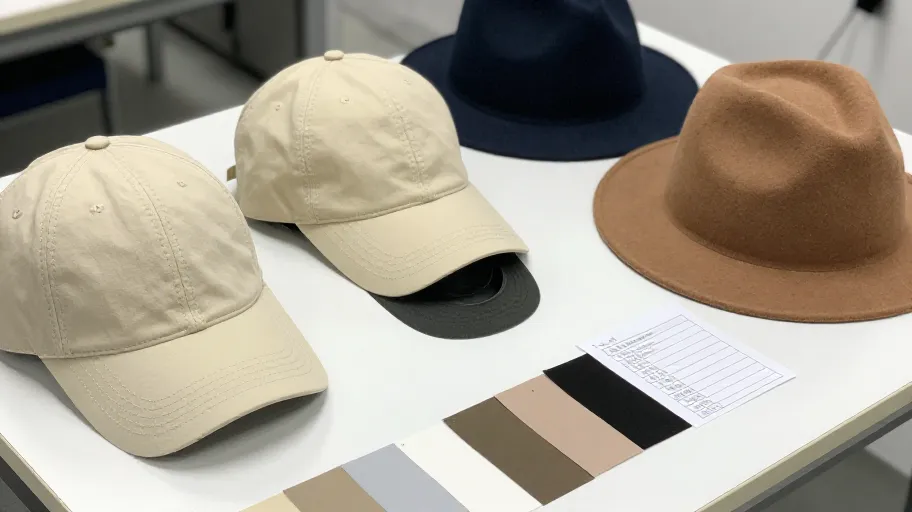
To compare the best hat manufacturers in China, stop evaluating photos and start evaluating physical samples against a documented framework. Photos cannot show stitching density under stress, lining attachment, brim recovery after packing, or whether two units match each other. Request multiple physical samples, inspect them against six named checkpoints, score each supplier identically, and approve only in writing after every checkpoint passes. The supplier that scores highest on verified evidence — not the one with the best catalogue — is the one worth shortlisting.
Why photographs are not evidence
A product photograph is a marketing asset. It is lit, retouched and staged to present the strongest possible view of a single unit. As a procurement lead, your job is not to judge the best image but to predict how a factory will perform across thousands of units, in your materials, under your tolerances.
Photographs fail at exactly the things that decide whether a bulk order succeeds: seam behaviour under tension, how a sweatband is attached inside the crown, whether an embroidery backing causes puckering, whether a structured cap keeps its shape after compression. None of this is visible in a flat image. Even video calls held inside a factory show you a stage, not a process.
That is not an accusation against any supplier — including us at New Generation, a Shenzhen-based OEM/ODM manufacturer of custom caps and headwear. It is a simple statement about the limits of remote evidence. Any manufacturer, ourselves included, should expect to be verified through physical samples and documentation rather than imagery. The method below is how we recommend every buyer evaluate us, and every competitor of ours.
The S.T.I.T.C.H. Sample Verification Framework
Use the same six checkpoints for every candidate factory, in the same order, with the same scoring. Consistency of method is what turns opinions into comparable data.
S — Stitching. Examine every seam on the sample with the cap in hand: crown panels, visor binding, button attachment, sweatband joins. Look for skipped stitches, uneven tension, raw edges inside the crown. Then apply light tension along each seam and observe behaviour. Photograph what you see at macro range so your records match what you touched.
T — Trims and decoration. Inspect embroidery density, backing, thread trimming and registration against your artwork. For printed elements, check edge sharpness and whether decoration sits flat. Ask the supplier to state which decoration method was used on the sample, and confirm whether that method will be used for bulk. Confirm the current policy directly on any change requests.
I — Inside view. Turn the cap fully inside out. The interior tells you how the factory finishes what the buyer never photographs: lining attachment, thread ends, taping, brim edge treatment. A clean interior is a signal about process discipline; a rough one is a question you must put to the supplier in writing before approving anything.
T — Tolerance behaviour. You need to know how the cap behaves, not just how it measures. Compress the crown, flex the brim, reshape, and observe recovery. Do not assume any numeric tolerance: ask each supplier to state, in writing, the dimensional tolerances they will commit to for your specific product, and make that written commitment part of your approval record.
C — Consistency across units. Request more than one sample of the same specification. Compare them against each other: colour match, crown shape, visor curve, stitching line placement. Two units that differ from each other tell you more about process control than any sales document. Ask the supplier to explain any variation you find.
H — Hand-feel and materials. Handle the fabric, sweatband and closures. Confirm in writing that the materials in the sample are the materials quoted for production, and ask how material substitution requests are handled if a specified fabric becomes unavailable. Confirm the current policy directly for every material commitment before signing off.
Decision table: scoring candidate suppliers
Score each checkpoint from 1 (failed) to 5 (verified and documented). Do not score from memory — score during the inspection, with samples in hand.
| Checkpoint | What you verify | Evidence to record | Score (1–5) |
|---|---|---|---|
| Stitching | Seam quality under tension, finish of raw edges | Macro photos of each seam type | __ |
| Trims and decoration | Decoration method, registration, flatness | Supplier's written method confirmation | __ |
| Inside view | Lining, taping, thread ends, brim treatment | Interior photos per unit | __ |
| Tolerance behaviour | Shape recovery after compression and flex | Written tolerance commitment | __ |
| Consistency | Unit-to-unit match across multiple samples | Side-by-side comparison photos | __ |
| Communication | Clarity and speed of written answers | Email trail in supplier file | __ |
The communication row matters as much as the technical rows. How a supplier answers precise written questions before an order is your clearest preview of how they will answer when a production question arises mid-run.
Approval questions to send before sign-off
Send these in writing and require written answers. Attach the answers to your purchase file.
- Please confirm the exact materials used in the approved sample, by specification, and that these will be used for bulk production.
- Please state the dimensional tolerances you commit to for this product.
- If a specified material becomes unavailable during production, what is your substitution process, and does it require our written approval?
- Please confirm the inspection stages you perform internally, and what documentation we will receive at each stage.
- If a bulk unit differs from the approved sample, what is your correction process?
- Please confirm your current sample policy, including any fees and shipping arrangements. Confirm the current policy directly in writing.
- Please confirm your current MOQ, lead time and payment terms for this specific project. Confirm the current policy directly.
None of these questions assumes any answer. They exist to convert supplier promises into documented commitments you can hold both sides to.
Documentation habits that protect your decision
Keep one file per supplier: the scorecard, macro photos, all written answers, and your final approval note. When you compare candidates weeks later, you will be comparing records, not recollections. When you onboard the chosen supplier, the approved sample and its written commitments become the reference standard for production. This is also the file you bring to internal stakeholders when justifying the sourcing decision.
FAQ
How many samples should I request from each hat manufacturer? Request at least two units of the same specification so you can compare unit-to-unit consistency, plus one decorated with your own artwork. Confirm the current policy directly on sample quantities, fees and shipping.
Can I judge a China cap factory from a video call? A live walkthrough is worth requesting, but it is staged evidence. Use it to observe process, not to approve product. Approval decisions should rest on physical samples in your hands.
What if two suppliers score almost the same? Weight the rows by what matters most for your product — decoration precision for embroidered caps, shape stability for structured styles. Then re-send your unanswered questions; how each supplier closes open items can be the deciding factor.
Should I visit the factory in Shenzhen before ordering? A visit adds real evidence, and many buyers combine it with a trade trip. But a documented sample evaluation, with written commitments, is the minimum standard for approval whether or not you visit.
How do I handle samples that arrive inconsistent with each other? Put the variation in writing and ask the supplier to explain it before you score. The explanation — or the absence of one — belongs in your supplier file.
Download the Supplier Scorecard and run every candidate through the same six documented checkpoints before your next approval decision.
Low-friction option: Not ready to score suppliers yet? Take the seven approval questions above into your next supplier email — they work on their own as a pre-qualification checklist.
New Generation is a Shenzhen-based OEM/ODM manufacturer of custom caps and headwear serving overseas brands, importers, wholesalers and corporate buyers. We expect to be verified the same way we advise you to verify anyone.
#cap manufacturers china, #headwear manufacturers china, #cap factory








