


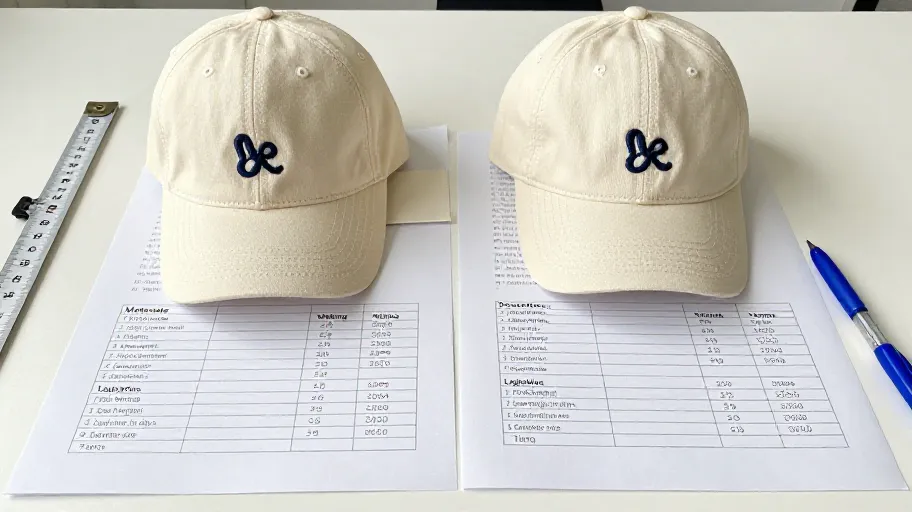
The best hat manufacturers in China for your project are the ones whose quotes you can read line by line, not the ones with the most impressive brochure. Use the Five-Column Quote Breakdown — Materials, Making, Decoration, Logistics, Terms — to compare two supplier quotes on identical scope, then verify every gap in writing before you commit.
Why comparing the bottom line fails
Procurement teams receive quotes in different formats. One supplier prices per piece delivered to port; another prices ex-factory and lists freight separately; a third assumes a decoration method you never asked for. When you compare totals across inconsistent scopes, the cheapest number can be the most expensive decision.
The failure mode is scope drift: you approve a total, then discover mid-project that an item — lining, a specific closure, inner packaging, tooling — was never in the quote. Whoever pays for that gap becomes a negotiation, not a plan. The fix is unglamorous and effective: force every quote into the same five columns, and compare column against column.
The Five-Column Quote Breakdown
| Column | What must be stated in the quote | Comparison question to ask each supplier |
|---|---|---|
| Materials | Fabric composition and weight, crown structure, brim type, closure, sweatband, eyelets, trims | Are we quoting the identical bill of materials, or are substitutes assumed? Which items, if any, are specified as "or equivalent"? |
| Making | Construction method, stitching specification, finishing steps | What is included in the making charge, and what would count as a change request later? |
| Decoration | Embroidery, print, patch, weave, appliqué — method, placement, size, stitch or colour count | Does the unit price assume this exact decoration spec, or a standard version of it? What changes the price? |
| Logistics | Incoterm, packing specification, carton configuration | Which Incoterm is quoted? Who books freight? What packing spec is assumed? |
| Terms | Tooling and setup charges, sample arrangement, payment schedule, validity period, revision policy | What is chargeable upfront, what is chargeable on change, and how long does the quoted price remain valid? |
Two rules make the table work. First, before comparing anything, send both suppliers the identical specification sheet — same bill of materials, same decoration spec, same Incoterm, same packing description. A quote you cannot align to a shared scope is not comparable, no matter how detailed it looks. Second, any column a supplier leaves blank is a question, not an omission to ignore. Ask for it in writing and add the written answer to the quote before you score anything.
Approval questions to send before you commit
Turn every ambiguity into a written question. A thoughtful sourcing adviser sends the same question set to both suppliers so the answers are comparable:
- "Please confirm the full bill of materials referenced in your quote, including any item you selected on our behalf."
- "Which decoration method and specification does this unit price assume? What would change if we adjust placement, size or technique?"
- "Which Incoterm and port is this quote based on, and does it include export documentation?"
- "What setup, tooling or sample-related charges apply to this project, and under what conditions do charges change?" — then verify the current policy directly with each supplier rather than assuming any arrangement.
- "What is the quotation's validity period, and what triggers a re-quote?"
- "What is your change-request process if we amend the spec after approving the quote, and how is that priced?"
- "Please provide the packing specification assumed in this quote: carton quantity, inner packaging and labelling."
Keep the answers attached to the quote file. When a supplier later disputes scope, your written record — not memory — settles it.
Running the comparison: a working checklist
Use this sequence for every two-supplier comparison. It is deliberately boring; that is the point.
- Build one specification sheet and send it unchanged to both suppliers.
- Request quotes restated in the five columns: Materials, Making, Decoration, Logistics, Terms.
- Flag every blank or vague cell and request written clarification.
- Normalise Incoterms so both quotes describe the same delivery point and responsibility split.
- Confirm sample arrangement and any related charges with each supplier directly; do not assume either supplier's policy.
- Score each column on completeness and fit, not just on the number — a quote that answers your questions costs less to manage even if its total is higher.
- Record every written answer as an appendix to the quote.
- Present both finalised quotes to your internal decision-maker in the same five-column format.
- Confirm lead-time expectation, capacity for your order size and any certification requirement directly in writing with each supplier before approval.
- Only after both quotes are fully specified, compare totals and decide.
Notice that the price comparison is the last step, not the first. By the time you compare totals, you are comparing the same product with the same terms — which is the only comparison worth making.
FAQ
Is the cheapest quote ever the right choice? It can be — but only after both quotes are restated to identical scope in the five columns. If the gap persists after normalisation, ask the lower-priced supplier what is excluded that the other includes. A defensible answer makes the choice sound; silence means the gap is somewhere you have not looked yet.
How do I compare quotes that use different Incoterms? Ask each supplier to restate the quote on the same Incoterm, or normalise it yourself by adding the missing cost components separately. Never compare an ex-factory number against a delivered number directly. Confirm the delivery point, documentation responsibility and freight arrangement in writing.
Should I tell suppliers they are competing? You do not need to stage a contest. Simply request that both quotes follow your specification sheet and column format. Suppliers respond to clear, structured requests with clearer, more comparable quotes — and you avoid inviting corner-cutting to win on total.
What if a supplier refuses to break down the quote? Treat refusal as information. A supplier who will not state what the price includes is asking you to absorb the risk of every ambiguity. You can still proceed, but document the accepted ambiguities in writing so scope disputes have a reference point.
Do quotes include samples and tooling? Policies differ between suppliers and change over time. Confirm the current arrangement for samples, setup or tooling charges, and any conditions attached to them, directly with each supplier and get the answer in writing before you rely on it.
Download the Supplier Scorecard
Put the Five-Column Quote Breakdown to work with our Supplier Scorecard — a fill-in comparison sheet built for procurement leads evaluating custom headwear suppliers. It turns this article into a one-page working document you can send to your team today.
[Download the Supplier Scorecard]
Before your next supplier call, run the ten-step checklist above. Copy it into your sourcing file, send the seven approval questions to both suppliers, and arrive at the comparison with scope instead of guesses. If you would like a custom-headwear quote restated in this five-column format, contact our team to request one.
#cap manufacturers china, #headwear manufacturers china, #cap factory








