


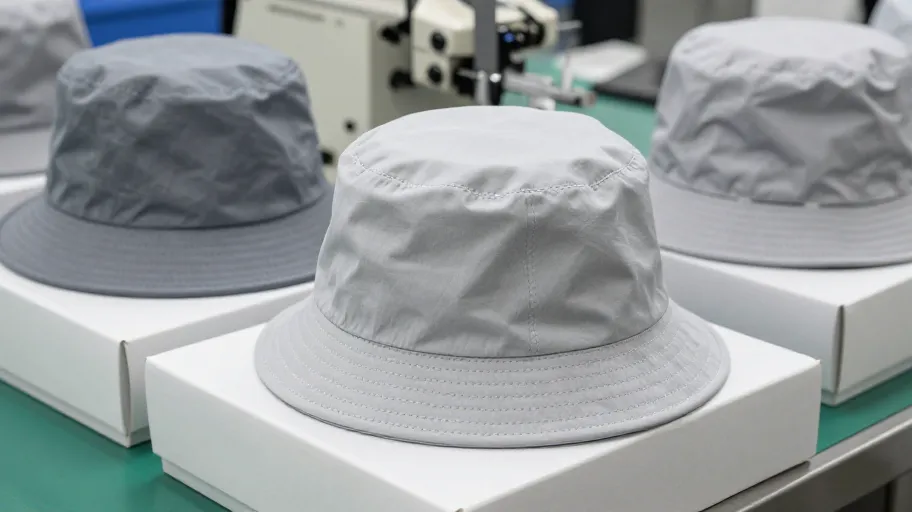
Choosing a bucket hat factory is less about comparing quotations and more about comparing specifications. This guide walks buyers through the TFP Check — Tolerances, Finish, Packaging — so that every enquiry you send defines measurable standards, every quote you receive is genuinely comparable, and bulk production is judged against documented, pre-approved criteria.
Why tolerances, finish and packaging decide the outcome
Bucket hats look deceptively simple: a crown, a brim, some stitching. That simplicity is precisely why vague specifications cause problems. Two factories can produce hats from the same photo and deliver goods that differ in crown height, brim curl, stitch density, eyelet finish and packing method — and each will consider itself compliant, because nobody defined compliance.
For a category buyer managing a seasonal range, or a promotional buyer ordering for a campaign with a fixed launch date, the cost of that ambiguity shows up in three places: inspection disputes, delayed shipments while goods are reworked, and inconsistent goods across repeat orders. The remedy is cheap. Before you request pricing, define what you will measure, what "good" looks like, and how the goods should be packed — then ask each candidate bucket hat factory to confirm those points in writing.
The TFP Check: Tolerances, Finish, Packaging
T — Tolerances. A tolerance is the acceptable variation you will allow on a measurable attribute: crown height, brim width, head circumference, embroidery or print placement. Do not accept "we will follow the sample" as a specification. Ask what measuring method the factory uses, at which points on the hat, and what variation range they are prepared to commit to for your specific construction and materials. The numbers themselves are project-specific — they depend on fabric, construction and your own brand standards — so agree them per order and record them in the approval document.
F — Finish. Finish covers everything a customer touches and sees: seam tape neatness, eyelet quality, underbrim and topstitching, the edge of any printed artwork, label attachment, and how the brim holds its shape. Because finish judgements are subjective unless written down, your leverage comes from a documented standard. Request a pre-production sample, approve it explicitly against a written finish list, and keep a sealed counter-sample as the reference for bulk inspection.
P — Packaging. Packaging is where buyers lose the most value per dollar spent on prevention. Decide before quoting: individual polybag or not, folding method, tissue or cardboard inserts, hangtags and their placement, carton quantity, carton dimensions, and any retail-readiness requirements such as barcodes or shelf-ready cartons. Then confirm how the goods will be packed for freight, because folding and carton loading affect brim shape on arrival.
Decision table: what to lock down at each stage
| Sourcing stage | What to specify | What to ask the factory to confirm |
|---|---|---|
| Enquiry / RFQ | Construction, materials, artwork, colourways, target market | Which points of the TFP Check they can commit to in writing; current sample and order terms — confirm directly, as these vary by project |
| Sampling | Pre-production sample as the quality reference | How the sample relates to bulk — approval criteria, and the current sample policy for your project (confirm directly) |
| Pre-production | Written tolerance sheet and finish checklist | Measuring method and points; agreed variation ranges per attribute |
| Bulk production | In-line and final inspection against the sealed counter-sample | Inspection process, and who checks what at which stage |
| Packing & shipment | Packaging spec and carton plan | Packing method, carton quantity, label placement, freight-readiness |
Approval questions to put in writing
Before you approve anything, send these questions and require written answers. Their value is not only the answers themselves but whether the supplier answers clearly at all.
- Which measurable attributes — crown height, brim width, circumference, placement — will you control, what measuring method do you use, and what variation ranges can you commit to for this construction?
- Will you provide a pre-production sample, and will bulk be inspected against a sealed counter-sample that both parties hold?
- What is your finish checklist for this style — seam tape, eyelets, topstitching, underbrim, print or embroidery edges — and may we amend it before approval?
- How will artwork edges and colour matching be verified, and what reference (physical or digital) will both sides use?
- What packaging do you propose — folding method, individual packing, inserts, hangtags, carton quantity — and how does that packing protect brim shape in transit?
- What are your current sample, payment and order terms for a project of this profile? (These are project-specific — confirm directly; do not assume them.)
- If bulk goods deviate from the approved counter-sample, what is the agreed process for inspection findings and resolution?
Question 7 matters more than any other. A documented deviation process converts a dispute into a procedure.
Pre-approval checklist
- Tolerance sheet drafted: every measurable attribute, measuring point and agreed variation range recorded
- Pre-production sample received and approved against the finish checklist
- Sealed counter-sample retained by both parties, dated and signed
- Packaging spec written: folding, individual packing, inserts, tags, carton quantity and freight packing
- Sample, payment and order terms confirmed directly with the supplier for this project
- Deviation process agreed: who inspects, against what reference, and how findings are resolved
- All of the above attached to the purchase documents, not left in email threads
If any box is unticked, you are not approving production — you are approving a hope.
FAQ
How tight should tolerances be on a custom bucket hat? There is no single correct answer. Tolerances depend on fabric, construction, sewing machinery and your own brand standards. Rather than copying a number from elsewhere, ask each candidate bucket hat factory what variation range it can commit to for your specific construction, then compare answers. A factory that cannot state its measuring method is telling you something useful.
Who pays for samples and sample shipping?
What should a packaging specification contain? At minimum: individual packing method, folding style, inserts if any, hangtag type and placement, units per carton, carton dimensions, and how goods are packed for the chosen freight mode. Ask the factory to show how the proposed folding protects the brim, because brim shape on arrival is one of the most frequent sources of retail complaints.
How do I keep quality consistent across repeat orders? Keep the tolerance sheet, finish checklist and sealed counter-sample on file and reference them by date in every repeat purchase order. Ask the factory to confirm in writing that each new order will be inspected against the same references. Consistency comes from documentation, not from goodwill.
Is a pre-production sample really necessary for a simple style like a bucket hat?
Get the Bucket Hat Enquiry Brief. New Generation has prepared a structured enquiry brief covering the tolerance sheet, finish checklist and packaging spec discussed above, so your next RFQ to any bucket hat factory is specific, comparable and documented. Request it, adapt it to your project, and send it with your enquiry.
Or start smaller: copy the pre-approval checklist above into your next RFQ email and ask the supplier to answer each point in writing. The quality of the replies will tell you a great deal before you spend anything.
All sample, pricing, shipping, lead time and policy terms referenced in this article are project-specific and must be confirmed directly with the supplier.
#cap manufacturers china, #headwear manufacturers china, #cap factory








